
Data last updated: September 28, 2026
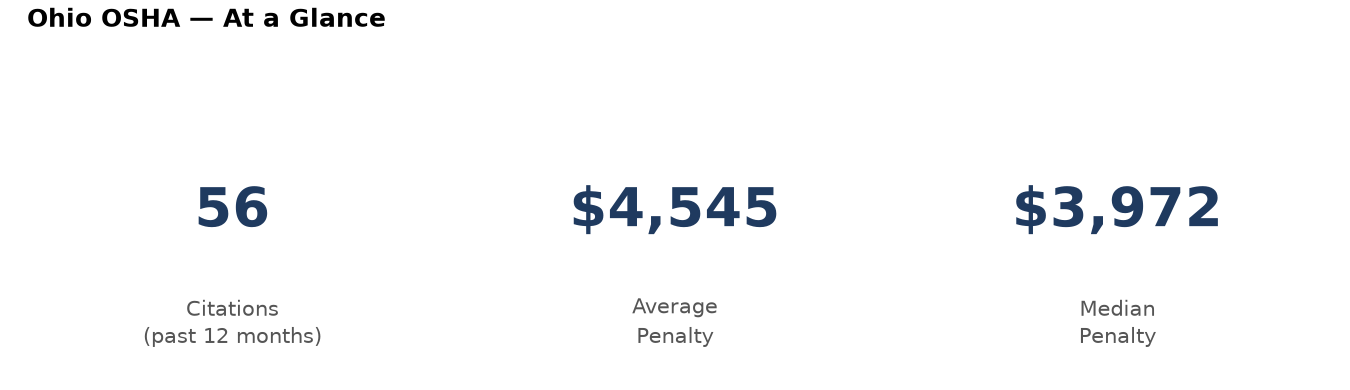
Ohio OSHA offices issued 56 citations under the ladder standard over the past 12 months, with an average penalty of $4,545 and a median of $3,972. Hamilton logged more of these citations than any other city in the state, and roofing contractors alone account for 45 of the 56 cases. If you run a construction crew in Ohio and a compliance officer just handed you paperwork, the numbers below explain why the fine looks the way it does and what your options are.
If you have received a citation, the clock is already running. Ohio employers get only 15 working days to file a Notice of Contest before the penalty becomes final. Talk to an Ohio OSHA defense attorney before that window closes.
What the ladder standard actually demands on a job site
Every one of these citations traces back to the 1926.1053 standard, OSHA’s general rulebook for ladders on construction sites. Stripped of legal jargon, it requires that ladders be set up and rated for the load they’re carrying, that they extend far enough past a roof edge or landing point so workers have something stable to grab onto when stepping off, and that damaged or jury-rigged equipment gets pulled from service instead of pushed back into use. It also covers how workers are expected to climb and descend — facing the ladder, keeping three points of contact, not carrying tools in a way that throws off balance. Inspectors don’t need to see an injury to write a citation. A ladder that’s a few inches short of the roofline, or one with a cracked rail still sitting on a truck, is enough on its own.
Why roofing crews make up the vast majority of Ohio’s cases
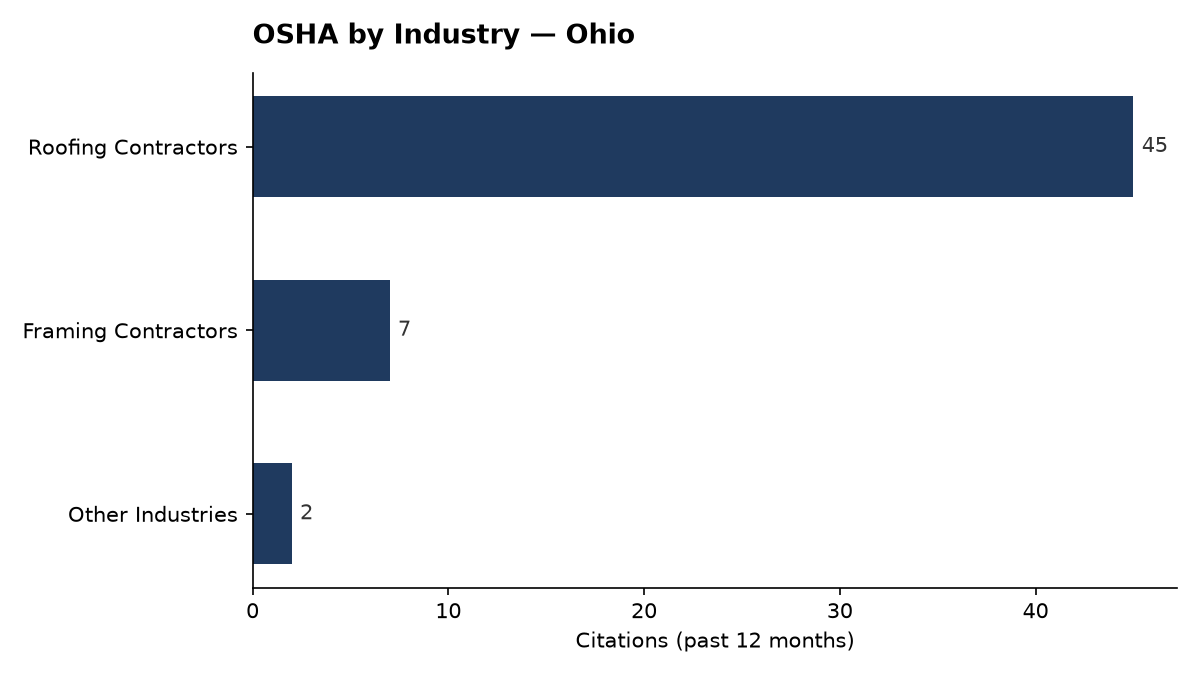
Of the 56 citations, 45 went to roofing contractors, with framing contractors picking up 7 and other trades accounting for just 2. That split isn’t random. Roofing work depends on ladder access to steep, elevated surfaces dozens of times a day, and the standard’s requirement that a ladder extend past the eave or landing is exactly the kind of detail that gets skipped when a crew is racing to finish a job before weather turns. Framing crews show up less often but still get cited for similar setup and inspection failures. When an industry relies on ladders as its primary access point rather than an occasional tool, it’s going to draw more attention from inspectors — and Ohio’s numbers make that pattern obvious.
What a citation actually costs once penalties are calculated
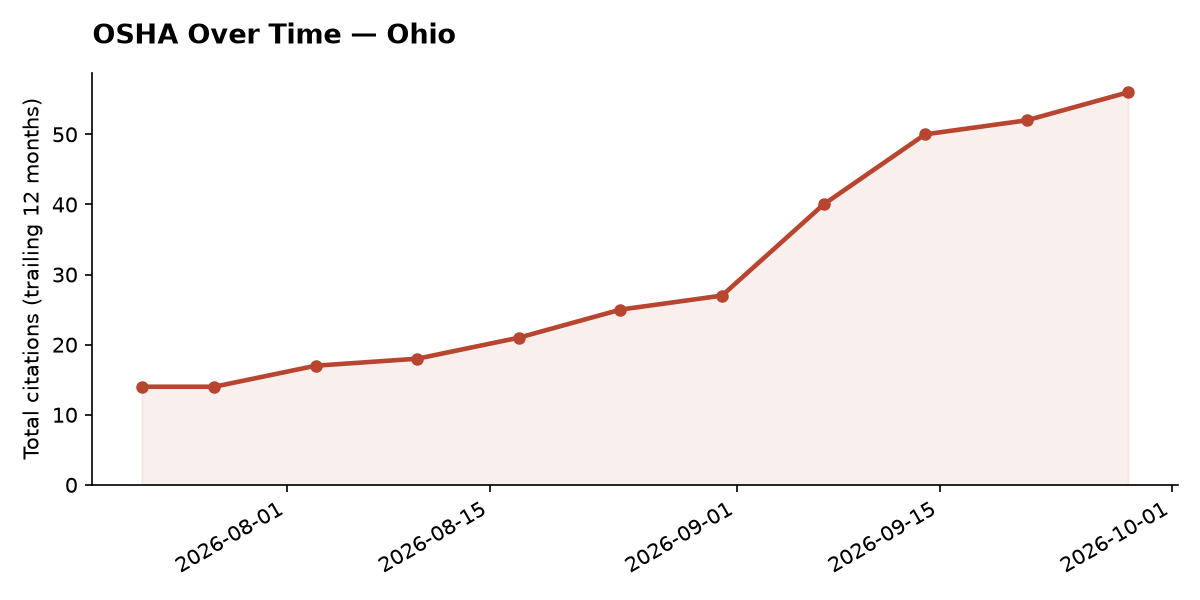
Most of Ohio’s ladder citations — 49 of the 56 — were classified as Serious, meaning OSHA determined the hazard could realistically cause death or serious physical harm. The remaining 7 were Repeat citations, which carry much steeper fines because the employer had a prior citation for the same or a substantially similar violation. That distinction matters a lot for your wallet. Repeat citations in Ohio have run well into the tens of thousands of dollars in recent cases, while first-time Serious citations tend to land closer to the state average.
Consider the spread among recent named citations. Beck Roofing, Inc. in Hamilton was cited under section 19261053 B01 for $29,790 as a Repeat violation, issued December 3, 2025. Alpine Valley Construction LLC in Belpre received an identical $29,790 Repeat citation under the same subsection, issued December 23, 2025. Intermediaries in Construction Services, LLC in Marysville and Grand Design Roofing, LLC in Massillon each faced $11,916 Repeat citations, issued April 20, 2026 and May 26, 2026 respectively. L & R Roofing LLC in Canton was cited $8,513, also a Repeat violation, issued August 5, 2026. Every one of these falls under the same B01 subsection of 1926.1053, which underscores how a single, narrow compliance gap keeps generating five- and six-figure exposure across the state.
Here’s the part worth paying attention to: the average penalty reduction between initial and final penalty in Ohio has been 25%. That’s not automatic — it happens because employers negotiate, provide context, or formally contest the citation rather than simply paying what’s on the first notice. For a full breakdown of how these numbers are built, see this explanation of OSHA ladder violation penalty amounts.
A quarter of the penalty amount, on average, gets negotiated away in Ohio — but that only happens when someone challenges the citation properly. Before you write a check, get an Ohio OSHA defense attorney to look at your paperwork first.
Your move once the citation letter arrives
The moment you sign for a citation, a 15-working-day clock starts. If you don’t file a Notice of Contest inside that window, the citation and the proposed penalty become a final order — no appeal, no negotiation, no second look. That’s true whether the citation is your first Serious violation or a Repeat citation carrying a $29,790 price tag like the ones issued in Hamilton and Belpre this past year.
Filing a contest doesn’t mean dragging things into a courtroom fight. It opens the door to informal conferences with the area office, where classification, abatement dates, and penalty amounts can all be revisited. Given that Ohio’s average reduction sits at 25%, that conversation is often worth having even if you don’t dispute that a ladder was set up wrong. The process, deadlines, and what to expect at each stage are laid out in detail in this guide to contesting an OSHA citation.
Fifteen working days disappears fast once you factor in scheduling a consultation. If you’ve received a ladder citation in Ohio — Serious or Repeat — reach out to an Ohio OSHA defense attorney now, while you still have options on the table.
Pull your citation paperwork, check the issuance date, and count backward from the deadline before you do anything else. Whether you run a roofing crew in Hamilton or a framing outfit anywhere else in the state, the fastest path to a lower final bill starts with getting someone who knows Ohio’s enforcement patterns to review the citation before you respond.