
Data last updated: September 21, 2026
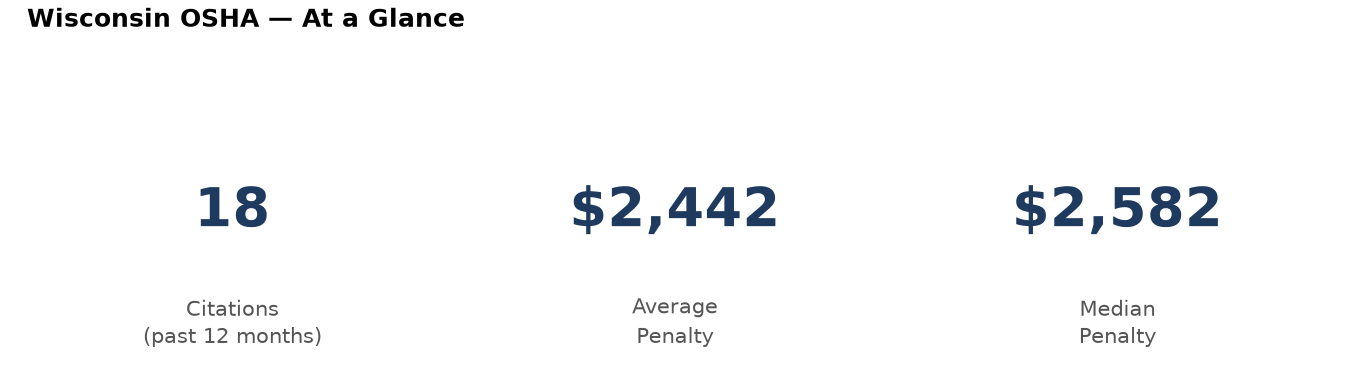
Wisconsin OSHA offices issued 18 scaffolding citations over the past 12 months, and every single one was classified Serious. There were no Willful or Repeat findings in this batch, but that does not mean the exposure is small. Average penalty across these cases was $2,442, with a median of $2,582, and the individual examples on record run as high as $5,958. Egg Harbor logged more citations than any other Wisconsin city in this period.
If you or your company just received one of these citations, the numbers below explain what you are facing and why moving fast matters. A good first step is talking with a Wisconsin OSHA defense attorney before you respond to anything in writing.
Every Citation Here Traces Back to One Rule: 1926.451
All 18 cases were issued under the 1926.451 standard, OSHA’s general rulebook for scaffolding on construction sites. This is not one narrow requirement — it is a broad standard covering how scaffolds get built, how much weight they can hold, how workers get on and off them safely, and what fall protection and guardrail or planking setups have to be in place before anyone steps onto the platform.
In practice, most citations under this standard come down to a handful of recurring gaps: missing or incomplete guardrails, planking that does not fully cover the work platform, scaffolds erected without a competent person checking the setup, or access points that force workers to climb cross-braces instead of using a proper ladder. Because the standard touches so many parts of scaffold use, inspectors have a lot of ground to check on a single site visit, and it is common for one walkthrough to generate more than one citation item.
Specialty Trade and Framing Crews Draw the Most Attention
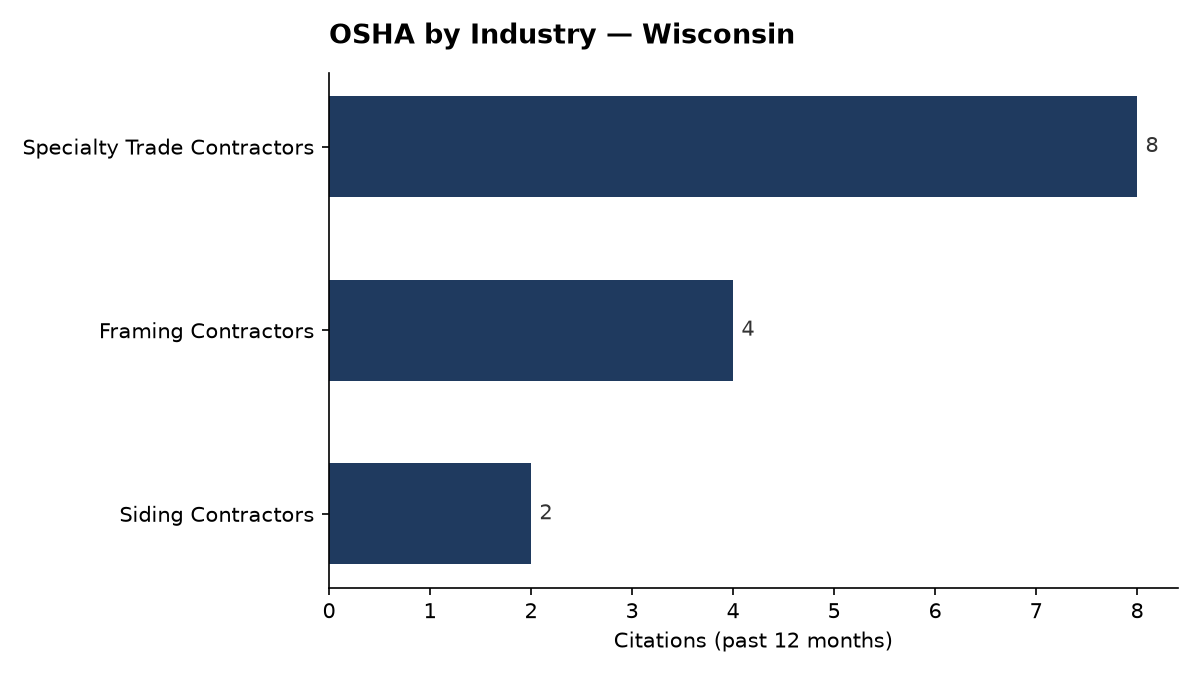
Specialty trade contractors accounted for 8 of the 18 citations in Wisconsin, making them by far the most cited group. Framing contractors followed with 4, and siding contractors picked up 2 more. Together these three categories cover the large majority of the state’s scaffolding enforcement activity.
The pattern makes sense once you think about how these crews actually work. Specialty trade contractors are frequently the ones erecting, modifying, or dismantling scaffolds on a job site — often on tight schedules, sometimes for short-duration tasks where a full inspection gets skipped. Framing and siding crews spend long stretches working at height on exterior walls, which puts them squarely in view of any compliance officer walking the perimeter of a site. When a scaffold platform is missing a guardrail or a plank, it is visible from the ground, and that makes it one of the easier violations for an inspector to spot and document.
What an All-Serious Record Still Costs You
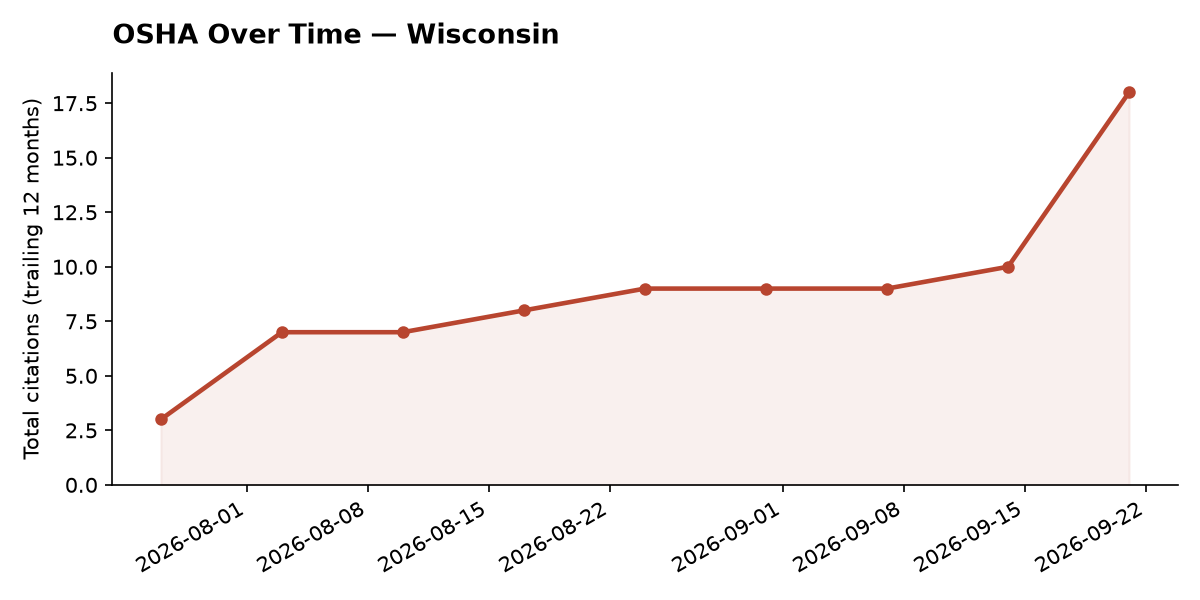
A Serious classification means OSHA determined the hazard could realistically cause death or significant physical harm, even if no one on that particular site was injured. That is why the penalties here are not trivial despite the absence of Willful or Repeat findings. The average of $2,442 and median of $2,582 reflect fairly consistent enforcement, and the named examples show the real range companies are dealing with:
- Booss Builders LLC, Fitchburg — $5,958, cited under 19260451 C02 V, issued October 15, 2025
- R&R Exterior And Interior, Inc., Greendale — $4,965, cited under 19260451 G01, issued January 23, 2026
- Mcsherry Custom Builders LLC, Madison — $4,965, cited under 19260451 G01, issued March 26, 2026
- Ricardo Naranjo, Oconomowoc — $3,547, cited under 19260451 G01, issued April 09, 2026
- Cci, Inc., Marathon — $3,547, cited under 19260451 C02, issued June 26, 2026
Notice that penalties for the same violation code cluster in similar ranges, which tells you OSHA is applying its penalty tables fairly consistently in Wisconsin. It also means there is room to negotiate. On average, initial penalties in these cases were reduced by 13% by the time they were finalized — usually the result of an employer or their attorney pushing back through the informal conference process or a formal contest. For a full breakdown of how these numbers get calculated, see this explanation of OSHA scaffolding violation penalty amounts.
A 13% reduction on a $4,965 citation is real money, but it rarely happens on its own. Employers who respond with a documented abatement plan and a clear legal argument tend to see better outcomes than those who simply pay the initial number. This is exactly the kind of leverage a Wisconsin OSHA defense attorney can help you use.
The 15-Day Window You Cannot Afford to Miss
Once a citation is issued, the clock starts immediately. You have 15 working days from the date you receive it to file a Notice of Contest. Miss that deadline and the citation, along with the full proposed penalty, becomes a final order — no appeal, no negotiation, no second chance to argue the classification or the abatement date.
Fifteen working days sounds like enough time until you factor in gathering job-site records, photos, training documentation, and witness statements while still running your crew and your business. Waiting even a week to start pulling that together can leave you scrambling right before the deadline. This guide on how to contest an OSHA citation walks through the mechanics of filing, but the practical reality is that most employers benefit from having someone experienced review the citation language, the cited subsection, and the penalty calculation before that window closes.
Given that all 18 Wisconsin cases this period were Serious rather than Other-than-Serious, and given that the average penalty of $2,442 can climb well past $5,000 depending on the specific violation code, this is not a situation to sit on. If you have a citation in hand, or you suspect one is coming after a recent inspection, talk to a Wisconsin OSHA defense attorney now, while you still have the full 15 working days to act.
Pull your citation paperwork, note the exact date you received it, and get a professional opinion before you decide whether to pay, negotiate, or contest — the deadline does not pause for you to figure this out alone.