
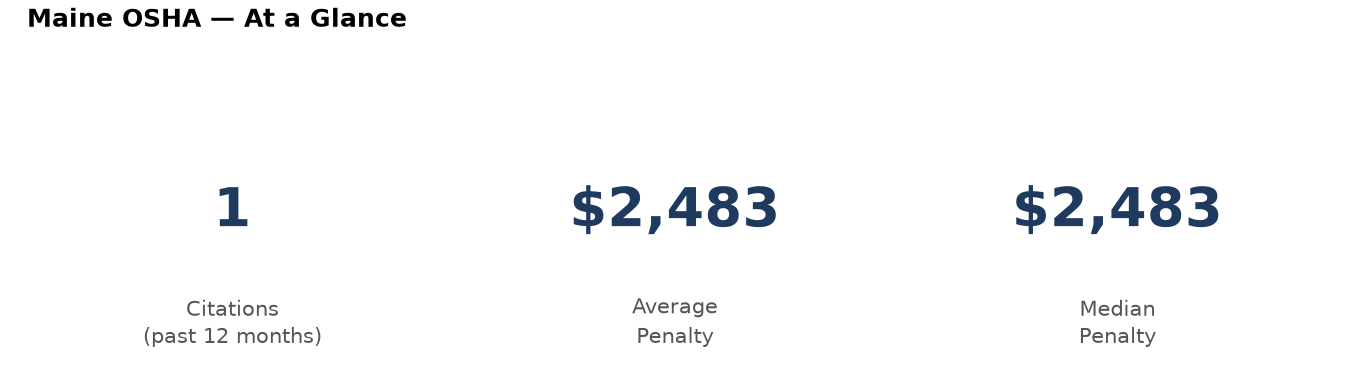
Over the past 12 months, Maine recorded exactly one ladder violation citation under federal OSHA rules, issued to a roofing contractor in Augusta for $2,483. That single number doesn’t sound like an epidemic, and it isn’t one. But if you’re the business that just got the letter, the size of the statewide dataset doesn’t matter at all — what matters is the clock that started running the day you signed for it.
If you’ve received a citation, or think one is coming, talking to a Maine OSHA defense attorney before you respond is the single most useful thing you can do right now.
The Rule Behind the Citation: 1926.1053
Ladder citations in Maine and everywhere else trace back to 29 CFR 1926.1053, the construction standard that governs how ladders get set up and used on a job site. It’s not a niche technicality — it covers the basics that inspectors check first: whether a ladder extends far enough past the landing surface for a worker to step off safely, whether it’s rated to carry the load actually put on it, whether it shows damage that should have taken it out of service, and whether workers are using it the way it was designed to be used rather than improvising with it. You can read the full breakdown of what inspectors look for on the 1926.1053 standard hub, but the short version is this: most violations under this rule come down to equipment that wasn’t checked before the job started, or setup that got rushed.
The one citation on record in Maine this period was classified as Serious, meaning OSHA determined there was a real possibility of injury or death connected to the condition cited, not just a paperwork gap. That classification matters because it’s the baseline penalty tier — Willful and Repeat violations, which apply when an employer knew about a hazard and ignored it or had been cited for the same thing before, carry penalties that can run several times higher.
Why Augusta’s Roofing Sector Is the Face of This Data
The only citation in this reporting period went to a roofing contractor working in Augusta, and that’s not a coincidence of small sample size — it reflects where ladder exposure concentrates in the trades generally. Roofing contractors spend more of their working day on a ladder than almost any other trade, moving materials up and down, repositioning constantly, and working at heights where a fall has serious consequences. Even a well-run crew accumulates wear on ladders faster than office-based trades, and a single overlooked crack or an extension ladder set up a few inches short of the roofline is enough to draw a citation if an inspector is on site or responding to a complaint.
With Augusta showing up as the city with the most activity in this dataset, it’s worth noting that OSHA enforcement in Maine tends to follow construction activity generally — and roofing work, given its height exposure, draws attention that lower-risk trades don’t.
What This Actually Costs an Employer
The average and median penalty for a ladder violation in Maine over this period both landed at $2,483 — there’s only one data point, so average and median are the same number, but it’s a useful benchmark for what a Serious-level ladder citation runs in this state right now. The real citation on file, against Ns Building Solutions in Augusta, was issued September 25, 2025, under subsection 19261053 B01, at that same $2,483 figure.
Here’s the number that deserves more attention than the raw penalty: citations in this category have seen an average reduction of 30% between the initial proposed penalty and the final settled amount. That gap doesn’t happen by accident. It happens because employers who push back — who contest, negotiate, or present evidence OSHA didn’t have at the time of inspection — routinely get better outcomes than employers who simply pay what’s on the initial notice. For a fuller breakdown of how these numbers get calculated and negotiated, see this explanation of OSHA ladder violation penalty amounts.
A 30% swing on a $2,483 citation is real money for a small contractor, and it’s evidence that these penalties are not fixed prices — they’re starting positions. That’s exactly the kind of leverage a lawyer knows how to use, and it’s worth a conversation with a Maine OSHA defense attorney before you decide how to respond.
The 15-Day Window You Cannot Afford to Miss
Whatever you decide to do about a citation, there’s a hard deadline attached to it: you have 15 working days from the date you receive the citation to file a Notice of Contest. Miss that window and the citation becomes a final order automatically — no exceptions, no informal negotiation after the fact, no second chance to argue the classification or the penalty. That’s true whether the citation is for $2,483 or ten times that amount.
Filing a Notice of Contest doesn’t mean going to a full hearing. It preserves your options: it can open the door to an informal settlement conference with OSHA, give your attorney time to review whether the standard was correctly applied, and let you challenge the classification if a Serious citation should have been an Other-than-serious one, or if the specific subsection cited doesn’t actually match the condition on site. For a step-by-step look at how that process works, read this guide on how to contest an OSHA citation.
Given how short that 15-working-day window is, the practical move is to get a lawyer looking at the citation right away, not after you’ve already decided how to respond on your own.
If you’ve been cited for a ladder violation in Maine, don’t let the calendar make the decision for you. Reach out to a Maine OSHA defense attorney now, while you still have time to contest the citation, negotiate the penalty, or make sure the record reflects what actually happened on your job site.