
Data last updated: September 28, 2026
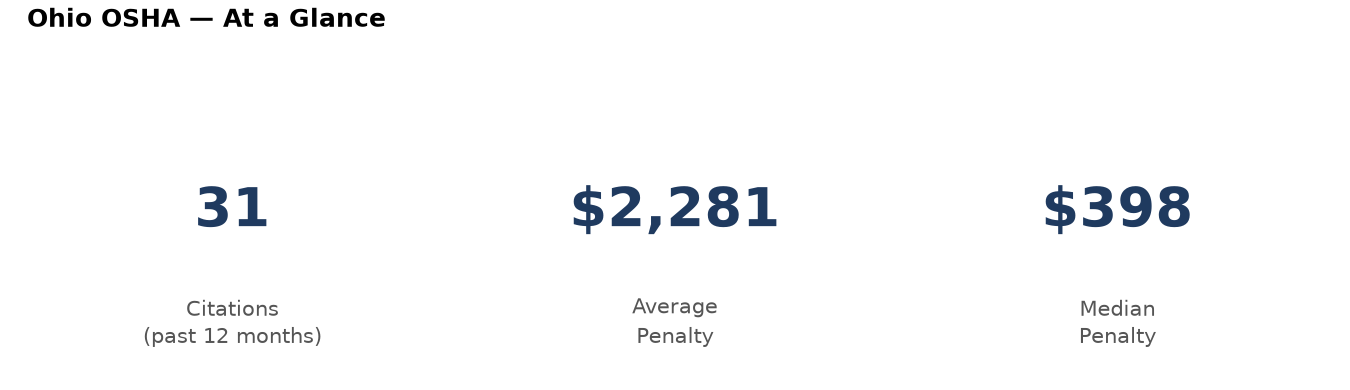
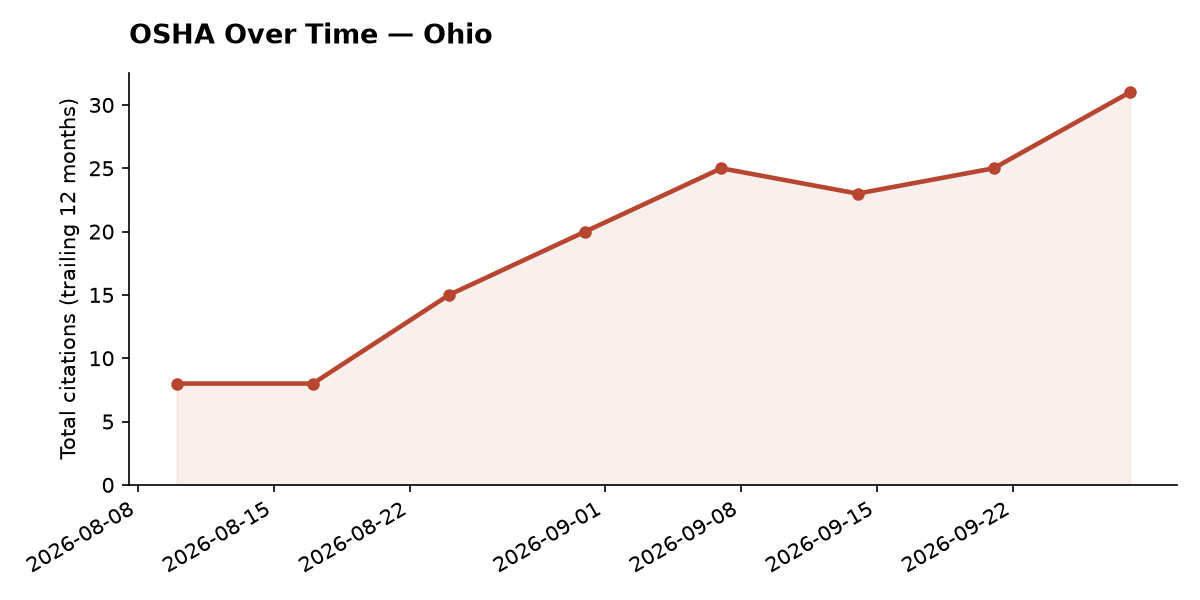
Ohio contractors racked up 31 scaffolding violations under 1926.451 over the past 12 months. The average penalty landed at $2,281, though the median of just $398 tells you most cases are smaller — until they are not. Dayton had more citations than any other city in the state, and specialty trade contractors took the brunt of enforcement activity.
If you have already received a citation, the numbers below matter less than your calendar. Talk to an Ohio OSHA defense attorney before you miss your window to push back.
What OSHA’s Scaffolding Rule Actually Demands on Ohio Jobsites
The 1926.451 standard is the backbone of scaffold enforcement in construction, and it is written broadly on purpose. It sets baseline rules for how a scaffold has to be built and rated for load, how workers get on and off it safely, what guardrail and planking configuration is required, and when fall protection has to be in place before anyone steps onto the platform. It does not care what trade you are in — framing, siding, roofing, masonry, electrical — if your crew works from a scaffold, this standard governs the setup.
Inspectors tend to focus on the basics: missing or improperly installed guardrails, planking that does not meet width or overlap requirements, scaffolds erected without proper footing or bracing, and crews working above six feet with no fall protection system in place. Several of the Ohio citations this year cite specific subsections of 1926.451 — B01 (platform construction), C02 (structural and support requirements), F07 (access), and G01 (fall protection) — which lines up with exactly these recurring problem areas.
Dayton, Siding Crews, and the Specialty Trades Carrying Ohio’s Citation Load
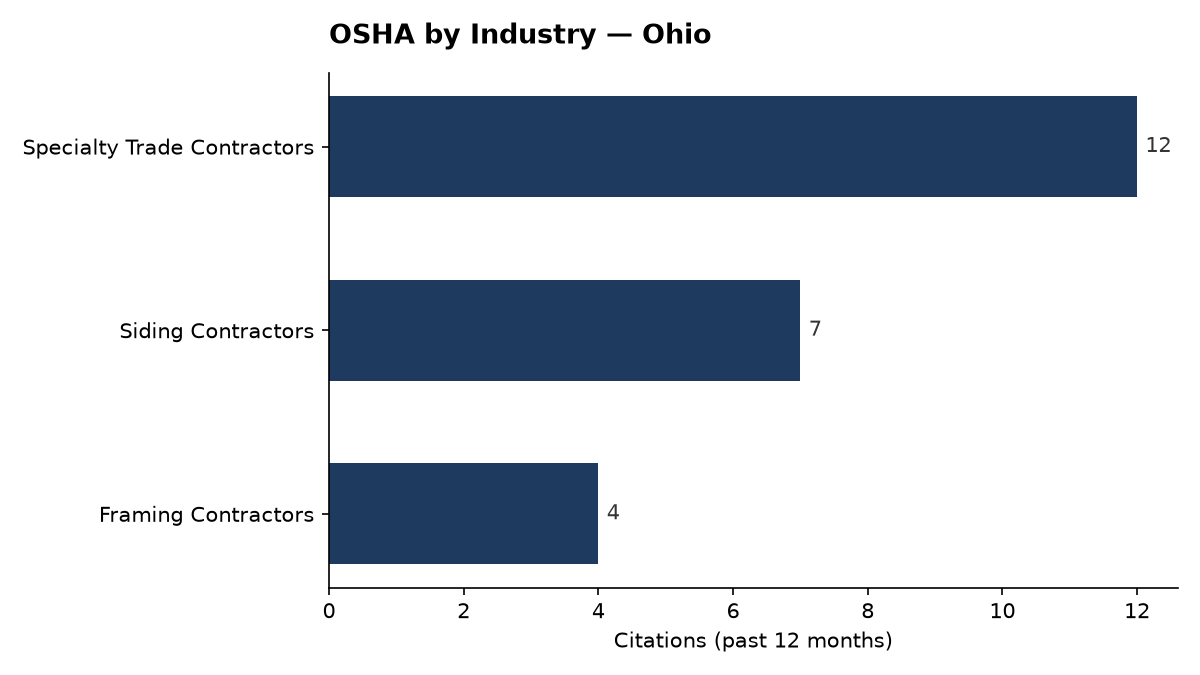
Specialty trade contractors accounted for 12 of the state’s 31 citations — by far the largest share. That is not surprising once you consider how much scaffold-dependent work falls under that umbrella: siding, exterior finishing, insulation, and other subcontracted trades that spend most of their day working off elevated platforms. Specialty trade contractors are structurally exposed to this standard because their work is scaffold work, almost by definition.
Siding contractors alone drew 7 citations, and framing contractors added another 4. Together, these three categories make up roughly three-quarters of all scaffolding enforcement in Ohio over the period. If your business falls into one of these trades, you are working in the segment OSHA is actively watching, and Dayton crews in particular have drawn more inspection attention than any other part of the state.
From $398 to Five Figures: What These Citations Actually Cost Ohio Contractors
The violation breakdown explains the wide gap between Ohio’s average and median penalties. Of the 31 citations, 21 were classified Serious, 6 were Other-than-Serious, and 4 were Repeat. Repeat violations are the ones that move the needle financially — OSHA penalizes a second finding of the same hazard far more aggressively than a first-time Serious violation, because it signals the earlier fix did not hold.
You can see that play out in the real citation record. Silverio Morales in Hamilton was cited $10,215 for a Repeat violation under 19260451 F07, issued June 24, 2026. Ccs Construction Services Llc in Dayton drew a $7,150 Repeat citation under 19260451 B01 on June 30, 2026. By contrast, the Serious citations in the same period ran lower: Djm Builders, Inc. in Massillon at $5,500 under 19260451 C02 IV, Egz Carpentry Llc in Mason at $4,965 under 19260451 G01, and Sergio Hernandez in Fairfield at $4,965 under 19260451 B01. The pattern is consistent — Repeat status roughly doubles the exposure compared to a standard Serious finding.
Here is the number that should get your attention if you are already holding a citation: penalties in this category get reduced by an average of 43% between the initial notice and final resolution. That reduction almost never happens by accident. It happens because someone negotiated, documented corrective action, or formally contested the citation on solid grounds. For a full breakdown of how these numbers are calculated and what drives them up or down, see this explanation of OSHA scaffolding penalty amounts.
A 43% swing on a $10,000 Repeat citation is real money. Before you decide to just pay it, talk to an Ohio OSHA defense attorney and find out whether your case has room to move.
The Clock Starts the Day You Sign: Your 15 Days to Respond
OSHA gives you exactly 15 working days from the date you receive a citation to file a Notice of Contest. Miss that window and the citation becomes a final order — no appeal, no negotiation, no reduction, regardless of whether the underlying finding was fair or accurate. That deadline does not pause for weekends beyond the standard workweek count, and it does not extend because you were waiting to hear back from your insurance carrier or corporate office.
If you plan to contest the classification (say, arguing a citation should be Serious rather than Repeat, which can cut the penalty substantially), or you want to negotiate an informal settlement, the process and its timing are covered in detail in this guide on how to contest an OSHA citation. But reading about the process is not a substitute for having someone build your case while the clock is still running.
Given the average 43% reduction Ohio cases see and the fact that Repeat violations here have run as high as $10,215, the math almost always favors getting a professional opinion before day 15 arrives. Reach out to an Ohio OSHA defense attorney now, while you still have options on the table.
Whether you run a siding crew in Dayton, a framing outfit downstate, or any specialty trade business that puts workers on scaffolds, the smartest move after a citation arrives is the same: get your documentation together, note the exact date you received the notice, and get legal advice before that 15-working-day window closes.