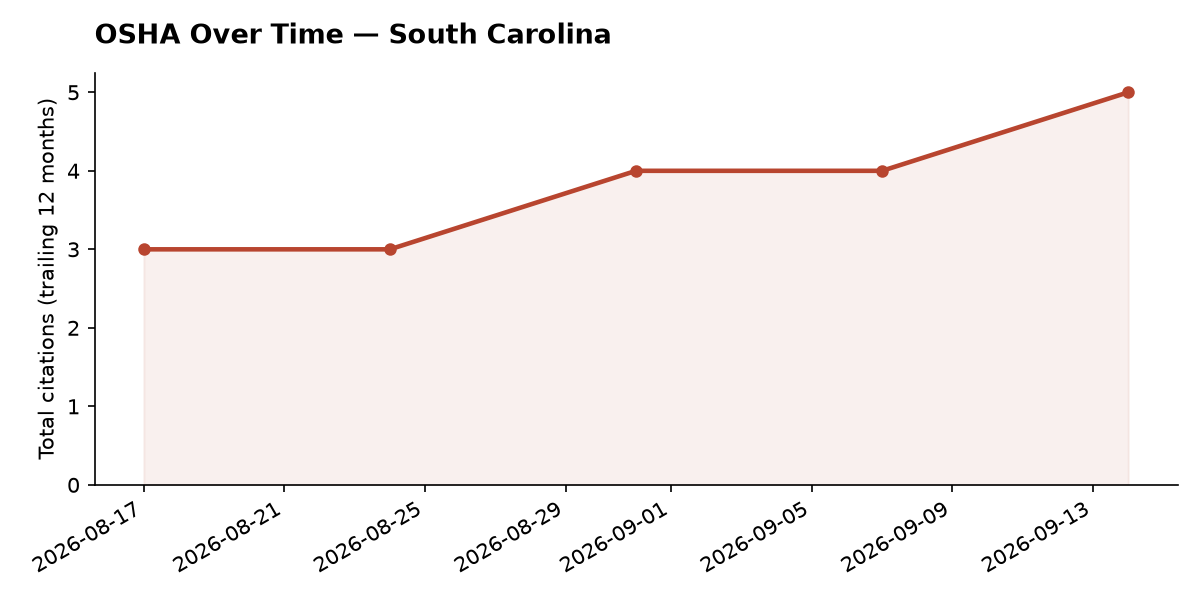
Data last updated: September 14, 2026
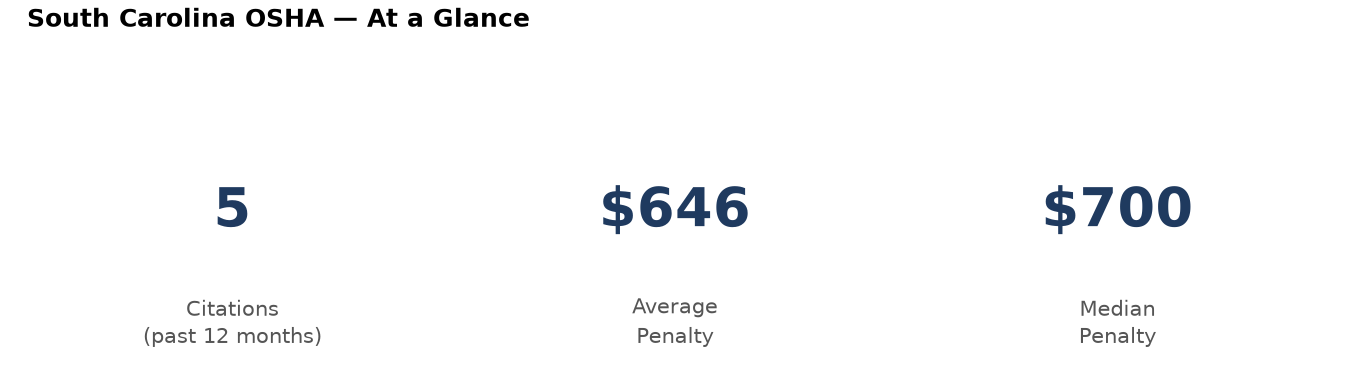
Over the past 12 months, OSHA issued 5 scaffolding-related citations to employers in South Carolina under standard 1926.451. Every single one was classified as Serious. The average penalty came in at $646, with a median of $700, and Bluffton stands out as the city with the most activity. That may sound like a small number of cases statewide, but if your company is one of the five, the number that matters is the one on your citation letter, not the statewide total.
If you have received a scaffolding citation in South Carolina, talking to a South Carolina OSHA defense attorney before you respond to OSHA can change how much you ultimately pay and what shows up on your compliance record.
What 1926.451 Actually Requires On Your Jobsite
The rule behind every one of these citations, 1926.451, is OSHA’s baseline framework for scaffold safety on construction sites. It is not a narrow technical footnote — it covers how a scaffold has to be built, how much weight it needs to hold, how workers get on and off it safely, what fall protection has to be in place at height, and how guardrails and planking need to be installed so nobody falls through a gap or off an unsecured platform. You can read the full breakdown of the standard on the 1926.451 standard hub, but the short version is this: if a scaffold on your site is missing guardrails, has an incomplete platform, lacks a safe means of access, or wasn’t built to the load capacity the job demands, you are exposed under this rule.
Two of the South Carolina cases illustrate this directly. Ayres Stucco Inc, cited in Bluffton, was flagged under subsection C02 of the standard, which deals with scaffold construction and design requirements. Haymak Masonry Inc, cited in Fort Mill, was cited under C03, a closely related construction-and-capacity provision. Both point to the same theme: OSHA inspectors in South Carolina are looking hard at how scaffolds are actually assembled, not just whether one exists on site.
Why Specialty Trade Contractors Are Carrying All Five Citations
Every single scaffolding citation issued in South Carolina over this period landed on a business classified under specialty trade contractors — the category that covers masonry, stucco, fire and life safety work, and similar subcontracted trades. That is not a coincidence. These are the businesses that erect and work from scaffolding daily, often on tight schedules, often on someone else’s general contract, and often with crews rotating between multiple active jobs. When a stucco crew or a masonry crew is racing to finish a wall section before weather or a deadline, scaffold guardrails and access points are exactly the details that get rushed.
The named cases back this up. A Fire And Life Safety Group in Mount Pleasant was cited for a Serious violation under G04 IV, part of the fall-protection provisions within 1926.451. Guy M Beaty – Co Inc in Anderson was cited under a related G04 I fall-protection subsection. Fall protection failures on scaffolds are consistently one of the more common findings nationally, and South Carolina’s numbers track that pattern closely — every one of the state’s five cases falls somewhere in this construction-and-fall-protection cluster.
What These Citations Actually Cost In South Carolina
None of the five South Carolina scaffolding citations reached Willful or Repeat status — all five were coded Serious, which is the standard classification OSHA uses when a hazard could realistically cause death or serious physical harm and the employer knew or should have known about it. Serious citations carry lower base penalties than Willful or Repeat findings, which is reflected in the state’s modest average of $646. But do not read that number as low-stakes. A Repeat or Willful finding on the same facts can multiply the penalty several times over, and a second citation for the same type of hazard moves a company into that higher-risk category fast.
It is also worth understanding that these penalty amounts are not fixed. South Carolina’s average penalty reduction between the initial citation and the final resolved amount was 7% over this period — proof that the number on the citation letter is a starting point OSHA expects to negotiate from, not a final bill. The named cases range from $400 for Guy M Beaty – Co Inc in Anderson up to $780 for A Fire And Life Safety Group in Mount Pleasant, with Ayres Stucco Inc in Bluffton at $750 and Haymak Masonry Inc in Fort Mill at $700. Those differences come down to specifics: the subsection cited, the size of the business, prior history, and how the case was argued. You can see how OSHA builds these numbers on the OSHA scaffolding violations penalty amounts page.
A 7% reduction on paper might not sound dramatic, but on a $700 or $780 citation that difference, multiplied across a company facing several citations at once, adds up. And penalty amount is rarely the only cost — a citation on record affects future inspection targeting and can complicate bidding on jobs that require a clean safety history.
Before you decide whether to pay, contest, or negotiate, it is worth getting a South Carolina OSHA defense attorney to look at the specific subsection you were cited under and whether the facts support it.
The Clock Is Already Running If You Have Been Cited
Once OSHA delivers a citation, you have exactly 15 working days to file a Notice of Contest. That deadline does not pause for the holidays, for a slow mail week, or because you are still gathering paperwork. Miss it, and the citation and penalty become final, no matter how strong your defense might have been. Given that South Carolina’s numbers are small statewide, most local employers have never dealt with this process before and do not know how tight that window really is.
The right first move is understanding your options under how to contest an OSHA citation — informal conference with the area office, formal contest, or negotiated settlement are all on the table, but each has its own timing and tradeoffs. What you should not do is let the 15-day clock run out while you decide, or assume a Serious citation with a few-hundred-dollar penalty is not worth a second look. The subsection cited, the inspection date, and how the violation was documented all matter to your options.
Given how little time you have to act, the most efficient step is a direct conversation with a South Carolina OSHA defense attorney who can review your citation, tell you whether contesting makes sense, and make sure your response gets filed before the deadline closes.
Whether your citation names a subsection like G04, C02, or C03, or you are simply trying to get ahead of a scaffold inspection before it happens, the smart move is to get the paperwork and the deadline in front of someone who handles these cases regularly, not to guess at what a Serious classification means for your bottom line.