
Data last updated: September 21, 2026
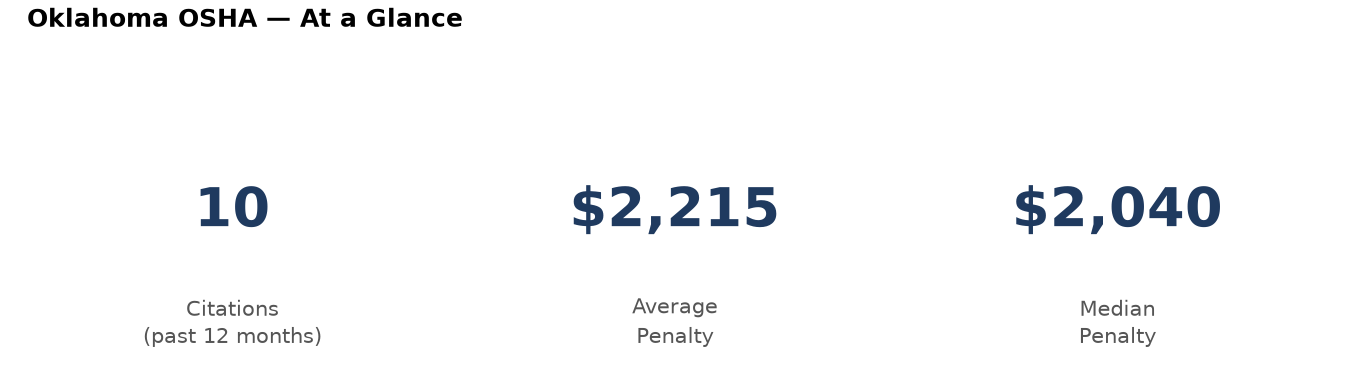
Oklahoma OSHA offices issued 10 ladder violations under 1926.1053 over the past 12 months, with an average penalty of $2,215 and a median of $2,040. That might sound like a small number of cases statewide, but if your company is one of them, the math is not abstract — it is a real invoice with a real deadline attached, and eight of these ten citations landed on roofing contractors alone.
If you have already been cited, or you are worried a citation is coming, talking to an Oklahoma OSHA defense attorney now costs you far less time and money than waiting until the contest window closes.
What OSHA Actually Expects From a Ladder Setup in Oklahoma
Every one of these citations traces back to the same rule: 1926.1053, OSHA’s general ladder standard for construction. It is not a single rule so much as a bundle of basic setup requirements — the ladder has to extend far enough past the landing surface for a worker to step off safely, it has to be rated for the load it is actually carrying, it cannot be used if it is damaged or repaired with makeshift fixes, and workers have to use it the way it was designed to be used rather than improvising a shortcut. None of this is exotic engineering. It is the kind of thing every foreman already knows, which is exactly why inspectors treat violations of it as easy to spot and easy to write up.
In Oklahoma, nine of the ten citations issued were classified as Serious, meaning OSHA determined the hazard could plausibly cause death or serious physical harm. Only one was Other-than-Serious. That ratio matters: a Serious classification carries a much higher base penalty than a paperwork-level finding, and it signals that the inspector saw a real fall exposure, not a technicality.
Why Roofing Crews Make Up Most of Oklahoma’s Cases
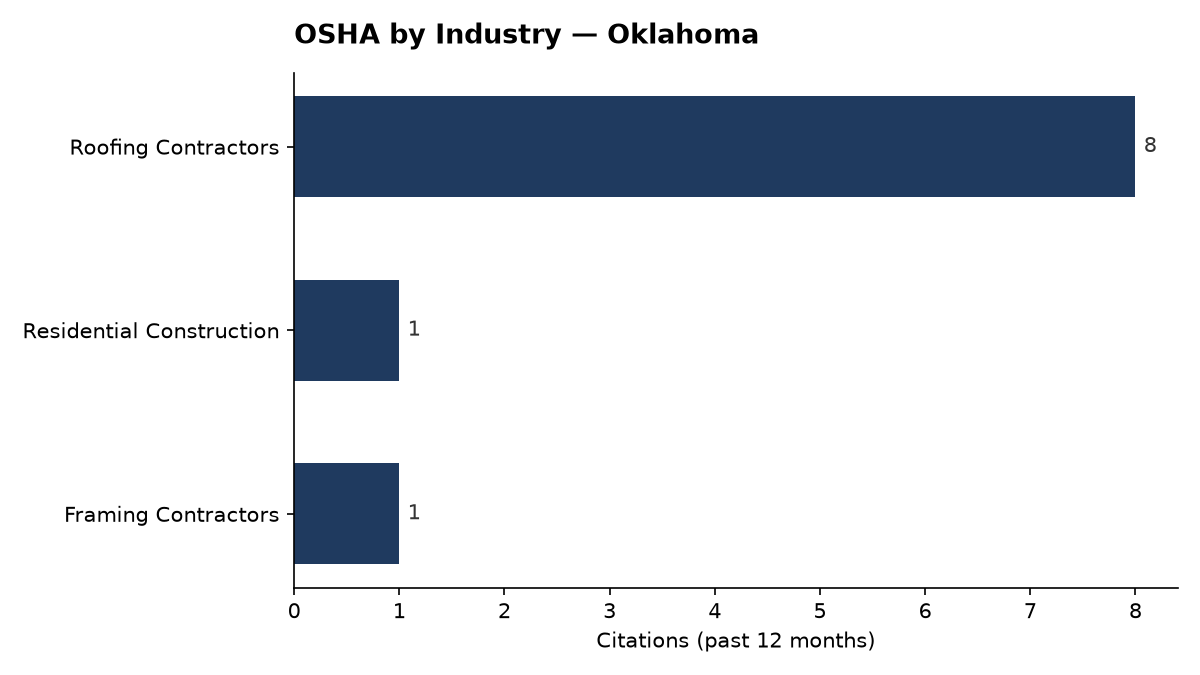
Eight of the ten ladder citations in this data set went to roofing contractors. One went to a residential builder and one to a framing contractor. That lopsided split is not a coincidence. Roofing work depends on ladders for nearly every access point on a job, crews move fast between houses, and ladder setup often gets rushed at the start or end of a shift when supervision is thinnest. Oklahoma City recorded the most citations of any city in the state, which tracks with the volume of roofing and remodeling activity concentrated in and around the metro area.
The named cases in this data set illustrate the pattern well. Conrad’s Roofing & Construction Inc, based in Owasso, was cited $4,256 for a Serious violation of 1926.1053(b)(1) issued July 16, 2026 — the highest penalty in the group. Lira Bros Construction LLC in Mustang was cited $2,837 for the same subsection on January 30, 2026. That same day, both Maldonado Roofing and Remodeling in Yukon and GNC Roofing and Construction LLC in Broken Arrow each received $2,412 Serious citations under the identical provision. Sooner Recon LLC of Broken Arrow was cited $2,270 for an Other-than-Serious violation issued March 17, 2026. Four of these five cases cite the exact same subsection of the standard, which suggests inspectors in Oklahoma are focused on one specific, recurring setup failure rather than a scattershot of unrelated issues.
What a Citation Like This Actually Costs You
The numbers in Oklahoma run from $2,270 on the low end to $4,256 on the high end among the examples above, with a statewide average of $2,215 and median of $2,040. That is the initial number OSHA proposes — it is not necessarily the number you end up paying. The data shows an average penalty reduction of 10% between the initial citation and the final settled amount, which tells you two things: negotiation happens routinely, and going in without preparation leaves money on the table that other employers are recovering. For a fuller breakdown of how OSHA calculates these figures and what drives them up or down, see this explanation of OSHA ladder violation penalty amounts.
Before you decide whether to pay, contest, or negotiate, it is worth getting an outside read on your specific citation. An Oklahoma OSHA defense attorney can tell you within a short conversation whether your case looks like the kind that typically gets reduced, and by how much.
The 15-Day Clock That Most Employers Don’t Take Seriously Enough
Once you receive a citation, you have exactly 15 working days to file a Notice of Contest. Not 15 calendar days — 15 working days, and OSHA does not extend that window for being busy, for waiting on an insurance adjuster, or for hoping the citation gets resolved informally. Miss it, and the citation becomes a final order with no further right to challenge it, even if you had a legitimate defense. If you are unsure how the contest process works or what it actually accomplishes, this guide on how to contest an OSHA citation walks through the mechanics.
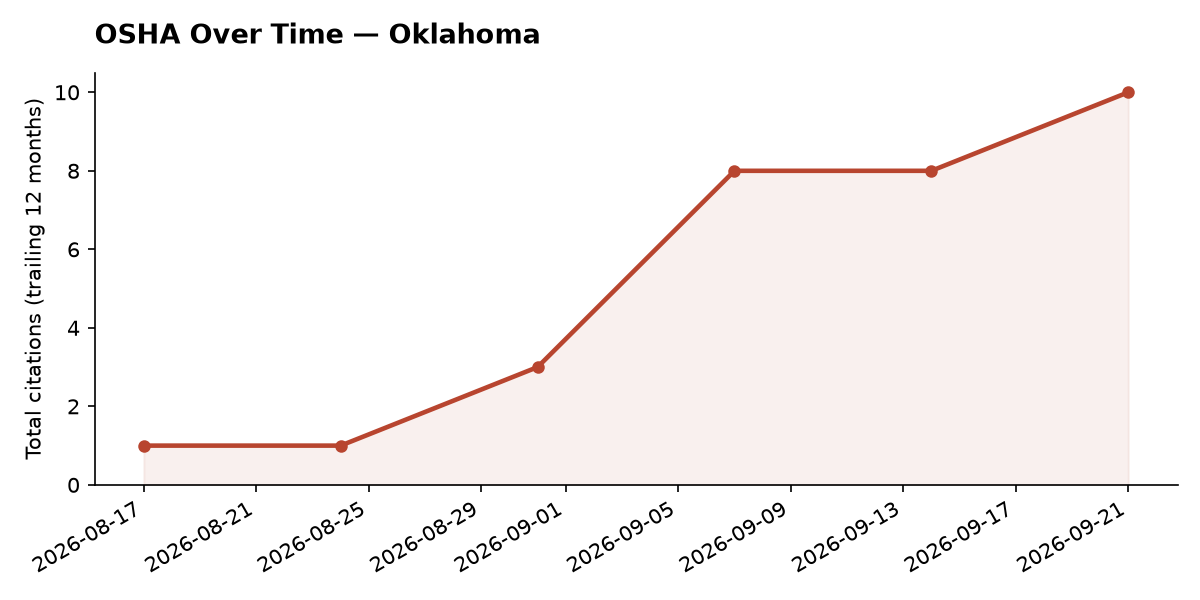
Given how tight that window is, and given that four of the five named cases in this data set were issued in January alone, the smart move is to treat the clock as running the moment the citation arrives, not the moment you decide to deal with it. If your penalty is anywhere near the $2,215 state average — or above it, like the Conrad’s Roofing case at $4,256 — it is worth a direct conversation with an Oklahoma OSHA defense attorney before that window closes, not after.
Pull your citation paperwork, note the exact date you received it, and count backward from the 15-working-day deadline today. Whether you plan to contest, negotiate, or simply understand what you are on the hook for, doing it with someone who handles these cases regularly puts you in a stronger position than doing it alone.