
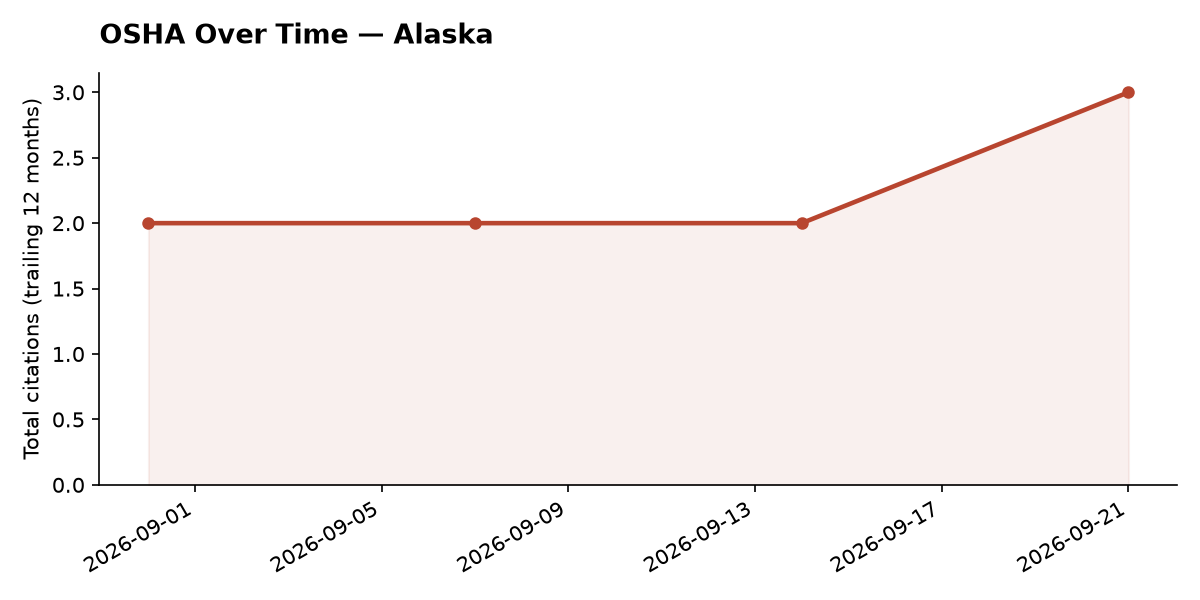
Data last updated: September 21, 2026
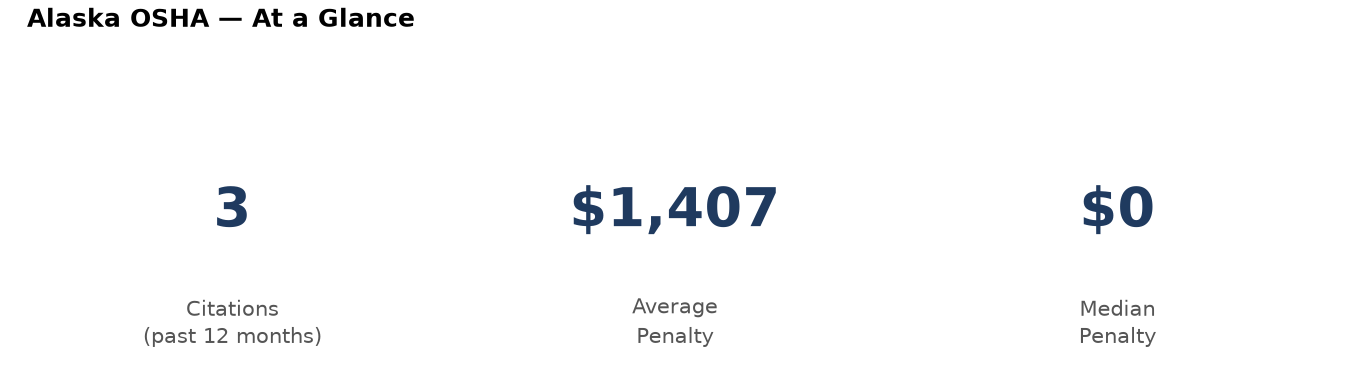
Alaska is not a high-volume state for scaffolding enforcement, but the numbers still tell a clear story. Over the past 12 months, OSHA issued 3 scaffolding violations statewide, every single one classified as Serious, and every single one traced back to job sites in Anchorage. The average penalty sits at $1,407, though the median is $0 — meaning some employers walked away with no fine at all while others paid several thousand dollars for the same type of violation.
If you have already received a citation under this standard, or you suspect one is coming, the small sample size in Alaska does not mean the risk is small. It means outcomes vary widely, and how you respond in the first two weeks matters more than the statewide average.
Talk to an Alaska OSHA defense attorney before you decide how to handle a scaffolding citation — the deadline to act is shorter than most contractors expect.
What OSHA Actually Requires on a Scaffold
Every one of Alaska’s recent scaffolding citations was written under 1926.451, OSHA’s general rulebook for scaffold safety in construction. This is the foundational standard covering scaffold construction and capacity, safe access, fall protection while workers are on a scaffold, and the specific requirements for guardrails and planking. It applies to essentially any scaffold used on a construction job, from a simple frame scaffold at a remodel to a larger system at a commercial build.
The standard is broad by design, which is part of why it generates citations across so many different trades. You can read the full breakdown of what inspectors look for on the 1926.451 standard hub, but the short version is this: if a scaffold platform is missing proper planking, guardrails are absent or incomplete, or workers lack fall protection while accessing or working from the structure, that is exactly the kind of gap OSHA compliance officers are trained to flag on sight.
Which Alaska Trades Are Getting Cited
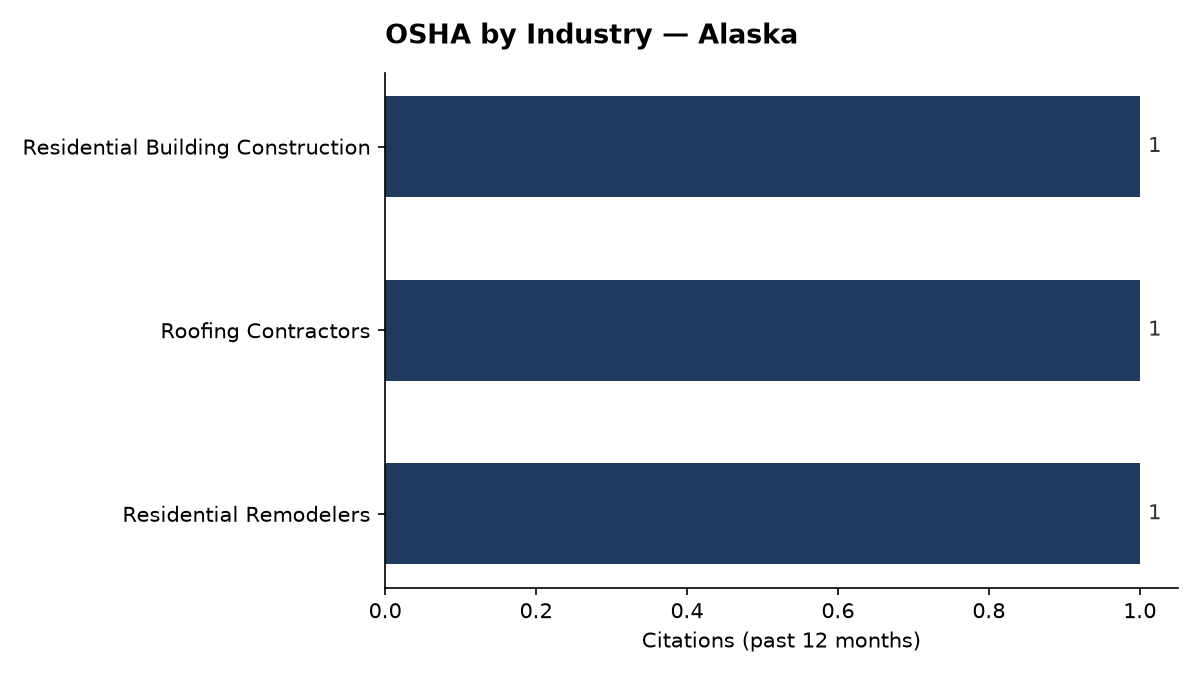
With only three citations on record, Alaska’s data does not point to one dominant offender — it points to a spread across residential-focused trades. The citations break down evenly among residential building construction, roofing contractors, and residential remodelers, one citation apiece.
That pattern lines up with how scaffolding tends to get used in Alaska’s construction market. Much of the state’s building activity is residential or small-scale remodel work, often involving exterior scaffolding for siding, roofing, or upper-story access. These jobs frequently run on tighter crews and tighter schedules than large commercial projects, which can mean less time spent double-checking guardrail height, plank overlap, or access points before OSHA shows up.
What a Scaffolding Citation Actually Costs in Alaska
The dollar figures here are worth sitting with. The average penalty across Alaska’s three scaffolding citations was $1,407, but that average hides a big spread. Two of the three cases resulted in a $0 penalty, while one employer paid substantially more:
- Jw Builders, LLC (Anchorage) — $4,220, Serious violation cited under 19260451 G01 I, issued December 16, 2025
- Burlywood Inc (Anchorage) — $0, Serious violation cited under 19260451 F15, issued November 10, 2025
- Northern Roof Systems (Anchorage) — $0, Serious violation cited under 19260451 F15, issued November 10, 2025
Statewide, the average penalty reduction between the initial citation and the final resolved amount runs at 67%. That is a significant swing, and it did not happen by accident. Employers who negotiate, provide documentation of abatement, or formally contest weak or overreaching findings tend to see real reductions. Employers who simply pay the initial citation amount rarely see any discount at all. You can see how OSHA calculates these figures on the OSHA scaffolding penalty amounts page.
A 67% average reduction is not a guarantee, but it shows that the initial number on your citation letter is frequently not the final number — provided you respond correctly and on time.
Before you write a check or assume the citation is final, speak with an Alaska OSHA defense attorney about whether your penalty can be reduced or the citation itself challenged.
The Clock Starts the Day You Receive the Citation
Here is the part most contractors miss: OSHA gives you only 15 working days from the date you receive a citation to file a Notice of Contest. Miss that window, and the citation — along with the penalty and the violation classification — becomes final. There is no automatic extension and no informal appeal after the deadline passes.
Given that all three of Alaska’s recent scaffolding citations were classified as Serious, and that penalties in this category ranged from $0 to over $4,200, the classification and the dollar amount are both worth scrutinizing before you accept them. A Serious classification on your OSHA record can affect future inspections, insurance considerations, and bidding on jobs that require a clean safety history. Details on the contest process, deadlines, and what documentation strengthens your position are laid out on the how to contest an OSHA citation page.
If you have already received a citation, do not wait to see how the deadline feels. Fifteen working days moves fast once you factor in gathering documents, photographs, and witness statements. Get an Alaska OSHA defense attorney reviewing your case as soon as possible so you have options while options still exist.
Whether your citation names a $0 penalty or several thousand dollars, treat the classification and the clock as the two things that matter most right now. Pull your citation paperwork, note the issuance date, and get a qualified opinion on your options before the 15 working days run out.