

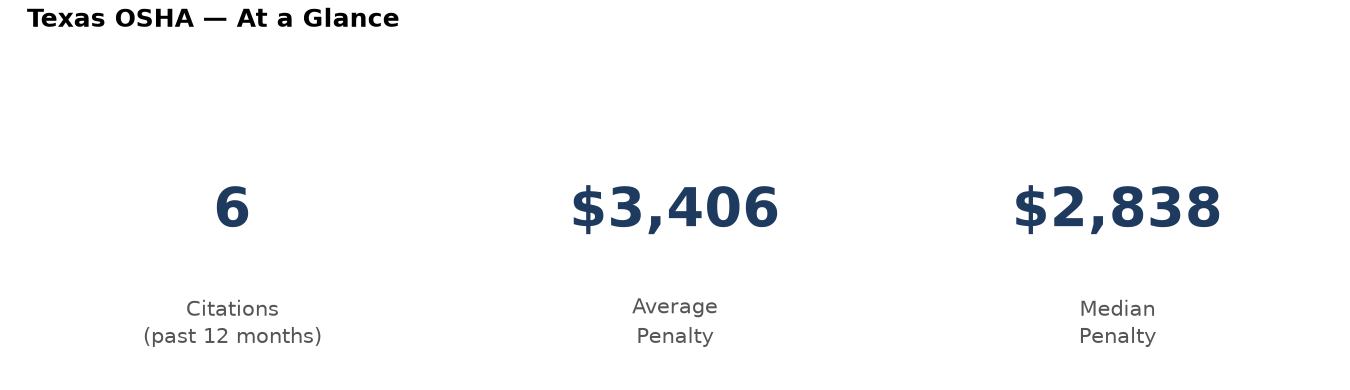
Over the past 12 months, Texas OSHA offices issued 6 citations under the ladder standard, 1926.1053. That is not a large number compared to some states, but the penalties tell a more serious story: the average fine sits at $3,406, the median at $2,838, and one employer in Wylie was hit with a Repeat violation carrying a $9,930 penalty. Bay City recorded more of these citations than any other Texas city in the period reviewed.
If you or your company just received a citation like this, the clock is already running. You have a genuine legal path forward, but the window to use it is short.
Talk to a Texas OSHA defense attorney before you decide how to respond — the earlier you get advice, the more options you keep on the table.
What the Ladder Standard Actually Requires on a Texas Job Site
The standard behind every one of these citations, 1926.1053, is not just a rule about owning a ladder. It sets specific, checkable requirements: ladders have to be set up and used correctly, extension ladders must reach far enough beyond a landing surface to give workers a stable handhold when stepping off, equipment has to be rated for the load it’s actually carrying, and damaged ladders have to be pulled from service rather than patched up and reused. Inspectors look at all of this during routine walk-throughs, and a single missing detail — a ladder tied off wrong, a cracked rail still in use, a load beyond rating — is enough to trigger a citation.
Five of the six Texas citations in this data set were classified as Serious, meaning OSHA determined the hazard could realistically cause death or serious physical harm. One was classified as Repeat, a category reserved for employers who have been cited for the same or a substantially similar violation before. Repeat citations carry much steeper penalties by design, and the Wylie case at $9,930 illustrates exactly why: it is more than three times the state average.
Roofing and Framing Crews Account for Most of Texas’s Ladder Citations
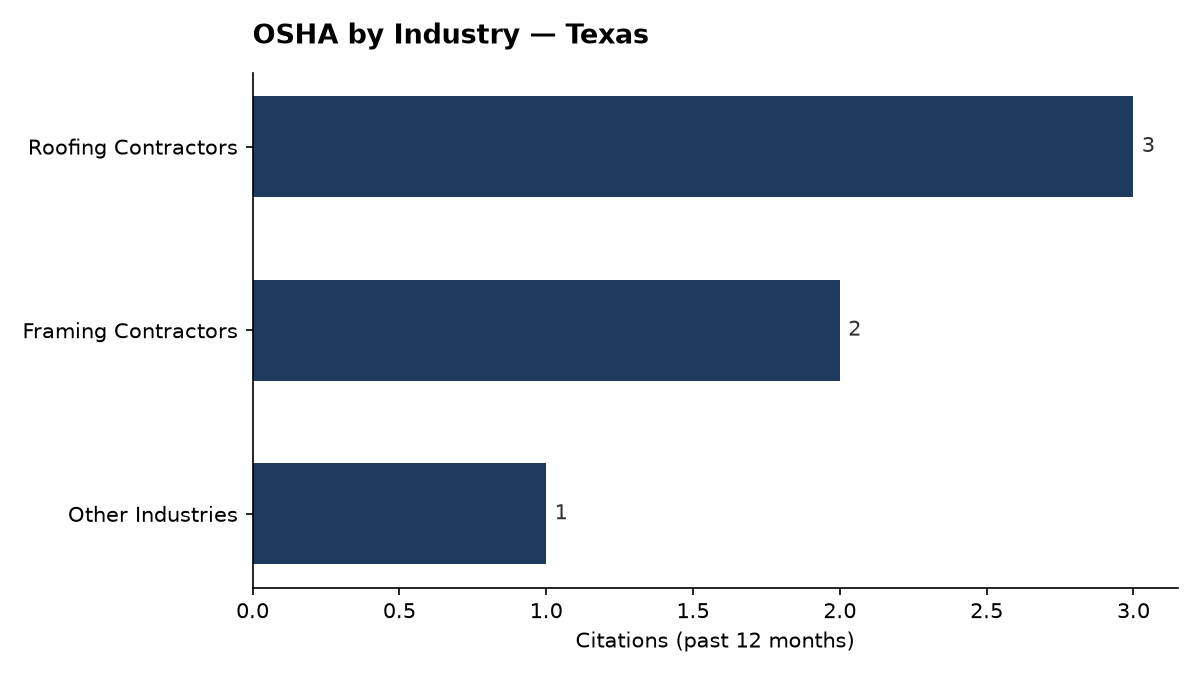
The industry breakdown here is not surprising to anyone who has spent time on a residential job site. Roofing contractors accounted for 3 of the 6 citations, and framing contractors picked up 2 more. Together, those two trades make up five out of six ladder cases in the state. The remaining citation came from an employer outside either of those categories.
This pattern makes sense given how these trades work. Roofers and framers rely on ladders constantly, often multiple times an hour, to move between the ground and an elevated work surface. That volume of use means more chances for a ladder to be set up on uneven ground, extended improperly, or kept in service after damage that should have taken it out of rotation. Inspectors know this, which is part of why these two trades are where enforcement attention concentrates in Texas.
What These Citations Actually Cost — and What Negotiation Can Change
Here is what the numbers look like when you put real names next to them. Santiago Ortiz in Wylie was cited $9,930 for a Repeat violation under subsection B01, issued October 20, 2025. Daniel Buentello, Jr. in Bay City was cited $3,000 for a Serious violation, also under B01, issued November 12, 2025. Alejandro Guzman in Canton faced a $2,838 Serious citation under B01, issued December 23, 2025. Crispin Gomez Cruz in Converse was cited $2,837 under subsection B13, a Serious violation issued January 7, 2026. And Mark Mack in Desoto received the smallest penalty in the group, $1,180, for a Serious violation issued January 14, 2026, also under B01.
Notice the spread: penalties in this same category range from just over a thousand dollars to nearly ten thousand, depending on classification and history. That is the kind of gap that a knowledgeable defense can influence. Statewide, the average penalty reduction between the initial citation and the final resolved amount was 21 percent in this period — a meaningful drop that typically comes from negotiation, evidence about abatement, or successfully contesting parts of a citation. You can see how these figures compare across the board on the OSHA ladder violations penalty amounts page.
A 21 percent average reduction is not automatic — it happens because employers push back with the right facts and the right timing. Before you accept a citation at face value, talk to a Texas OSHA defense attorney about whether your case has room to move.
Your 15-Day Window to Contest a Citation
Once a citation is issued, OSHA gives you 15 working days to file a Notice of Contest. Miss that deadline and the citation, along with the proposed penalty, becomes a final order — no appeal, no negotiation, no second look. That is true whether your citation is a $1,180 Serious violation or a $9,930 Repeat one.
Fifteen working days sounds like a reasonable amount of time until you factor in gathering documentation, reviewing the specific subsection cited (B01 and B13 both appear in the Texas cases above, and each has different technical requirements), and deciding whether to contest, negotiate an informal settlement, or pay as issued. Waiting even a week to start that process eats into time you may need. The how to contest an OSHA citation page walks through what that process actually involves.
If you have already received a citation, the 15 working day deadline is running right now. Reach out to a Texas OSHA defense attorney today so someone with experience in these cases can look at your paperwork before that window closes.
Whether you run a roofing crew in Bay City, a framing operation elsewhere in the state, or any business that puts workers on ladders, the smartest move after a citation lands is the same: get the citation and your ladder program reviewed by someone who handles these cases regularly, and do it inside that 15-working-day window rather than after it closes.