Data last updated: September 21, 2026
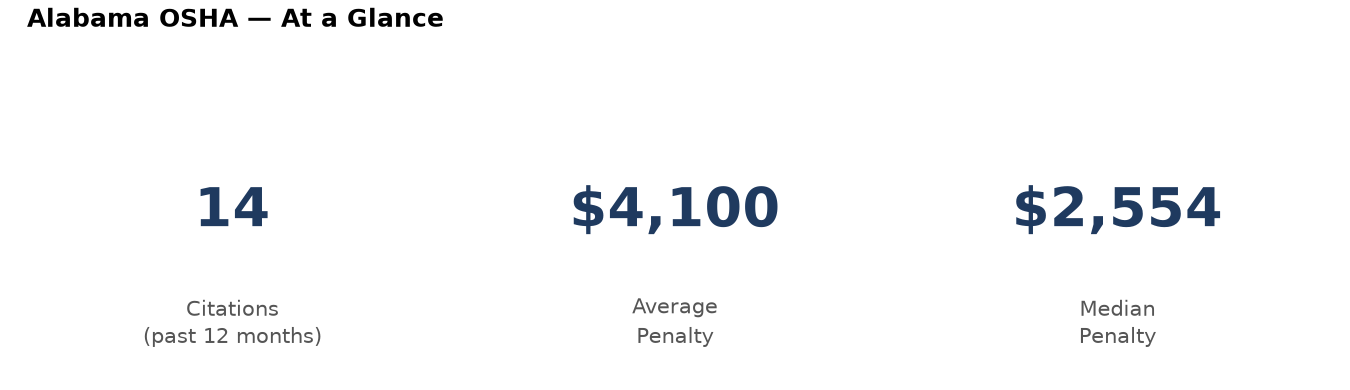
Alabama employers racked up 14 ladder-related OSHA citations over the past 12 months, with penalties averaging $4,100 and a median of $2,554. That average gets pulled upward fast when Repeat violations enter the picture, and two of the 14 citations in this state carried that Repeat designation, which OSHA punishes far more heavily than a first-time Serious finding. If you run a framing crew, a roofing outfit, or a general contracting operation anywhere from Foley to Bessemer, this is the standard inspectors are checking against right now.
If you have already received a citation, the clock is running. You get 15 working days from the date on the citation to file a Notice of Contest, and once that window closes, the penalty and the violation become final whether you agree with it or not. Talking to an Alabama OSHA defense attorney before that deadline passes is the single most useful thing you can do right now.
What OSHA Actually Expects Under the Ladder Standard
Every one of these 14 citations traces back to one rule: 1926.1053, OSHA’s general requirements for ladders on construction sites. In plain terms, the 1926.1053 standard spells out how a ladder has to be set up and maintained anytime it’s used to reach an elevated work area. That includes extending the ladder far enough past the landing surface so workers have something stable to grab onto as they step off, keeping the ladder rated for the load it’s actually carrying, pulling damaged or compromised ladders out of service immediately, and making sure workers use the equipment the way it was designed to be used rather than improvising with makeshift footing or overreaching from the top rungs.
None of this is complicated engineering. Most violations happen because a crew is moving fast, a damaged ladder didn’t get flagged and removed, or a supervisor never walked the site to check setup before work started. Inspectors know this, which is exactly why ladder citations remain one of the most commonly issued categories in construction enforcement nationwide.
Framing Crews Are Drawing the Most Attention in Alabama
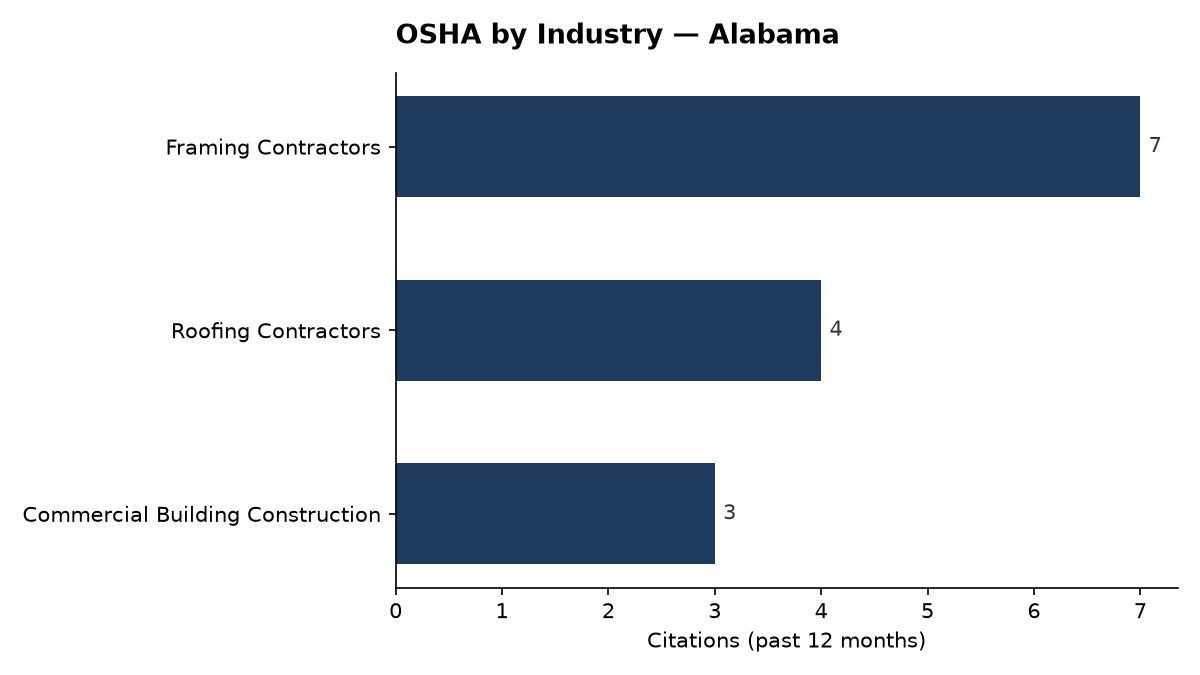
Of the 14 citations issued statewide, framing contractors accounted for 7 — exactly half. Roofing contractors picked up 4, and commercial building construction firms accounted for 3 more. That pattern lines up with the nature of the work: framing and roofing crews are constantly moving ladders between elevations, often on uneven ground or partially built structures, and that repeated setup-and-teardown cycle is where corners get cut and inspectors catch it.
Foley posted more ladder citations than any other city in the state during this period, which tracks with the volume of residential and light commercial framing work happening along Alabama’s Gulf Coast growth corridor. If your company operates in that region, or does the kind of work these industries do anywhere in the state, assume your jobsite is a realistic candidate for an inspection.
What These Citations Actually Cost — In Real Alabama Cases
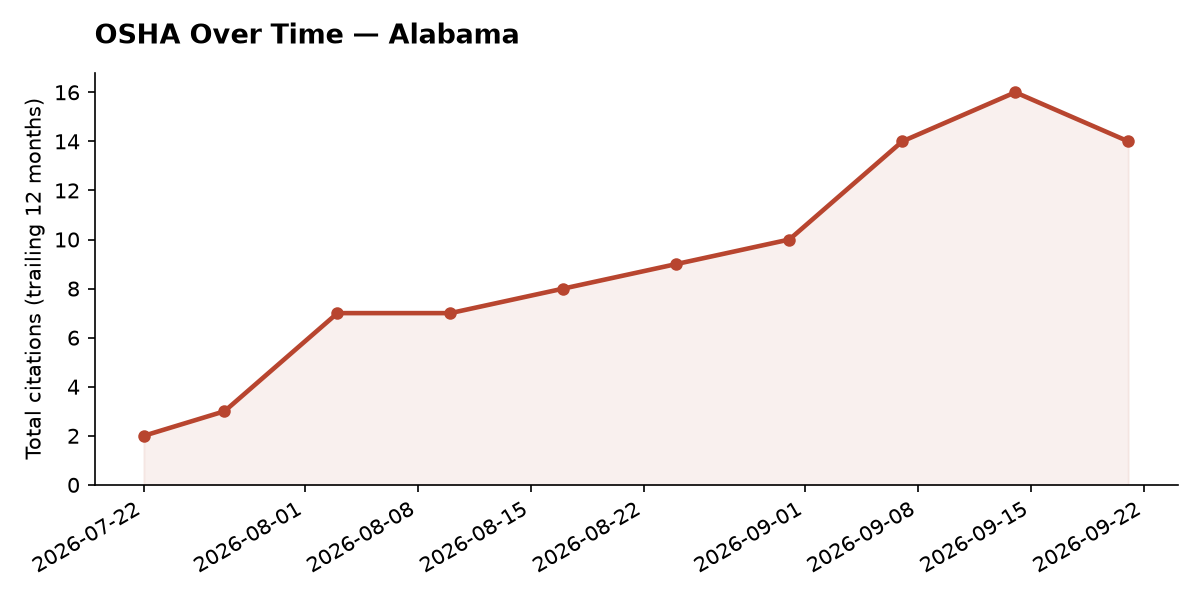
The dollar figures vary widely depending on whether OSHA classifies the finding as Other-than-Serious, Serious, or Repeat, and the state’s recent record shows that spread clearly. Of the 14 citations, 11 were classified Serious, 2 were Repeat, and 1 was Other-than-Serious. Repeat citations exist because the employer (or a related entity) was cited for a substantially similar violation before, and OSHA’s penalty structure reflects that with significantly steeper fines.
Real examples from the past year illustrate the range:
- Alder Rivera Enriquez, Trussville — $10,215, Repeat, cited under 19261053 B01, issued October 17, 2025
- Malone Roofing Services, LLC, Odenville — $9,268, Other-than-Serious, cited under 19261053 B01, issued December 17, 2025
- Bernardo Perez, Foley — $6,809, Repeat, cited under 19261053 B01, issued April 02, 2026
- CB&A Construction, L.L.C., Bessemer — $5,959, Serious, cited under 19261053 B04, issued January 22, 2026
- Rogelio Torres De La Cruz, Warrior — $5,958, Serious, cited under 19261053 B01, issued March 10, 2026
Notice that the two Repeat citations, Alder Rivera Enriquez and Bernardo Perez, both landed well above the state average, while the Other-than-Serious citation against Malone Roofing still carried a substantial penalty — a reminder that even the lowest-severity classification isn’t automatically cheap. For a deeper breakdown of how OSHA calculates these numbers, see this guide to OSHA ladder violation penalty amounts.
One more figure worth knowing: penalties in this category have historically been reduced by an average of only 5% between the initial citation and the final settled amount in Alabama. That’s a modest reduction compared to some other violation categories, which tells you informal negotiation alone rarely moves the number much — the citation classification itself, and whether it holds up as Serious versus Repeat, matters far more to your final bill.
A penalty in the $6,000 to $10,000 range isn’t hypothetical here — it’s the going rate for a Repeat finding in this state right now. Before you pay it or let the deadline lapse, get an Alabama OSHA defense attorney to look at the specific subsection you were cited under and whether the classification actually fits the facts on your site.
Your 15-Day Window Starts the Moment You Sign for the Citation
OSHA doesn’t send a warning before the contest deadline closes. From the day you receive the citation, you have 15 working days to file a Notice of Contest if you intend to dispute the classification, the penalty amount, or the underlying facts. Miss that window and the citation becomes a final order — no appeal, no negotiation, and it stays on your record as a prior violation that can trigger Repeat status on any future citation for years afterward. Given that two of the five example cases above were hit with Repeat classifications, that long tail is not abstract.
Before that clock runs out, it’s worth understanding exactly what filing a contest involves and what it can and can’t change — this rundown of how to contest an OSHA citation walks through the process step by step. But reading about the process and actually building a defense are two different things, especially when the classification (Serious versus Repeat versus Willful) is what’s driving most of the cost.
If you’ve been cited, or you’ve just been notified that an inspection is coming, don’t wait until day 14 to make a decision. Talk to an Alabama OSHA defense attorney now, while there’s still time to review the evidence, challenge the classification, and file the paperwork before the deadline closes for good.