
Data last updated: September 28, 2026
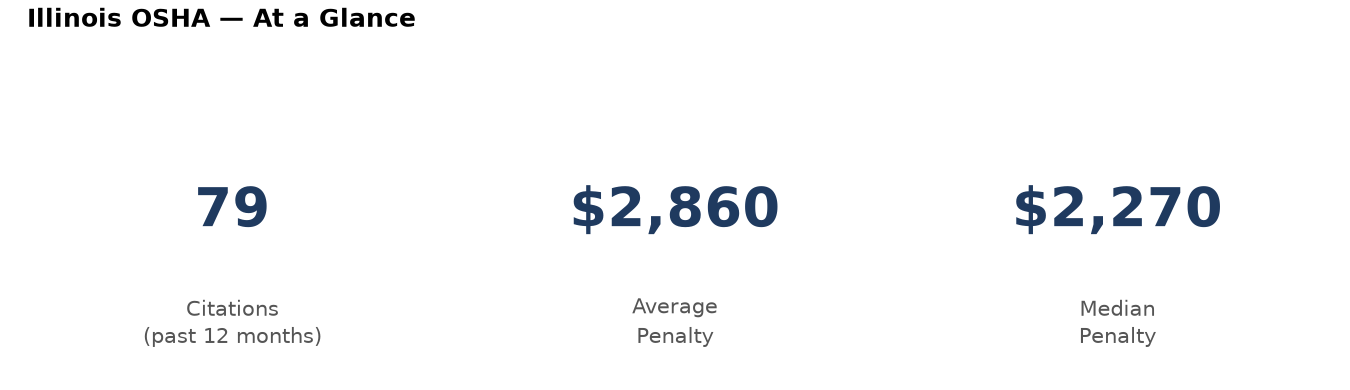
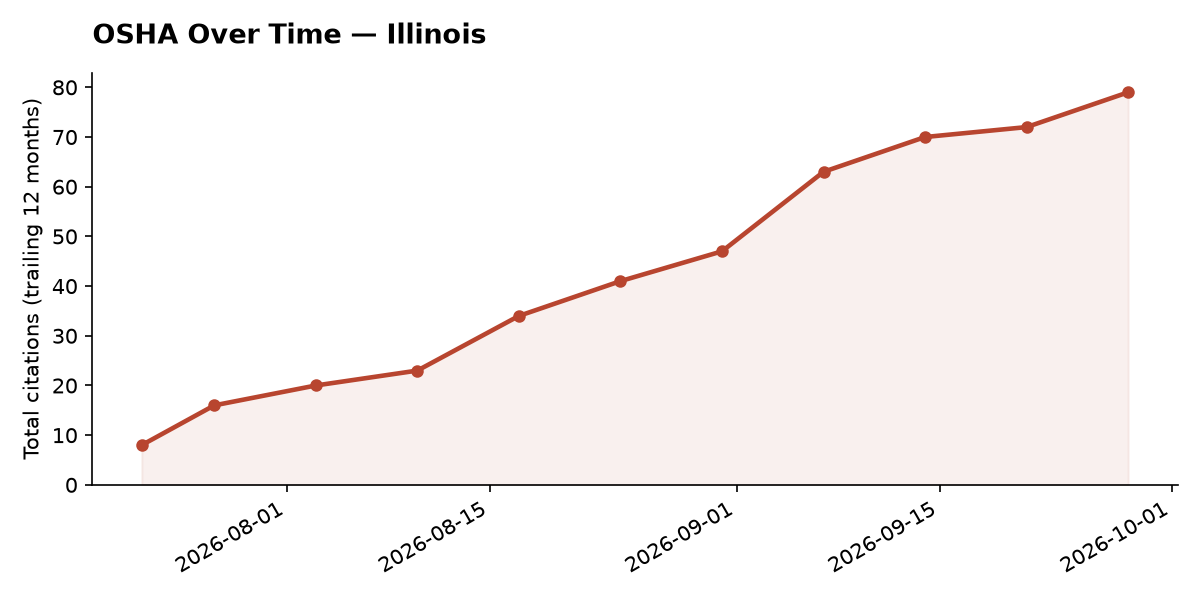
Seventy-nine ladder citations landed on Illinois employers in the past 12 months, averaging $2,860 per citation with a median of $2,270. Sixty-eight of those were classified Serious, and ten came back as Repeat violations — a category that tells OSHA inspectors an employer has been down this road before and pushes penalties well past the average. Chicago logged more of these citations than any other city in the state.
If you are staring down a citation right now, the clock matters more than the paperwork. Talk to an Illinois OSHA defense attorney before you decide how to respond.
What Inspectors Are Actually Checking Under 1926.1053
Nearly every one of these 79 cases traces back to a single rule: 1926.1053, the ladder standard that governs general use on construction sites. It is not complicated on paper — ladders need to extend far enough past a landing to be climbed safely, they cannot be loaded beyond their rated capacity, damaged units have to be pulled from service immediately, and workers need to be using them the way they were designed to be used, not as makeshift scaffolding or a shortcut past guardrails. In practice, this is where a lot of daily jobsite habits collide with the written rule. A ladder that’s a foot short of the roofline, a rung that’s been cracked and taped rather than replaced, a crew member leaning off the side rail instead of repositioning the ladder — any of these can trigger a citation. You can read the full breakdown of the 1926.1053 standard to see exactly where the line sits.
Roofers Account for Most of the State’s Citations
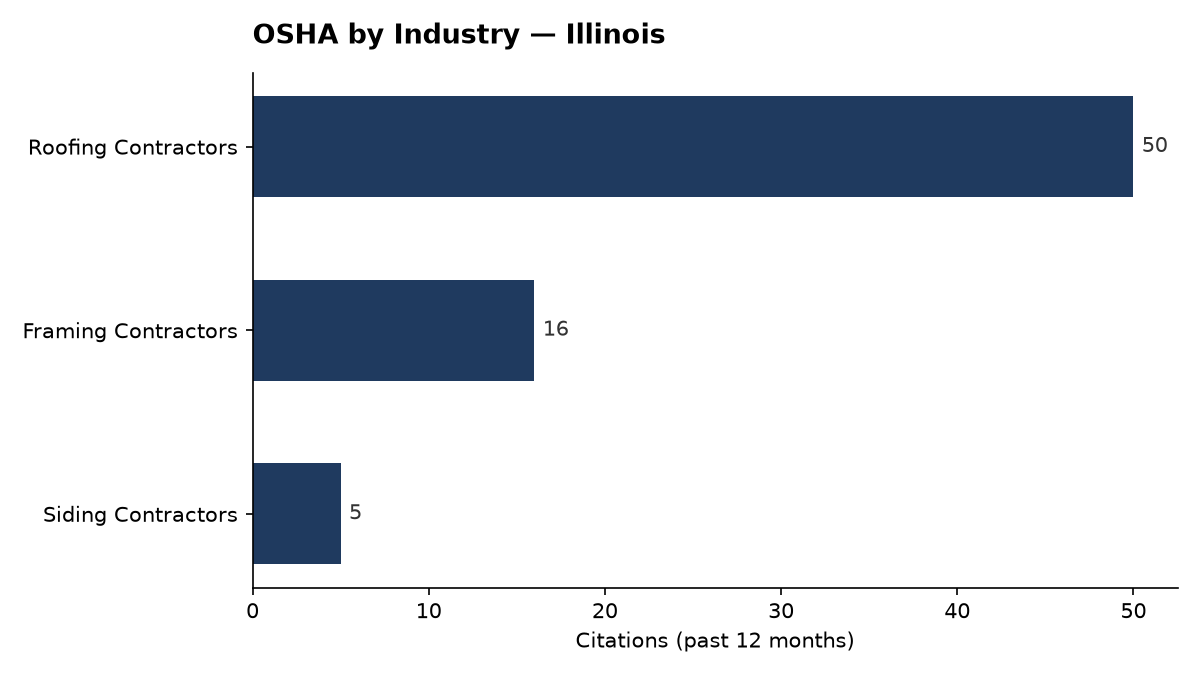
Of the 79 citations, 50 went to roofing contractors — more than 60 percent of the total. Framing contractors picked up 16, and siding contractors accounted for 5. That concentration isn’t random. Roofing work puts ladders in near-constant use for access to steep, elevated surfaces, often on tight schedules where crews are moving equipment up and down multiple times a day. That repetition is exactly where shortcuts creep in, and it’s exactly what OSHA inspectors are trained to look for when they show up on a residential or light commercial roofing site. If you run a roofing operation in Illinois, it’s worth understanding how roofing contractors get cited for these exact issues before your crew gives an inspector a reason to look twice.
Several recent cases show how this plays out. Alejandro Sanchez Espinoza, doing business as Espinoza Roofing in Warrenville, was cited $8,513 under 19261053 B01 in a Repeat classification, issued June 12, 2026. L&C Construction Corporation, operating as Wild Stone Corp. in Hampshire, faced a $21,281 penalty — also Repeat, also under 19261053 B01 — issued the same day. These aren’t isolated dollar figures; they reflect what happens when an inspector finds a violation type the employer has been cited for before.
What a Citation Like This Actually Costs
The average penalty across all 79 Illinois ladder citations sits at $2,860, but that average hides a wide range. Millennium Contracting Co. in Glencoe was cited $11,000 for a Repeat violation under 19261053 B01, issued December 12, 2025. Carlos Diaz, cited in Normal, and Juan P Villanueva Sagrero — doing business as JPV Carpentry, Inc. in Edwards — each faced $8,513 penalties, both Repeat classifications, issued November 21, 2025 and April 29, 2026 respectively. Repeat citations consistently run several times higher than a first-time Serious finding, which is exactly why that classification matters so much once an inspector writes it down.
Here’s the number that matters most if you’re deciding whether to fight a citation: penalties in Illinois have been reduced by an average of 26 percent between the initial citation and final resolution. That reduction doesn’t happen by accident — it happens through negotiation, documentation, and in some cases formal contest, usually with legal representation involved. You can see how these numbers are calculated on the OSHA ladder violations penalty page, but the short version is that the initial number on your citation is rarely the final number, especially if you respond correctly and quickly.
A 26 percent reduction on a $21,281 penalty is real money. Before you pay a citation at face value, it’s worth a conversation with an Illinois OSHA defense attorney to see what’s actually negotiable in your case.
The 15-Day Window You Cannot Afford to Miss
Once you receive a citation, OSHA gives you exactly 15 working days to file a Notice of Contest. Miss that window and the citation becomes a final order — the penalty, the classification, and any abatement requirements are locked in, with no further right to challenge them through the normal process. There is no grace period and no informal extension once the deadline passes.
This is why waiting to see what happens is usually the worst option. Fifteen working days sounds like a reasonable amount of time until you factor in gathering documentation, reviewing the specific subsection cited (B01 and B13 show up repeatedly in the Illinois cases above), and deciding whether an informal conference with OSHA or a formal contest makes more sense for your situation. Both routes exist, and the right one depends on the facts of your citation — something worth working through with someone who has handled these before. The full process is laid out on the how to contest an OSHA citation page.
With Repeat citations averaging well above the state median and a 26 percent gap between initial and final penalties on the table, the 15-working-day deadline is not a formality — it’s the difference between negotiating and simply paying. If you’ve received a citation, get an Illinois OSHA defense attorney looking at it today, before that window closes.
Pull your citation paperwork, check the issue date, and count backward from the 15-working-day deadline right now — that single number determines whether you still have options or whether the citation is about to become final.