
Data last updated: September 28, 2026
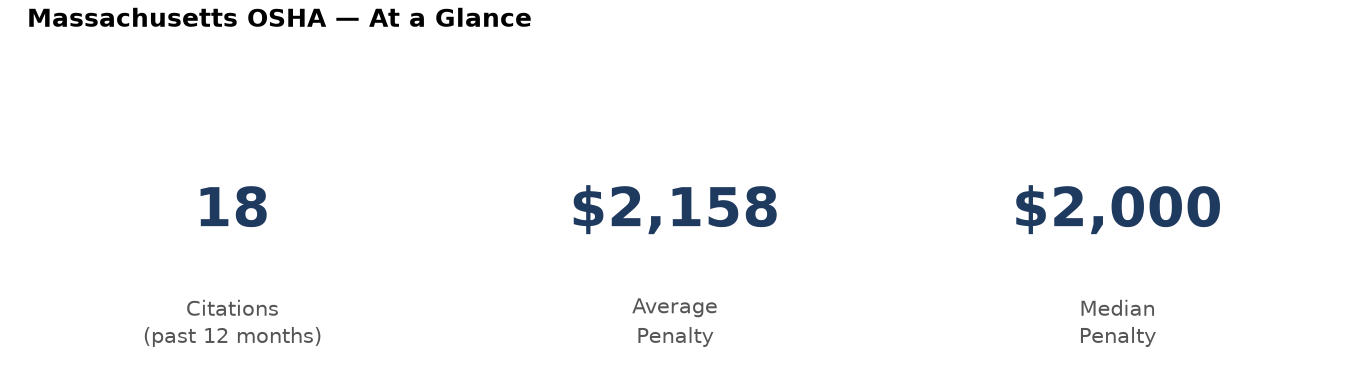
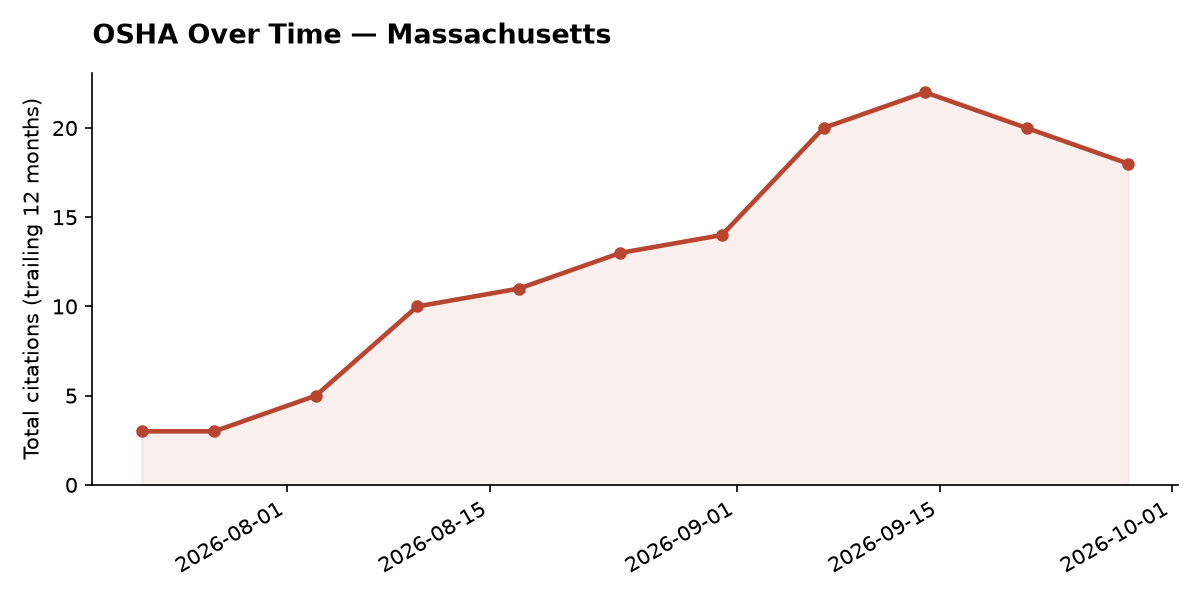
Massachusetts contractors racked up 18 ladder violations under 1926.1053 in the past 12 months, with penalties averaging $2,158 and a median of $2,000. That might sound like a small number compared to bigger construction states, but the citation pattern tells a clear story: Melrose has quietly become the epicenter of ladder enforcement in the state, and siding, roofing, and framing crews are the ones getting caught.
If you just opened an envelope with an OSHA citation inside, the clock is already running. Talk to a Massachusetts OSHA defense attorney before you decide how to respond — the filing window closes fast, and the wrong first move can lock in a penalty you might otherwise have reduced.
What the Ladder Standard Actually Demands on a Jobsite
The rule behind every one of these 18 citations, 1926.1053, isn’t just about owning a ladder that meets specs. It governs how the ladder is set up on-site — the angle, the extension past the landing point, whether it’s rated for the load it’s actually carrying, and whether it shows damage that should have taken it out of service that day. Inspectors don’t need to see an accident happen. They just need to see a ladder in use that violates one of these setup or condition rules, and that’s enough to write it up.
In practice, this means the citation often has nothing to do with the ladder’s manufacturing quality and everything to do with how a crew used it that morning — not extending it far enough above a roof edge, propping it at the wrong angle against siding, or continuing to use it after a rung cracked. Those are judgment calls made in the field, which is exactly why so many of these citations end up getting negotiated down once a closer look happens.
Siding, Roofing, and Framing Crews Are Carrying the Load
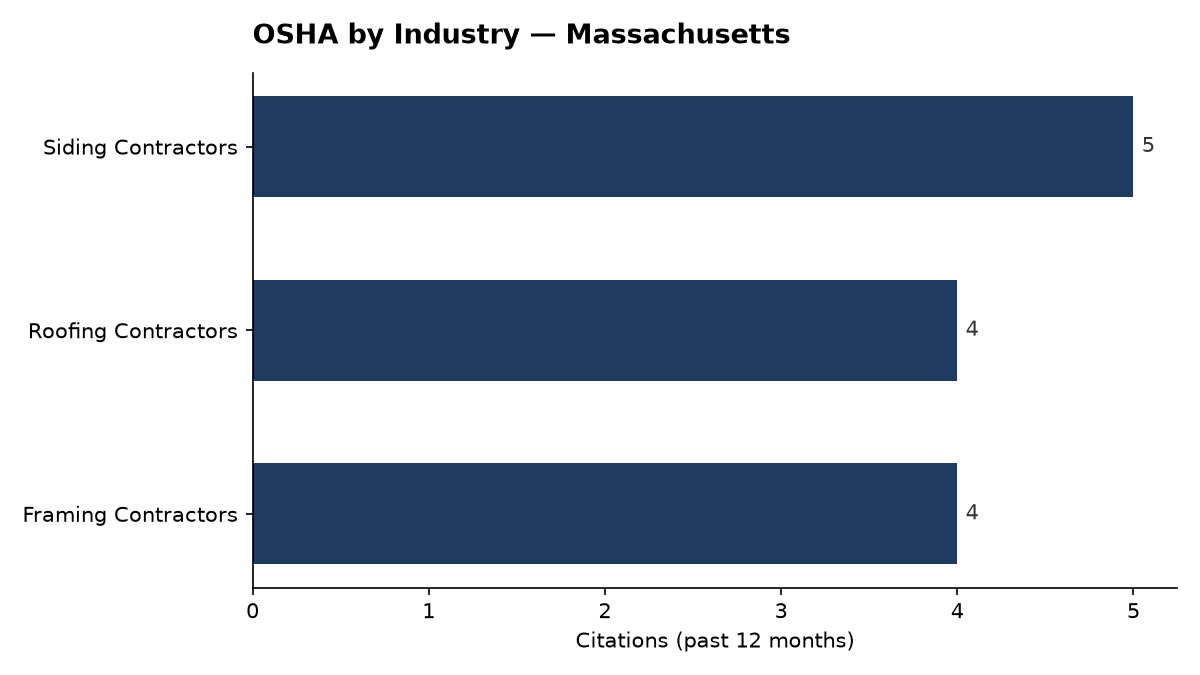
Three trades account for the overwhelming majority of Massachusetts ladder citations this period: siding contractors with 5 citations, roofing contractors with 4, and framing contractors with 4. Together that’s 13 of the 18 citations statewide, concentrated in exterior work where ladders are the primary way crews reach elevated surfaces for hours at a stretch.
That pattern makes sense once you think about the work itself. Siding installation means constant repositioning up and down a wall line, often on uneven ground near foundations, with materials being carried up and down all day. Roofing and framing add height and edge exposure into the mix. All three trades involve exactly the conditions where a ladder gets extended too far, set at an angle that seemed fine yesterday, or pressed into service one job past when it should have been retired. Melrose, the city with the most citations in this data set, saw two of its largest penalties come from exactly this kind of exterior work.
What These Citations Actually Cost in Massachusetts
Of the 18 citations, 15 were classified as Serious and 3 as Other-than-Serious — meaning the overwhelming majority involved conditions OSHA determined could realistically cause death or serious physical harm, not paperwork technicalities. That classification matters because it drives the penalty math directly, and it’s the difference between a citation that gets treated as routine and one that follows a company through future inspections as part of its enforcement history.
The real examples on record show the range clearly. Lifetime Contractors, Inc. in Melrose was cited $7,000 for a Serious violation under 19261053 B01, issued June 3, 2026. Hwa Services LLC, also in Melrose, was cited $5,958 under the same subsection, issued June 1, 2026. D’Eva Construction, Inc. in Needham drew a $4,341 Serious citation under 19261053 B07 on July 30, 2026. Gmf Construction Corp in Andover and Real Minas Construction, Inc. in Merrimac each received $3,972 penalties, cited under B01 and B04 respectively. None of these are outliers dreamed up for effect — they’re the actual public record for this reporting period, and they show how far a single citation can run above the state average once the specifics of the violation push it into a higher penalty tier.
Here’s the number that should get your attention: the average penalty reduction between initial and final assessment in Massachusetts was 51 percent. Half the dollar value, on average, didn’t survive to the final bill. That gap usually comes from employers who pushed back — providing context, correcting the condition, or formally contesting the citation — rather than employers who simply paid what was first written on the notice. You can see how the math on OSHA ladder violations penalty amounts works across different violation classes before deciding your own next step.
A 51 percent average swing is not something to leave on the table without at least asking a professional whether your case qualifies. Get a Massachusetts OSHA defense attorney to review your citation before you pay it or let the response window lapse.
The 15-Day Window You Cannot Afford to Miss
Once a citation is issued, you have 15 working days to file a Notice of Contest. That’s a hard deadline, not a suggestion, and it’s measured in working days, not calendar days, which means it moves faster than most people expect. Miss it, and the citation and penalty become final — no negotiation, no appeal, no second look at the classification or the amount.
Given that the average reduction across these Massachusetts cases came in at 51 percent, that short window is exactly when the leverage exists to make a difference. Waiting past it to reconsider your options means waiting past the point where those options exist. If you’re weighing whether to fight a citation, accept it, or negotiate an informal settlement, the process for how to contest an OSHA citation lays out the mechanics, but the decision itself needs to happen fast.
Before that clock runs out, get someone in your corner who has handled these cases before. Speak with a Massachusetts OSHA defense attorney while you still have every option on the table.
If you’re a siding, roofing, or framing contractor operating in Melrose or anywhere else in Massachusetts, treat a ladder citation as a time-sensitive legal matter, not routine paperwork. Pull your citation, check the issue date against the 15-working-day deadline, and get a second set of eyes on it before you sign off on anything.