

Data last updated: September 28, 2026
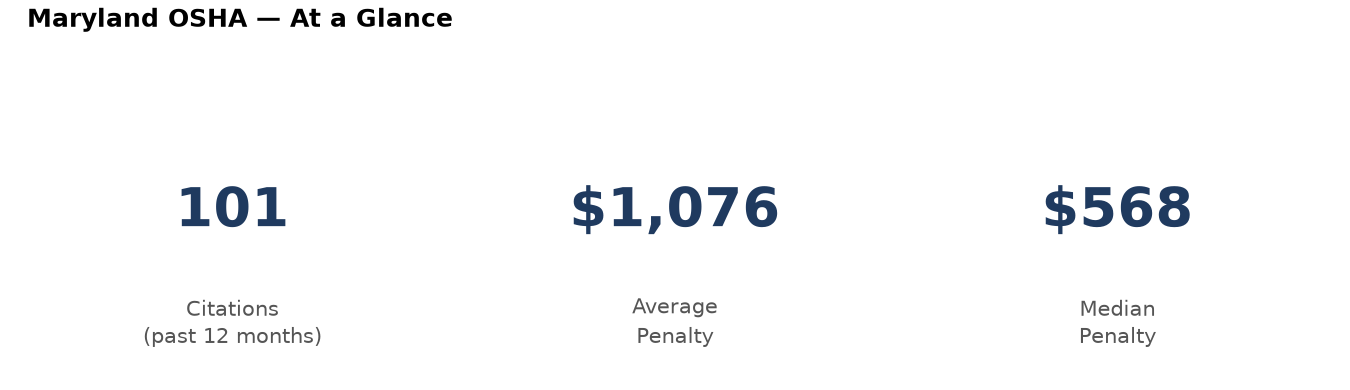
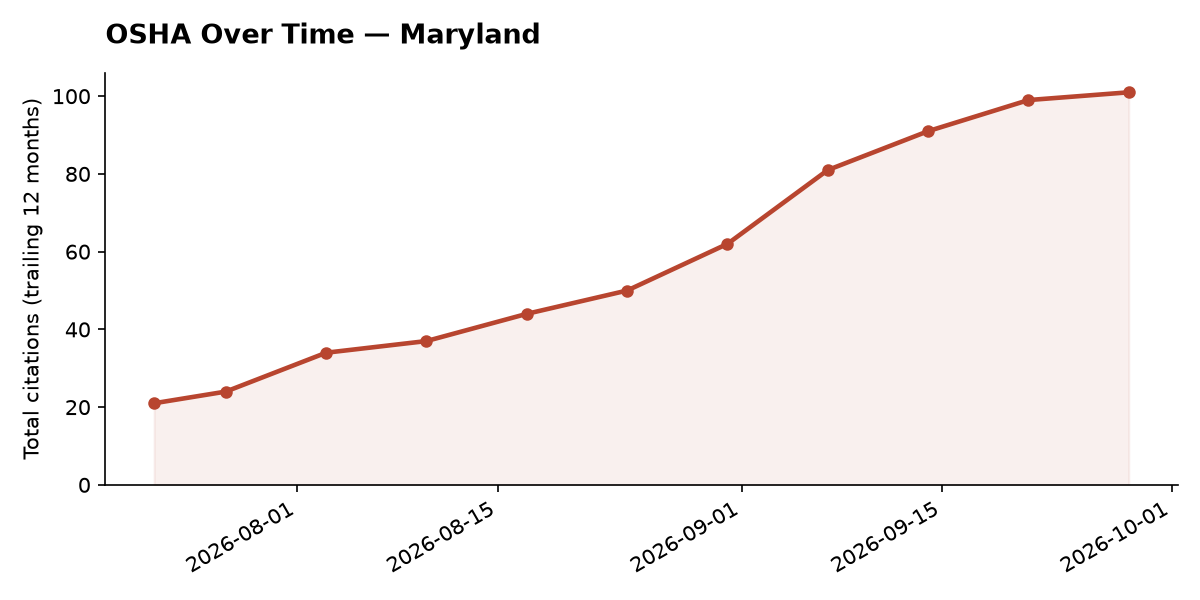
Over the past 12 months, OSHA logged 101 ladder violations across Maryland worksites, with an average penalty of $1,076 and a median of $568. Baltimore leads the state in citation count, and roofing contractors account for more than half of all the cases on the books. If you’re holding a citation right now, or you suspect one is coming, the numbers below tell you exactly what you’re up against.
If you’ve received a ladder citation in Maryland, don’t wait to see how it plays out. Talk to a Maryland OSHA defense attorney before your response window closes.
What the ladder standard actually demands on site
Nearly every citation in this dataset traces back to one rule: 1926.1053, OSHA’s general requirements for ladders on construction sites. This standard isn’t complicated in concept, but it’s easy to violate without meaning to. It covers how a ladder has to be set up, how far it needs to extend past a roof or floor landing, how much weight it’s rated to hold, what happens when a rung or rail is damaged, and how workers are expected to use it once it’s in place — things like not carrying loads that throw off balance, not standing on the top rung, and not using a ladder for something it wasn’t built for.
Inspectors check this stuff constantly because it’s visible from the ground. A ladder that doesn’t extend far enough past the eave, or one with a cracked side rail still in service, is an easy find during a walk-around. That’s a big reason ladder violations show up so often in enforcement data compared to more technical standards.
Why roofers and framers account for most of Maryland’s citations
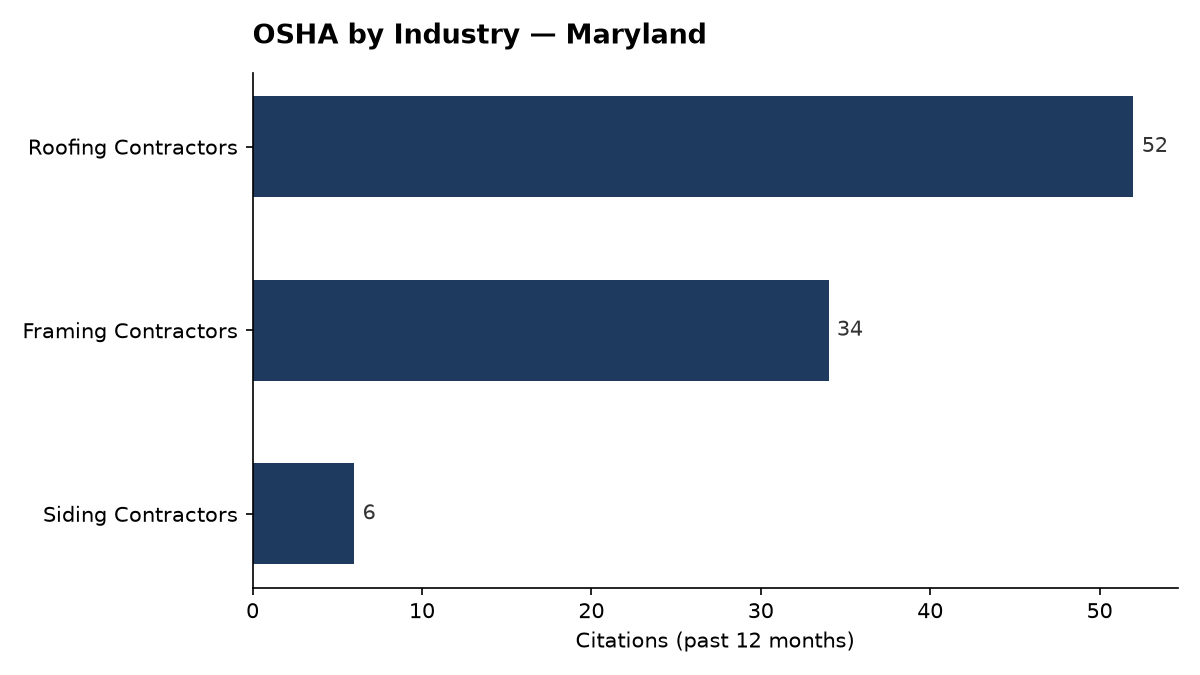
The industry breakdown here isn’t subtle. Roofing contractors picked up 52 of the state’s 101 ladder citations — more than half. Framing contractors follow with 34, and siding contractors add another 6. Together, these three trades account for the overwhelming majority of enforcement activity tied to this standard in Maryland.
That pattern makes sense once you think about the work. Roofing and framing crews are on and off ladders all day, often in tight timelines, often on residential jobs where a supervisor isn’t standing over every access point. Ladders left set up over a lunch break, moved by a different crew, or reused past their condition without a second inspection are exactly the kind of thing OSHA flags. If your business falls into one of these trades, assume your crews are working under more scrutiny than average, not less.
What a citation actually costs once it lands
The average penalty across Maryland’s 101 ladder cases is $1,076, but that number hides a wide spread. Of the 101 citations, 54 were classified as Serious, 27 as Other-than-Serious, 18 as Repeat, and 2 as Willful. That last category matters most — Willful citations carry penalties in a different league entirely, and Maryland’s own records prove it.
Noe Membreno Melendez, a contractor in Denton, was cited $17,500 for a Willful violation under subsection B01, issued May 11, 2026. Elder Josue Perez Ortega, in Queen Anne, faced a $14,000 Willful citation under subsection B12, issued March 11, 2026. On the Repeat side, Mmg Construction LLC in Centreville was penalized $4,900 under B01 in October 2025, German Franco Construction, LLC in Easton was fined $4,200 under B01 in November 2025, and Ac_Are Construction Services LLC in Frederick received a $3,000 Repeat citation, also under B01, later that same month.
Notice how much higher the Willful figures are compared to the Repeat ones, and how much higher those are compared to the state median of $568. The classification OSHA assigns to your case drives the number almost as much as the underlying facts do. It’s also worth knowing that Maryland’s average penalty reduction between initial and final assessment sits at 12% — meaning a meaningful share of employers who push back, negotiate, or contest end up paying less than the number on the first notice. See the full breakdown of how these figures are calculated on our OSHA ladder violations penalty amounts page.
A $17,500 Willful penalty or an $4,900 Repeat citation isn’t something to absorb quietly. Before you decide how to respond, get a Maryland OSHA defense attorney to look at your specific paperwork.
The clock that starts the moment the citation arrives
Once OSHA issues a citation, you have exactly 15 working days to file a Notice of Contest. Miss that window and the citation, along with whatever penalty is attached, becomes a final order — no appeal, no negotiation, no second look. That 15-day period includes weekends only in the sense that they don’t count toward it; it’s business days only, and it moves fast once the clock starts.
Given that 12% average reduction between initial and final penalties, and given how differently Willful, Repeat, and Serious classifications get treated, this is not a deadline to sit on while you figure out your next move. Our guide on how to contest an OSHA citation walks through the mechanics, but the short version is: the earlier you get a professional involved, the more options you actually have — including whether the classification itself (Serious versus Repeat versus Willful) can be challenged before it locks in.
If a citation is sitting on your desk right now, check the issuance date before you do anything else, then count forward. Whatever time is left, use it to get a qualified opinion on your case rather than guessing at how much this is going to cost or whether it’s worth fighting. Talk to a Maryland OSHA defense attorney while your Notice of Contest window is still open — once it closes, your leverage closes with it.