

Data last updated: September 28, 2026
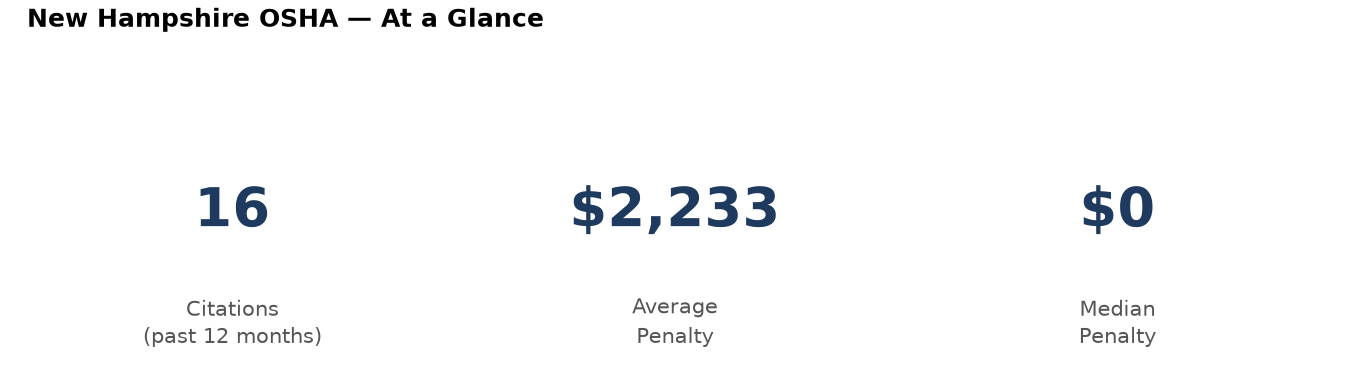
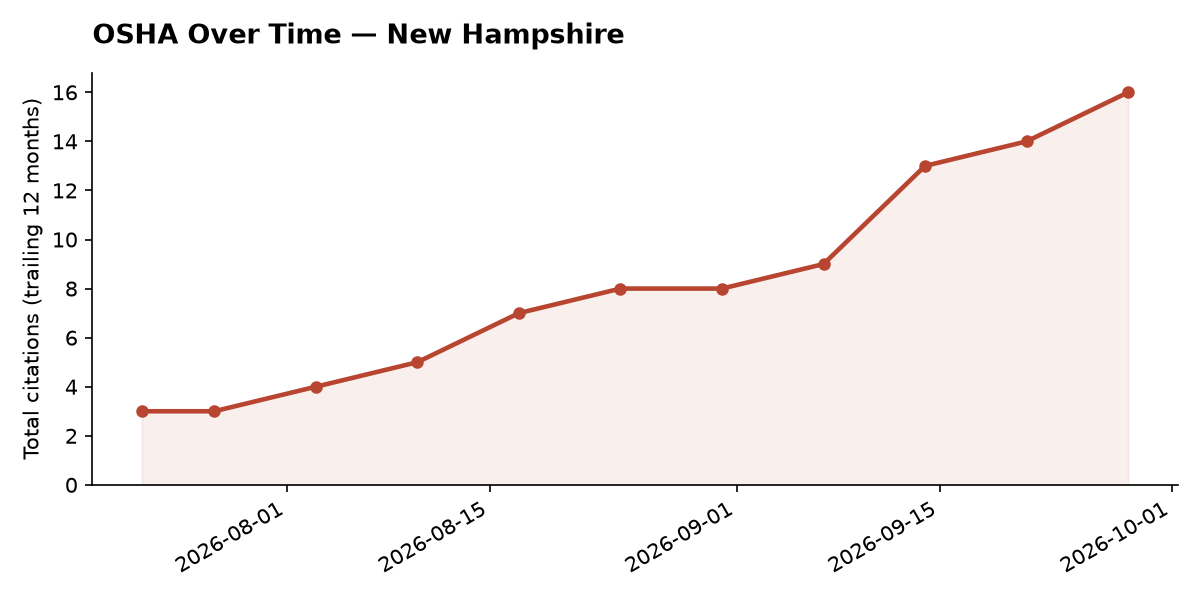
Over the past 12 months, OSHA issued 16 ladder-related citations to employers in New Hampshire under standard 1926.1053. That is not a huge number compared to bigger construction states, but the average penalty of $2,233 tells you these are not paperwork slaps. Two of the 16 citations were classified as Repeat violations, which OSHA punishes far harder than a first-time Serious finding, and the actual dollar figures on individual cases in this state have run as high as $9,931.
If you have already received a citation, the clock is louder than the number. You get 15 working days from the date on the citation to file a Notice of Contest before it becomes a final order you cannot fight. Talking to a New Hampshire OSHA defense attorney now, while that window is still open, is the difference between negotiating and simply paying.
What OSHA’s Ladder Rule Actually Requires On Site
Every one of these New Hampshire citations traces back to the same rule, the 1926.1053 standard, which governs general ladder use on construction sites. It is not a single narrow requirement. It covers how far an extension ladder has to reach past a landing surface, how much weight a ladder is rated to hold versus what is actually being loaded onto it, the condition of the equipment itself (cracked rails, missing feet, makeshift repairs), and how workers are expected to climb, position themselves, and maintain three points of contact. Inspectors do not need to catch a fall in progress. A ladder set up wrong, or a damaged one still in rotation, is enough to write the citation on the spot.
In New Hampshire, four of the five documented cases this period cite the same subsection, B01, which deals with setup and condition issues rather than a training gap. That pattern suggests inspectors are finding problems they can see immediately when they walk a job site: an unsecured ladder, an overloaded one, or one that should have been pulled from service already.
Roofers Are Drawing Most Of The Scrutiny
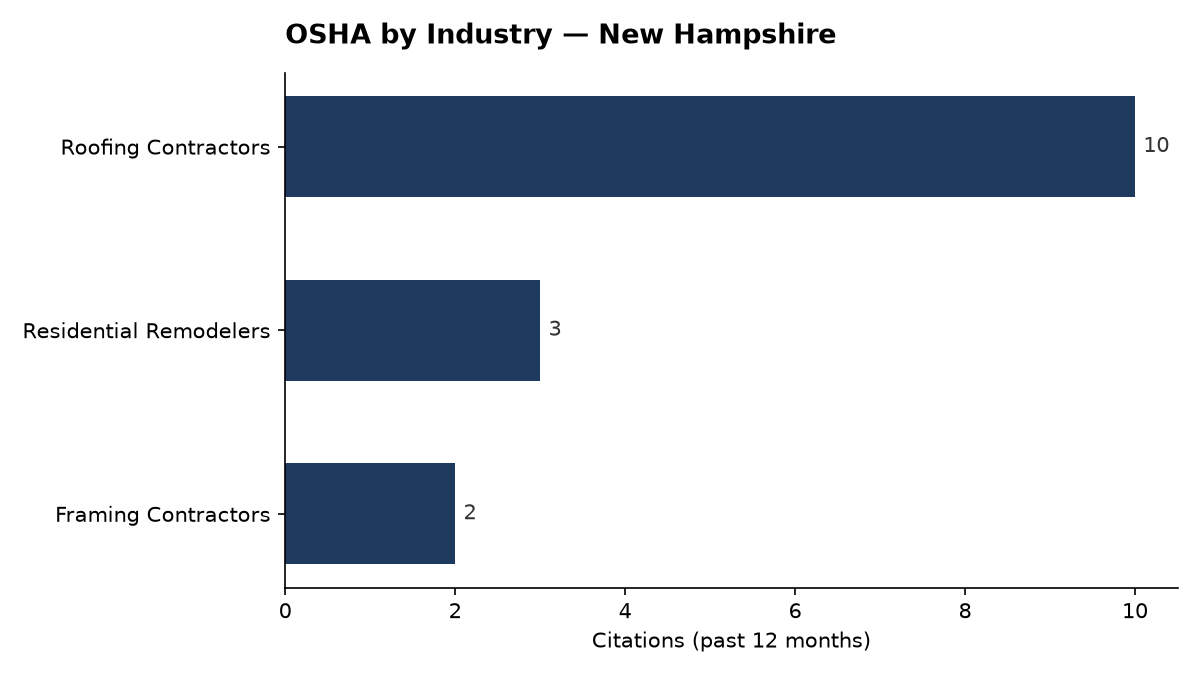
Ten of the state’s 16 ladder citations, well over half, went to roofing contractors. Residential remodelers picked up three, and framing contractors accounted for two more. That lopsided split is not a coincidence. Roofing work puts crews on ladders constantly, for setup, material staging, and repeated trips up and down throughout the day, and it happens on some of the most visible, easiest-to-inspect job sites OSHA compliance officers drive past. A ladder leaning against a house at a bad angle, or extending only a foot past the eave line, is visible from the street.
Litchfield came up as the city with the most citations in this reporting period, but the named cases span the state, from Derry and Nashua to Laconia, Kingston, and Farmington. That geographic spread tells you this is not a local enforcement sweep in one town. It is a statewide pattern tied to the nature of roofing and remodeling work itself.
What These Citations Actually Cost In New Hampshire
The math here is worth sitting with. Average penalty across all 16 New Hampshire ladder citations was $2,233, but the median was $0, meaning a meaningful chunk of cases settled for little or nothing once contested or negotiated. That gap between average and median is the clearest evidence that fighting or negotiating a citation changes outcomes. Statewide data shows an average penalty reduction of 34% between the initial proposed fine and the final settled amount.
The real cases on record show how wide the spread can get. Olam Builders Inc in Derry was cited $9,931 for a Serious violation issued June 5, 2026. Best Pro Smg Construction Corp. in Laconia drew a $9,930 penalty for a Repeat violation issued January 30, 2026, a category that costs far more precisely because it signals OSHA already flagged the same problem before. Ortega General Construction Corp in Nashua was hit with $5,959 for a Repeat citation issued June 23, 2026. Kr Pro Construction Inc in Kingston faced $3,547 for a Serious violation issued May 11, 2026, and Jonathan Sarmeto in Farmington was cited $2,838, also Serious, issued the same day as the Olam Builders case. Every one of these falls under the same B01 subsection of 1926.1053. For a full breakdown of how OSHA calculates these figures and what pushes a fine up or down, see OSHA ladder violations penalty amounts.
Given that 34% average reduction, the question is not whether it is worth pushing back. It is whether you are equipped to do it without help. Before you write a check or accept the first number OSHA proposes, talk to a New Hampshire OSHA defense attorney about what a comparable case actually settled for.
Your 15-Day Window Starts The Moment The Citation Arrives
Once a citation lands, the 15-working-day clock to file a Notice of Contest starts immediately, not when you get around to dealing with it. Miss that window and the citation, and the penalty attached to it, becomes final. There is no appeal after that point, no matter how strong your defense might have been. The process for challenging a citation is detailed at how to contest an OSHA citation, but the short version is that you need to act inside those 15 days, gather your documentation on ladder inspection and maintenance records, and decide quickly whether you are contesting the classification, the penalty amount, or both.
Repeat classifications in particular are worth challenging early. A citation labeled Repeat, like the Laconia and Nashua cases above, assumes OSHA already cited a substantially similar violation at that employer within the past five years. If that link is weak, contesting the classification alone can knock a case back down to Serious and cut the penalty significantly.
Do not let a citation you disagree with, or cannot afford at face value, sit on your desk while the clock runs. Get a New Hampshire OSHA defense attorney looking at your paperwork this week, not after the 15 working days have already passed.