
Data last updated: September 14, 2026
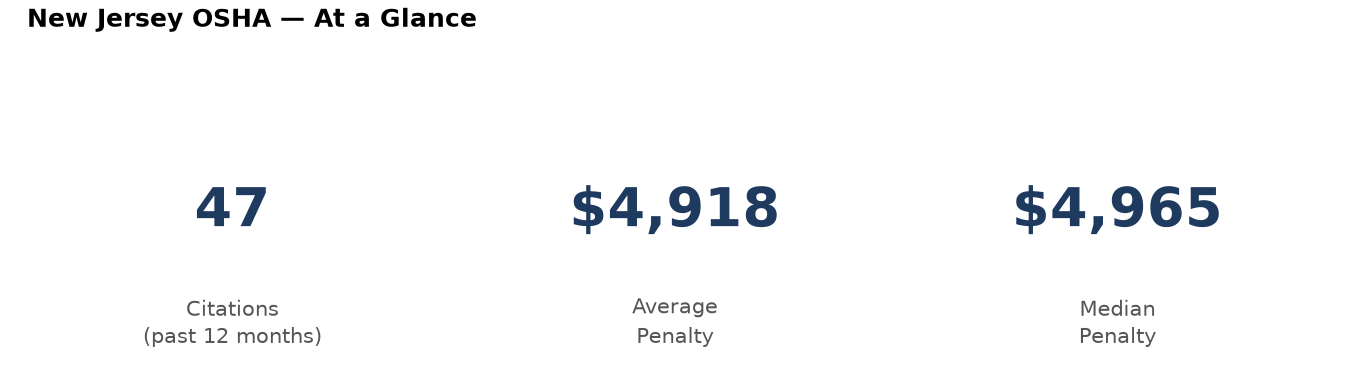
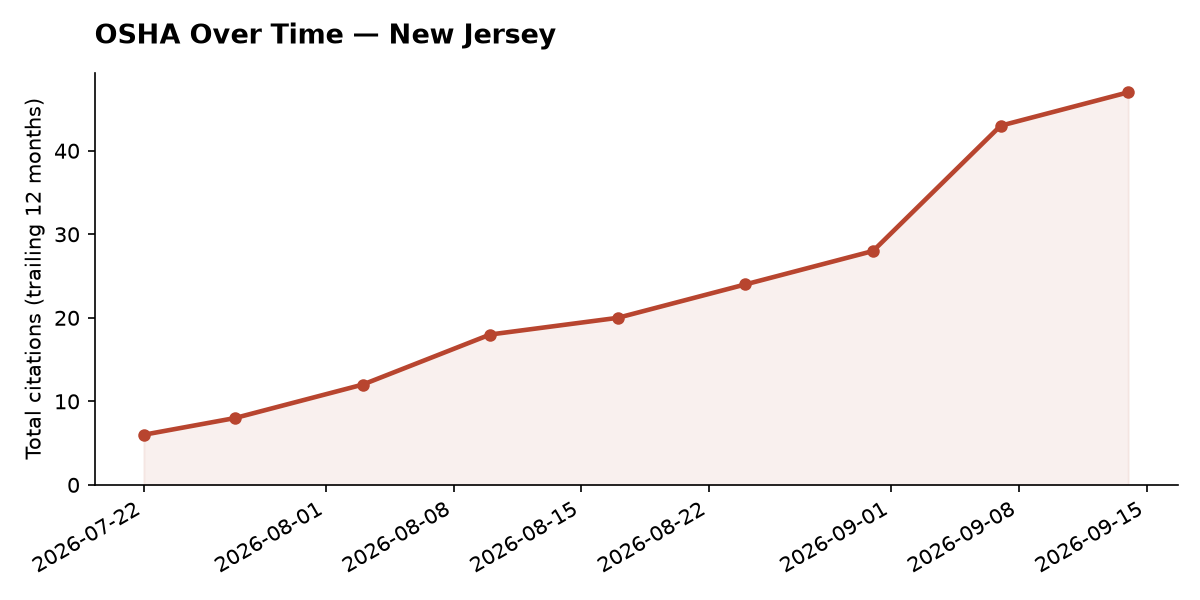
Forty-seven ladder violations were issued to New Jersey employers over the past 12 months, every single one of them classified as Serious. The average penalty landed at $4,918, with a median of $4,965 — meaning half of the cited companies paid more than that. Newark logged more of these citations than any other city in the state.
If you are staring down a citation like this right now, the clock is already running. You have a limited window to respond, and how you respond changes what you end up paying.
Before anything else, talk to a New Jersey OSHA defense attorney about your specific citation. A short consultation now can save you thousands and protect your ability to fight back later.
What OSHA Actually Expects Under the Ladder Standard
Every one of these 47 New Jersey citations was written under 1926.1053, OSHA’s general ladder standard for construction work. This rule is not just about owning ladders — it governs how they get set up, how far they must extend past a landing point, how much weight they’re rated to hold, whether damaged units stay in service, and how workers are expected to use them on an active job site.
In practice, inspectors are looking for things like a ladder that doesn’t reach far enough above the roof edge, a side rail that’s cracked or repaired with tape, or crews climbing a ladder rated for lighter loads than what they’re actually carrying up. You can review the full scope of the 1926.1053 standard to see exactly where the line is drawn between compliant and non-compliant setups.
Roofing and Framing Crews Are Drawing Most of the Attention
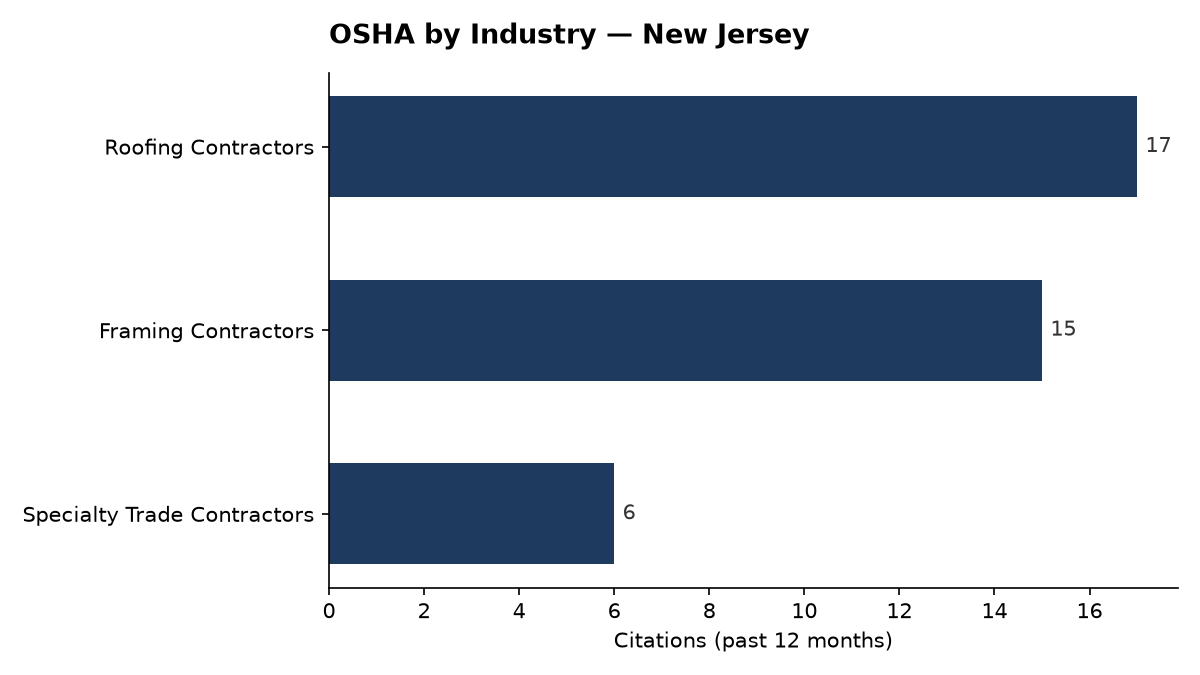
The industry breakdown in New Jersey is not subtle. Roofing contractors accounted for 17 of the 47 citations — by far the largest share — followed by framing contractors at 15. Specialty trade contractors picked up another 6. Together, roofing and framing alone make up more than two-thirds of all ladder citations issued in the state this past year.
That pattern lines up with the nature of the work. Roofers and framers spend more hours on ladders, at greater heights, moving between landings and elevated surfaces, than almost any other trade on a job site. It’s also why roofing contractors show up so consistently in OSHA’s enforcement data across the country, not just here. If you run a roofing or framing crew in New Jersey, this is the exact violation type inspectors are primed to look for when they show up.
What a Citation Like This Actually Costs You
The numbers tell a fairly consistent story once you look at real cases. J.S Aldo’S Construction Co, Inc., based in Maywood, was cited $16,550 under 1926.1053(b)(5)(i), issued October 16, 2025 — well above the state average, and a reminder that penalties escalate quickly depending on the specific violation cited.
Several other companies landed closer to the median: Rs Moreno Construction, LLC in Hamilton was cited $5,958 under 1926.1053(b)(1) on September 16, 2025. Jrn Carpentry, Inc. in Whippany received the same $5,958 penalty under 1926.1053(b)(13), dated April 10, 2026. El Primo Construction, LLC in Hopewell and New Contractor 1 Corporation, also in Hopewell, each faced identical $5,958 penalties under 1926.1053(b)(1), issued May 5, 2026 and March 18, 2026 respectively.
Notice how consistent that $5,958 figure is across unrelated companies — that’s not a coincidence, it reflects how OSHA calculates base penalties for this violation type before any adjustments. What is worth paying attention to: the average penalty reduction in New Jersey over this period was only 8%. That’s a modest gap between what gets initially proposed and what actually gets finalized, which tells you that most employers are not negotiating these down much on their own. Understanding how OSHA ladder violation penalty amounts are calculated helps explain why an 8% reduction is typical without professional pushback — and why it can potentially be larger with the right representation.
An 8% average reduction means most companies are leaving money on the table simply by not contesting effectively. Before you accept a proposed penalty as final, get a New Jersey OSHA defense attorney to review the citation and tell you whether that number is actually negotiable in your case.
Your Window to Respond Is Short — Don’t Let It Close
Once a citation is issued, you have exactly 15 working days to file a Notice of Contest. Miss that deadline and the citation — and the penalty attached to it — becomes final, with almost no room left to argue classification, dispute the facts, or negotiate the amount. There is no grace period and no automatic extension.
This matters even more given that every single one of the 47 New Jersey citations in this data set was classified as Serious rather than Other. A Serious classification already carries real financial weight, and if any element of the citation gets read more aggressively — for instance if a Repeat or Willful tag gets attached later based on your inspection history — the exposure jumps sharply higher. Knowing how to contest an OSHA citation before that 15-day window closes is the single most consequential decision most employers face after receiving one of these notices.
If you’ve received a citation in the mail, don’t sit on it while you weigh your options — the days are already ticking. Reach out to a New Jersey OSHA defense attorney now so someone experienced with these exact 1926.1053 cases is reviewing your paperwork before that deadline passes.
Pull your citation letter, check the issuance date against today, and count your remaining working days before you decide anything else — that number is the only deadline that matters right now.