Data last updated: September 21, 2026
New York’s Ladder Citation Numbers: 49 Cases, Most of Them Serious
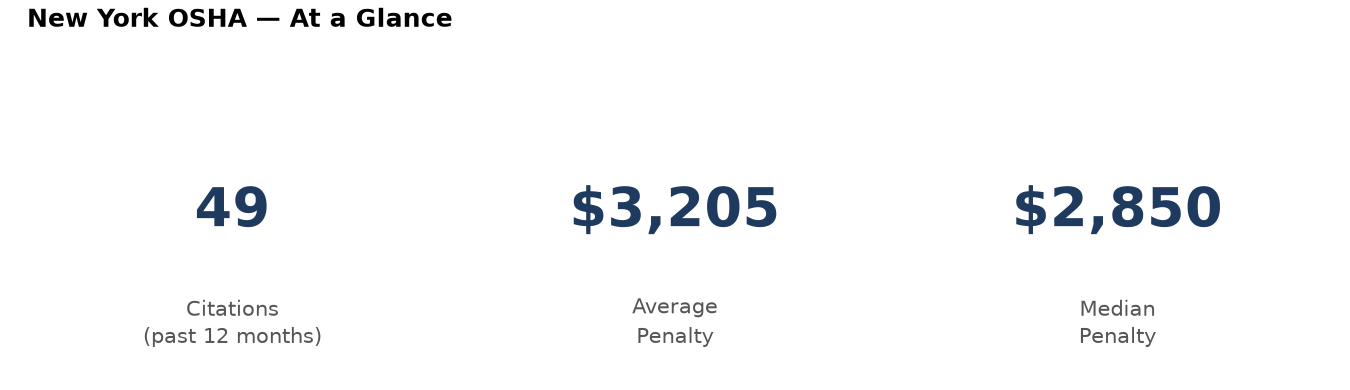
Over the past 12 months, OSHA issued 49 ladder violations to New York employers under standard 1926.1053, with an average penalty of $3,205 and a median of $2,850. Syracuse recorded more of these citations than any other city in the state. Of the 49 cases, 42 were classified as Serious and 4 as Repeat — a category that carries steeper fines because it signals OSHA found the same problem at the same employer before.
If you or your company just received one of these citations, the clock is already running. Before you decide how to respond, it helps to talk to a New York OSHA defense attorney who handles ladder cases specifically and knows how New York-area OSHA offices tend to negotiate.
What 1926.1053 Actually Requires on a New York Jobsite
The standard behind every one of these 49 citations, 1926.1053, sets the baseline rules for ladder use in construction. It covers how a ladder needs to be set up and secured, how far it must extend past a landing point when workers are stepping on or off, how much weight it has to safely hold, and when a damaged or modified ladder has to be pulled from service entirely. It also gets into everyday use questions — facing the ladder, keeping three points of contact, not standing on the top rungs — the kind of thing that looks minor until someone falls. You can see the full breakdown of what falls under this rule on the 1926.1053 standard hub, which is worth reading before you respond to any citation paperwork.
Most citations here trace back to a handful of recurring problems: extension ladders that were not tied off or footed properly, ladders used past a landing surface without the required extension, and equipment that had visible damage but stayed in rotation anyway. None of these are exotic violations — they are the kind of shortcuts that happen on almost every roof and every framing job at some point, which is exactly why enforcement stays steady.
Why New York’s Roofing Contractors Carry the Bulk of These Citations
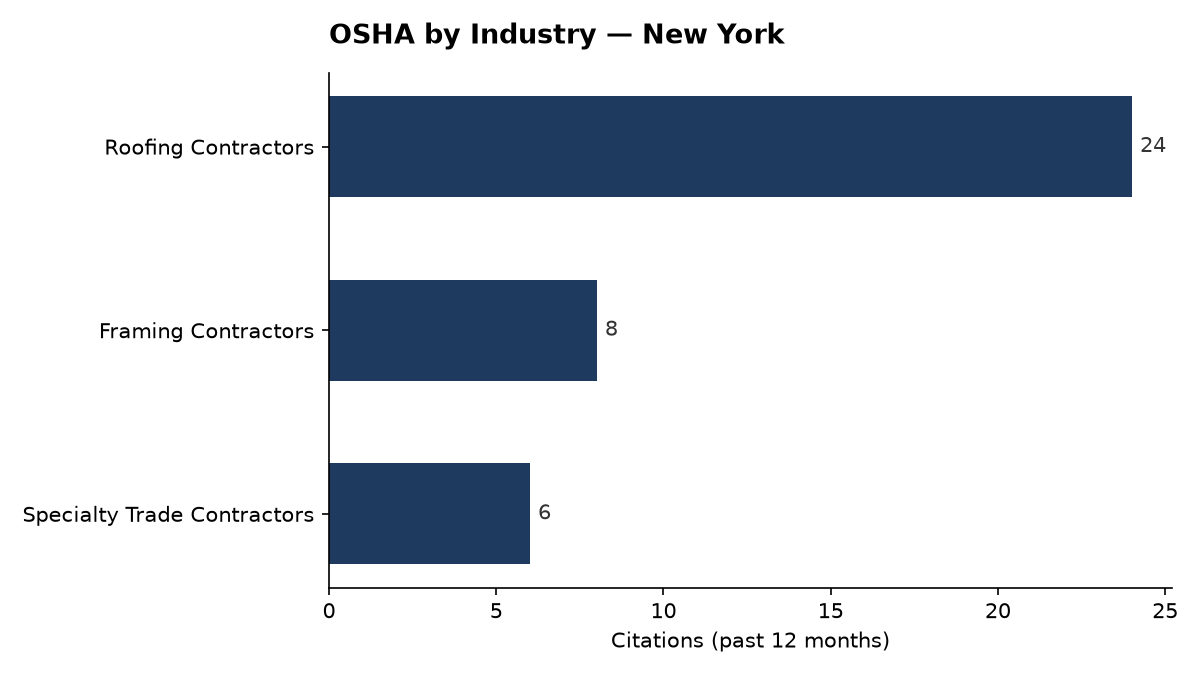
Roofing contractors accounted for 24 of the state’s 49 ladder citations — nearly half. That is not a coincidence. Roofing work depends on ladders for almost every access point, workers move up and down them constantly through a shift, and setup often happens fast on uneven ground or against a fascia edge that was not designed for it. Framing contractors came in second with 8 citations, followed by specialty trade contractors with 6. If you run a roofing company anywhere in New York, it is worth reviewing the patterns on the roofing contractors ladder violations page, since the same setup mistakes show up citation after citation across the state.
The named cases from the past year make the pattern concrete. Melo Roofing, Inc. in Syracuse was cited $21,281 for a Repeat violation under 19261053 B01, issued December 5, 2025. Segelman Shaw Roofing, Siding & Gutters in Scarsdale drew an $11,916 Repeat citation, also under 19261053 B01, on February 4, 2026. Ep Construction LLC in Yorktown Heights was hit with an $8,435 Serious citation under the same subsection on November 28, 2025. Jimy Contracting, LLC in Scarsdale received a $4,257 Repeat citation under 19261053 B13 on January 23, 2026, and Yongxin Interior Contractor Inc. in Howard Beach was cited $4,256 under 19261053 B22, classified Serious, on January 15, 2026. These are public OSHA records, and they show how quickly a Repeat classification pushes a penalty well above the state average.
What a Ladder Citation Actually Costs in New York
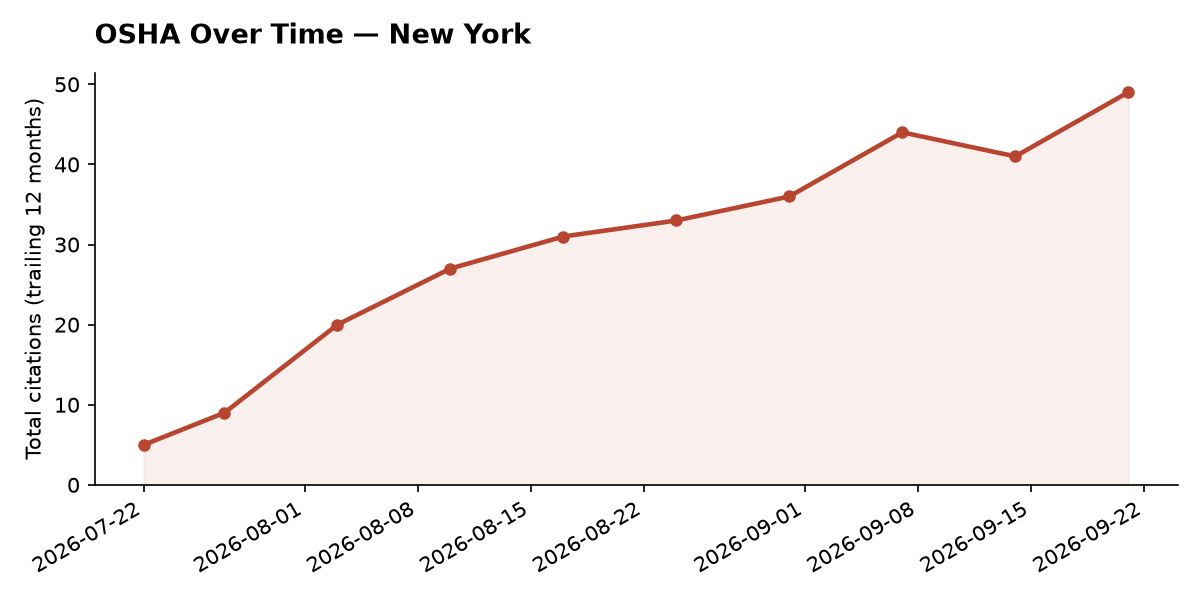
The average penalty across all 49 New York cases is $3,205, but that number hides a wide range. Serious citations, the largest group at 42 cases, tend to land closer to the median of $2,850. Repeat citations — only 4 of the 49, but disproportionately expensive — pushed some penalties above $20,000, as the Melo Roofing case shows. Even the 3 Other-than-Serious citations still carry real cost and paperwork burden, even though they represent the lowest-risk category.
One number matters more than most employers realize: penalties in this dataset were reduced by an average of 19% between the initial citation and the final resolved amount. That gap usually comes from informal conferences, negotiated settlements, or a formal contest — not from the citation simply going away. It is a strong argument for not just paying the initial number without a second look. You can compare how New York’s numbers stack up against national averages on the OSHA ladder violations penalty amounts page.
Given how much a Repeat classification can add to your bill, and how much room there often is to negotiate that number down, it makes sense to get a New York OSHA defense attorney involved before you sign anything or send a check.
The 15-Day Window You Cannot Afford to Miss
Whatever you decide to do about the underlying violation, there is a hard deadline attached to it: you have 15 working days from the date you receive the citation to file a Notice of Contest. Miss that window and the citation becomes a final order automatically — no matter how strong your case might have been, no matter whether the classification was fair. There is no extension built into the process for missing that date.
That short window is exactly why waiting to talk to someone is the riskiest move you can make. The process for contesting, including what a Notice of Contest needs to say and how it changes your negotiating position with OSHA, is laid out on the how-to-contest-an-OSHA-citation guide. Reading it will tell you what your options are, but it will not file the paperwork for you or negotiate the classification down.
If your citation lists a Repeat or Willful classification, or the dollar amount is anywhere near the $21,281 Melo Roofing paid, treat the 15-day clock as your top priority this week. Talk to a New York OSHA defense attorney now, while you still have time to contest the citation, negotiate the classification, or push for the kind of reduction that brought New York’s average penalty down 19% from its starting point.
Pull your citation paperwork, check the issuance date, and count your 15 working days before you do anything else. The earlier a lawyer sees your case, the more options you still have on the table.