
Data last updated: September 28, 2026
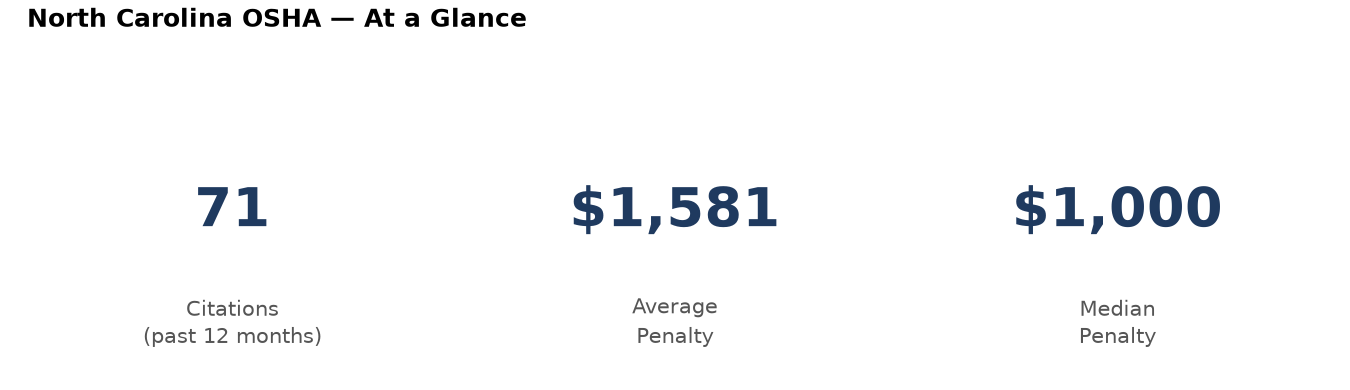
Over the past 12 months, OSHA issued 71 ladder-related citations to North Carolina employers under standard 1926.1053. The average penalty came in at $1,581, with a median of $1,000 — meaning half of all cited companies paid less than that, and half paid more. Winston Salem logged more of these citations than any other city in the state, but the exposure is not confined to one metro area. If you build houses, hang roofs, or install siding anywhere in North Carolina, this is one of the standards inspectors check first.
If you have already received a citation, the clock is running. You typically get only 15 working days from the date you receive it to file a Notice of Contest, and once that window closes, the penalty amount is generally locked in. Talking to a North Carolina OSHA defense attorney before that deadline passes is the single most useful thing you can do right now.
What Ladder Safety Actually Requires Under 1926.1053
Standard 1926.1053 is the rulebook OSHA uses to judge whether a ladder was set up and used the way it should have been on a construction site. It covers the basics that get skipped when a crew is moving fast: making sure a ladder extends far enough past the landing surface it’s leading to, keeping ladders rated for the load they’re actually carrying, pulling damaged units out of service instead of patching them up, and using the equipment the way it was designed to be used rather than improvising. You can read the full breakdown of how this standard gets applied in practice on the 1926.1053 standard hub.
Of the 71 North Carolina citations in this reporting period, 66 were classified as Serious — meaning OSHA determined there was a real chance of death or serious physical harm if the hazard played out. Three were Repeat citations, which carry steeper penalties because the employer had been cited for the same or a similar violation before. Two were Other-than-Serious. That mix matters: a Repeat classification alone can multiply the penalty several times over compared to a first-time Serious violation for the exact same physical hazard.
Framing Crews Are Drawing the Bulk of the Attention
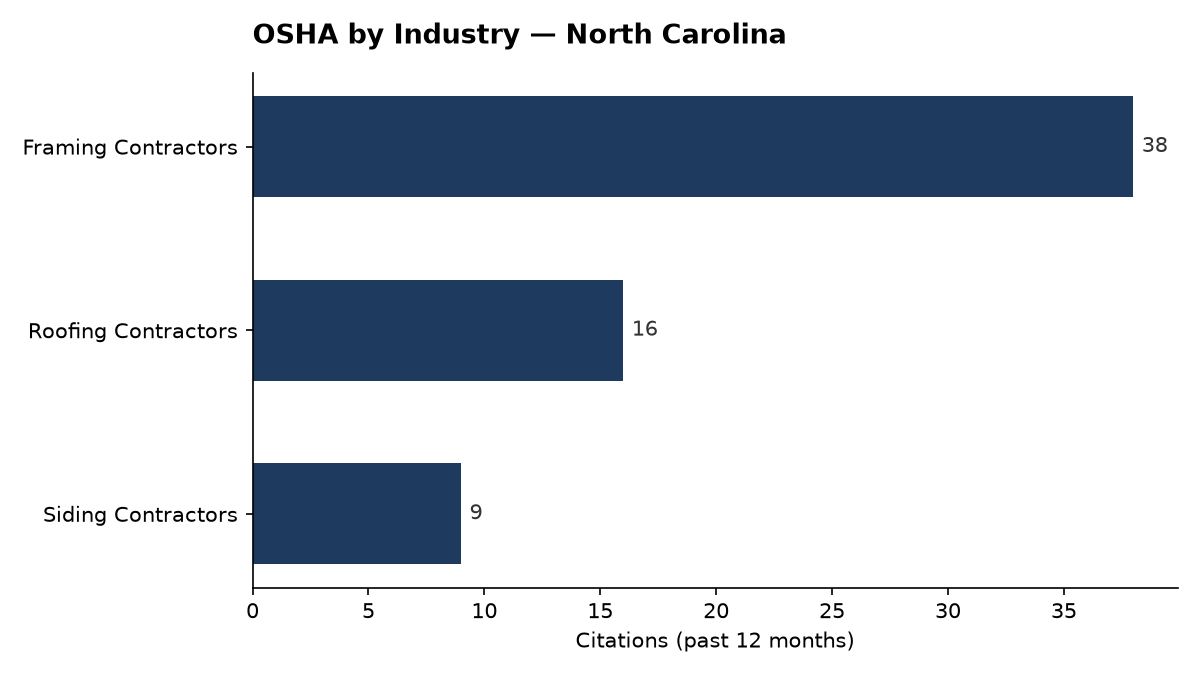
Framing contractors accounted for 38 of the 71 citations statewide — well over half. That’s not a coincidence. Framing work involves constant ladder use for wall sections, second-story work, and roof transitions, often on tight schedules where crews are moving equipment between tasks faster than they’re inspecting it. Roofing contractors picked up 16 citations, and siding contractors added another 9, both trades where workers are routinely positioned at height on ladders that were set up in a hurry. If you run a framing operation, it’s worth reading through how ladder citations play out for framing contractors specifically, since the fact patterns inspectors flag tend to repeat across the trade.
What These Citations Actually Cost in North Carolina
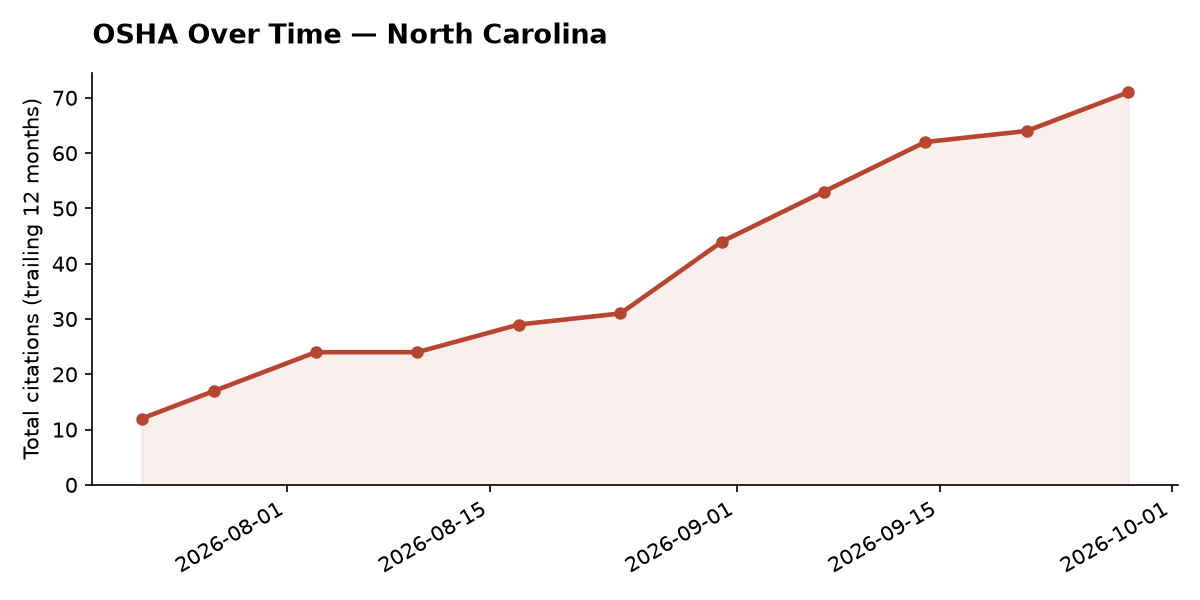
The $1,581 average and $1,000 median penalty describe the starting point, not necessarily the final bill. Penalties climb fast once a violation is marked Repeat or Willful, and North Carolina’s own data shows it: Rivera Construction LLC in Huntersville was hit with a $6,000 penalty for a Repeat violation cited under 19261053 B01, issued April 30, 2026. TR Construction NC LLC in Angier faced a $4,200 Repeat citation under 19261053 B13, issued October 20, 2025 — both considerably above the state average because the Repeat label pushed the number up.
The Serious-classification citations in the record also carry real weight. Guillermo Salvador Lorenzo in Beaufort was cited $4,965 under 19261053 B16, issued January 7, 2026. A-D’S Metal Roofing Company LLC, also in Beaufort, received an identical $4,965 penalty under the same subsection just weeks later, issued January 22, 2026. S. F. Ballou, Inc., another Beaufort employer, was cited $3,972 under 19261053 B16 on January 8, 2026. Notice how three separate Beaufort-area employers were cited under the same B16 provision within about two weeks of each other — a strong sign that this particular ladder deficiency was actively being targeted in that region during that stretch.
There’s also a negotiating reality worth knowing: the average penalty reduction between the initial and final penalty amount in North Carolina during this period was 8%. That’s a modest but real discount, and it typically only happens when an employer formally engages with OSHA rather than simply paying the initial number. For a fuller picture of how these dollar figures are calculated and adjusted, see this breakdown of OSHA ladder violation penalty amounts.
An 8% average reduction usually doesn’t happen by accident — it happens because someone pushed back on the record before the deadline closed. Before you decide whether to pay, appeal, or negotiate, it’s worth a conversation with a North Carolina OSHA defense attorney who can tell you whether your citation has room to move.
If You’ve Just Been Cited, Here’s the Actual Timeline
Once a citation lands, you are not required to simply accept the penalty as written. You have the right to formally dispute the classification, the penalty amount, or both — but only within 15 working days of receiving the citation. Miss that window and the citation typically becomes a final order, closing off most of your options for reducing what you owe. The process for filing a Notice of Contest is specific and has to be done correctly, which is why it helps to walk through how to contest an OSHA citation before you send anything to the agency.
Given that Repeat citations in North Carolina have run as high as $6,000 in this dataset, and that even standard Serious citations are landing near $5,000 in some cases, the cost of getting a second opinion is small compared to the cost of letting the deadline pass without one.
If a ladder citation is sitting on your desk right now, don’t let the 15-working-day window close while you’re still deciding what to do. Get a North Carolina OSHA defense attorney to look at the specific citation number and subsection before you respond to OSHA.