
Data last updated: September 14, 2026
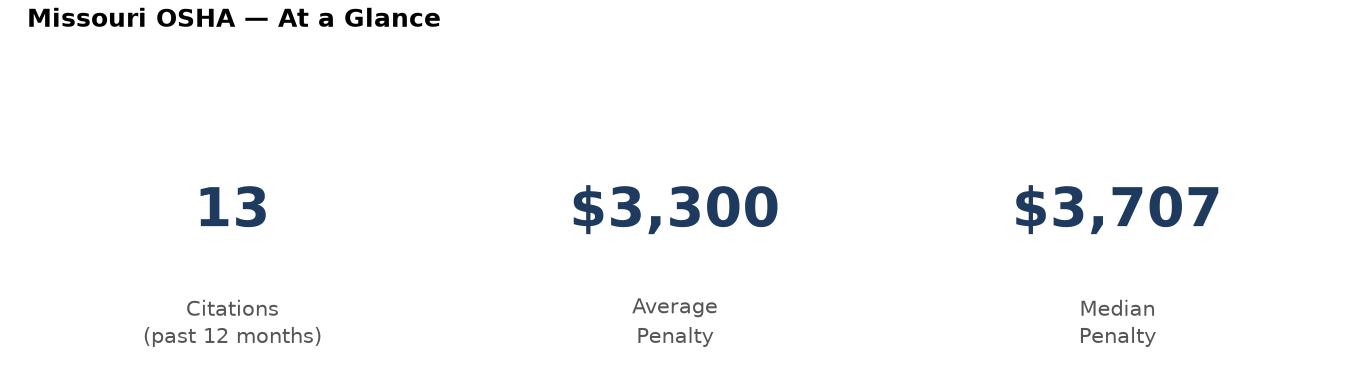
Missouri contractors racked up 13 scaffolding violations under OSHA’s 1926.451 standard over the past 12 months, with penalties averaging $3,300 and a median of $3,707. Every single one of these citations was classified as Serious. Raymore stands out as the city with the most activity, but the real cases below span from Saint Charles to Kansas City to small towns like Clinton and Smithville, which tells you enforcement here isn’t limited to one metro area.
If you’ve just opened an envelope from OSHA, the clock is already running. Talk to a Missouri OSHA defense attorney before you decide how to respond.
What OSHA Actually Expects Under 1926.451
The standard behind every one of these Missouri citations, 1926.451, is the general rulebook for scaffold safety on construction sites. It’s not one narrow rule but a whole set of requirements covering how a scaffold is built, how much weight it can carry, how workers get on and off it safely, what fall protection has to be in place at height, and how guardrails and planking need to be arranged so nobody steps into a gap or falls through a missing board.
In plain terms, inspectors are checking whether a scaffold was engineered to hold the load actually on it, whether workers had a safe way up rather than climbing braces, and whether the platform and rails were complete before anyone stepped onto them. The citation codes attached to Missouri’s cases, things like G02, B01, and G04(I), each point to a specific piece of that puzzle, such as a capacity failure, an access problem, or a guardrail gap.
Framing and Specialty Trade Crews Are Drawing the Most Attention
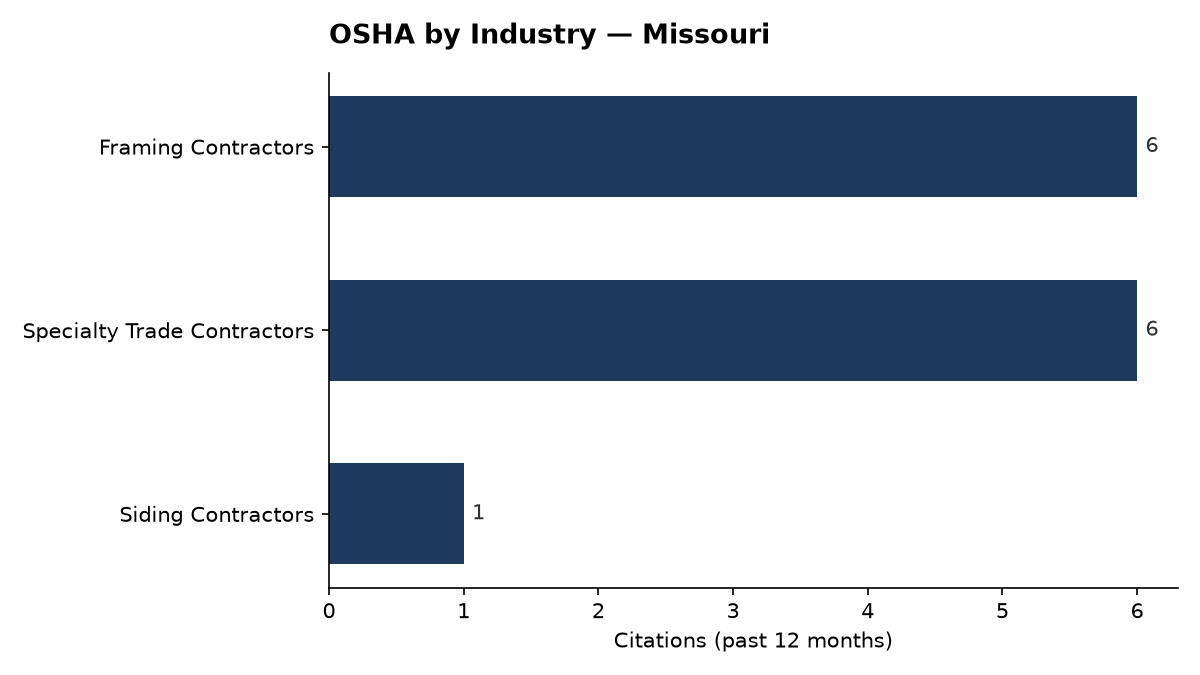
Two sectors account for nearly all of Missouri’s scaffolding citations this year: framing contractors and specialty trade contractors, each with 6 citations, and siding contractors trailing with 1. That split makes sense given the work. Framing contractors spend most of their day working at height on temporary platforms that go up and come down fast, often before every guardrail or plank is locked in. Specialty trades, from masonry to painting, tend to bring in scaffold systems for shorter jobs where crews may be less familiar with a particular setup’s quirks.
The real examples bear this out. Waddell Concrete Inc. in Saint Charles was cited for a capacity-related violation (G02) at $8,689, the largest penalty in this batch. Alliance Masonry & Preservation Services in Smithville picked up a guardrail-related citation (G04(I)) at $2,383. Rainbow Painting Company in Wentzville and Gonzales Construction LLC in Kansas City were both cited under B01, an access-related provision, at $3,707 and $4,965 respectively. Torchylo Builders LLC in Clinton rounds out the list at $3,972 under G01. None of these were flagged as Willful or Repeat, which matters, because those categories carry far steeper fines and signal a pattern OSHA has already seen before at that employer.
What a Citation Like This Actually Costs
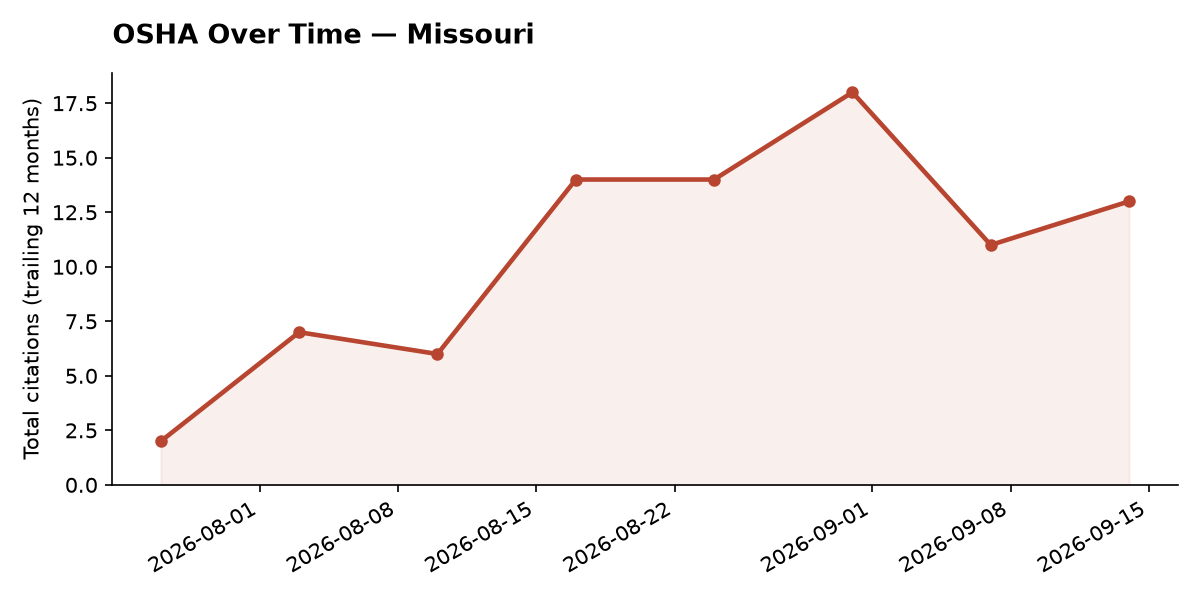
On paper, a $3,300 average penalty might not sound like it threatens a business. But that number is just the starting fine, and it doesn’t include the schedule delays, the retraining, or the reputational hit of having a citation on public record if a client or bonding company checks. Missouri’s numbers also reveal something contractors often don’t know: the average penalty reduction between the initial citation and the final settled amount here is 37 percent.
That’s a significant gap. It means more than a third of the original penalty amount, on average, gets negotiated down before the case closes. That doesn’t happen by accident or by simply paying the fine when it arrives. It happens because someone challenged the classification, questioned the evidence, or negotiated the abatement terms. You can see how these numbers typically break down on our page explaining OSHA scaffolding penalty amounts.
Given that a third of the penalty is often on the table, it rarely makes sense to just write the check. Get a Missouri OSHA defense attorney to review the citation before you pay anything or agree to abatement terms.
Your 15-Day Window Starts the Day You Receive the Citation
Here’s the part that catches employers off guard: you have exactly 15 working days from the date you receive an OSHA citation to file a Notice of Contest. Miss that window and the citation becomes a final order, penalty and all, with almost no way to challenge it afterward. Working days means weekends and federal holidays don’t count toward the total, but that’s still a narrow runway once you factor in reviewing the citation, gathering your records, and deciding on a strategy.
Before that deadline hits, it’s worth understanding how to contest an OSHA citation and what actually qualifies as valid grounds, whether that’s disputing the classification, the abatement date, or the underlying facts inspectors relied on. Given how often Missouri penalties get reduced after the fact, simply accepting the first number on the page usually leaves money and leverage on the table.
If you’re inside that 15-working-day window right now, don’t wait to see what happens. Speak with a Missouri OSHA defense attorney today so your response gets filed correctly and on time.
Pull your citation paperwork, note the exact date you received it, and start counting those 15 working days immediately, because that deadline doesn’t bend for anyone, and the earlier you get a professional set of eyes on the case, the more options you’ll have.