

Data last updated: August 17, 2026
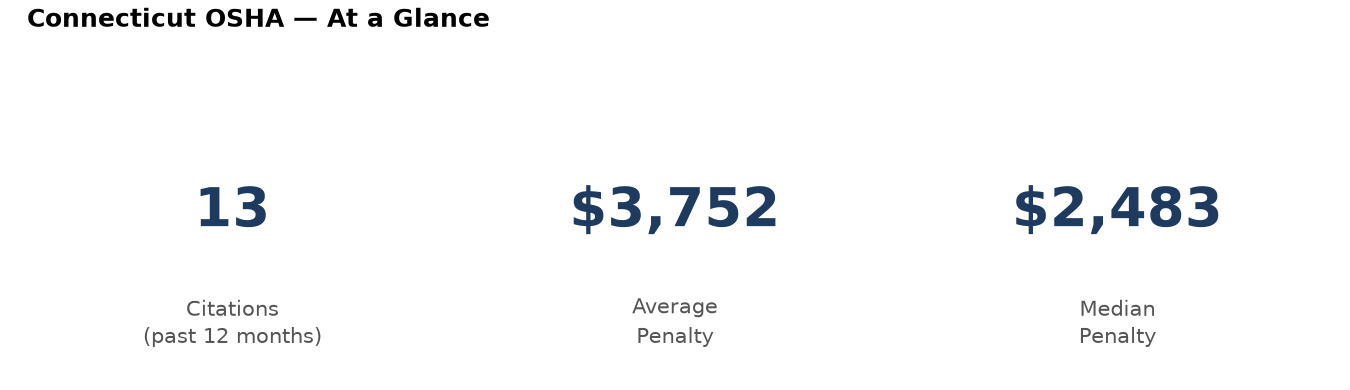
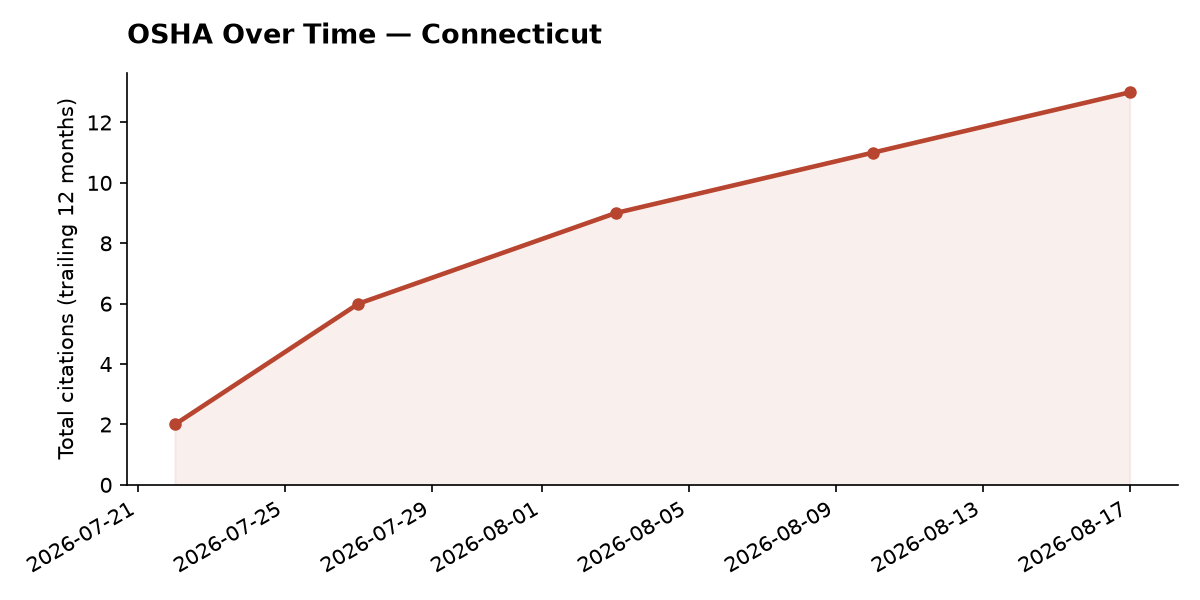
Connecticut OSHA inspectors issued 13 scaffolding violations under the 1926.451 standard over the past 12 months. Every single one was classified Serious. The average penalty came to $3,752, the median sat at $2,483, and New Haven led all cities for citation volume. Thirteen cases might sound small next to bigger industrial states, but the dollar amounts and the fact that every citation was rated Serious tell a contractor in Connecticut something important: inspectors here are not writing paperwork citations. They’re finding real fall hazards and pricing them accordingly.
If you’ve just been handed one of these citations, the clock is already running. Talking with a Connecticut OSHA defense attorney before you respond can change how much you end up paying and what stays on your record.
What the 1926.451 Scaffolding Standard Actually Requires
The 1926.451 standard is OSHA’s baseline rulebook for any scaffold used on a construction job, and it covers a lot of ground. It sets minimum requirements for how a scaffold platform must be built and rated for load, how workers get on and off it safely, when guardrails or personal fall protection are required, and how planking has to be installed so it doesn’t shift, gap, or fail under weight. It also addresses footing and structural stability, since a scaffold that’s improperly braced or set on unstable ground creates the same fall risk as one missing guardrails entirely.
In practice, most citations under this standard trace back to a handful of recurring problems: no guardrail system at height, planking that’s incomplete or overloaded, missing or inadequate access points like ladders, and scaffolds erected without proper base support. Every one of Connecticut’s 13 citations this past year was Serious, meaning OSHA determined there was a real, foreseeable chance of death or serious injury tied to the condition cited, not a minor paperwork gap.
Which Connecticut Trades Are Drawing These Citations
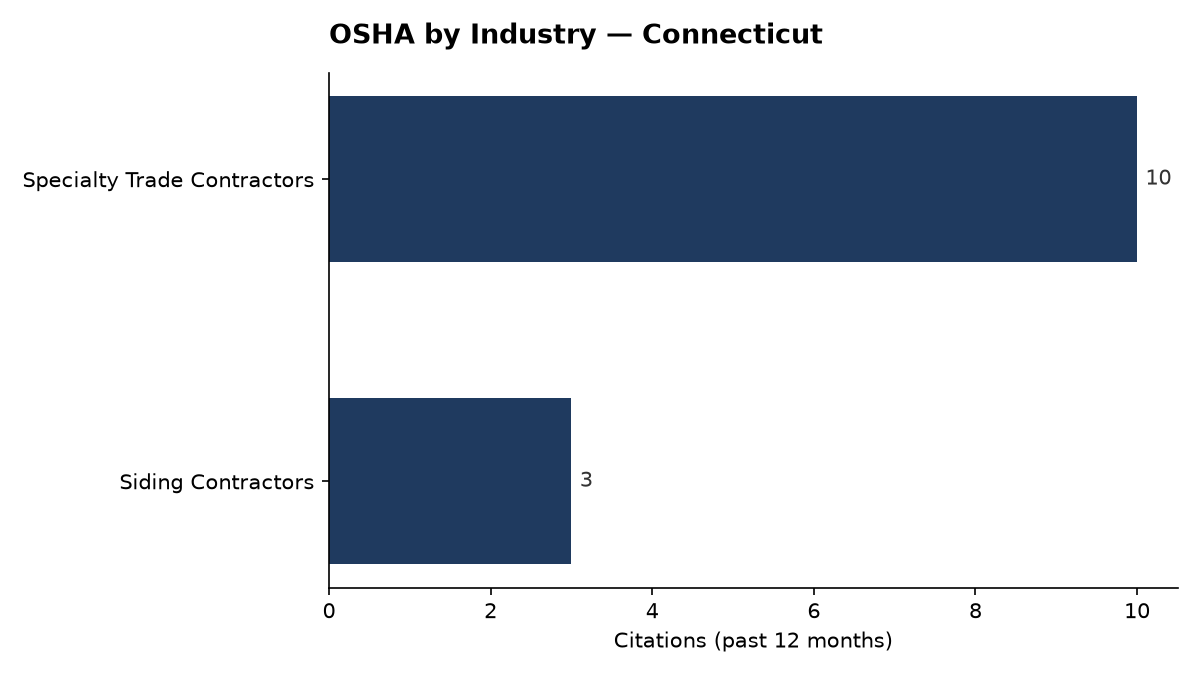
The pattern in Connecticut is lopsided. Specialty trade contractors account for 10 of the 13 citations, with siding contractors picking up the remaining 3. That split makes sense given the type of work involved. Specialty trades often bring in scaffolding for short-duration tasks — a few days of siding, painting, or exterior repair — and that short timeline can tempt crews to skip full guardrail installation or proper planking because the job will be done soon anyway. OSHA doesn’t grade on how long the scaffold stays up; a worker can fall just as far on day one as on day ten.
Siding work specifically tends to put workers at height along exterior walls where fall protection is easy to overlook if the crew is moving fast between sections. Given how concentrated Connecticut’s citations are in these trades, any contractor doing exterior residential or light commercial work should treat scaffold setup as a checklist item on every job, not just the big ones.
What These Citations Cost, in Real Dollars
The average penalty for a Connecticut scaffolding citation over this period was $3,752, with a median of $2,483 — meaning half of all cited employers paid at or below that figure. But averages hide the spread. Ronnie Demeo Construction, Inc. in Naugatuck was cited $9,932 for a Serious violation under 19260451 B01, issued May 14, 2026 — nearly triple the state average. Efrain Cruz Jiminez in New Haven drew a $3,972 penalty under 19260451 C01, issued June 22, 2026. Ace Painting & Wallpaper, LLC in Waterbury was fined $2,483 under 19260451 F07, issued December 29, 2025. Manuel Tenesaca in Greenwich faced a $2,400 penalty under 19260451 G01 VII, issued December 22, 2025, and J&M Brothers Construction LLC in Torrington was cited $1,987 under 19260451 H02 II, issued January 30, 2026.
One number worth paying close attention to: the average penalty gets reduced by 32% between the initial citation and final resolution in Connecticut. That’s not a guarantee, and it doesn’t happen automatically — it happens when an employer pushes back, corrects the hazard, and negotiates rather than simply paying the initial number. For a full breakdown of how OSHA calculates and adjusts these figures, see this explanation of OSHA scaffolding violation penalty amounts.
A near one-third reduction on a citation in the $3,000 to $10,000 range is real money for a small contracting business. That gap between the initial number and the final number is usually where legal representation earns its cost. Before you write a check or accept a citation as final, it’s worth a conversation with a Connecticut OSHA defense attorney to see whether your citation has room to move.
You Have 15 Working Days — Here’s What Happens Next
Once OSHA issues a citation, the employer has exactly 15 working days to file a Notice of Contest. Miss that window and the citation becomes a final order automatically — no appeal, no negotiation, no do-over. This is true whether the proposed penalty is $1,987 or $9,932.
Filing a Notice of Contest doesn’t mean you’re picking a fight with OSHA for the sake of it. It preserves your options: to negotiate a lower penalty, to argue the classification was wrong, to challenge the abatement timeline, or to contest the citation outright if you believe the facts don’t support it. Walk through the specific steps and what a contest actually involves in this guide to how to contest an OSHA citation.
Given how short that 15-working-day window is, and given that every scaffolding citation issued in Connecticut this year was classified Serious, this isn’t a decision to sit on. Get a Connecticut OSHA defense attorney looking at your citation as soon as it arrives, not after the deadline has already passed.
If you run a specialty trade or siding business anywhere in Connecticut and you’ve got scaffolding on an active job site, take an honest look at your guardrails, planking, and access points this week — before an inspector does it for you.