

Data last updated: September 28, 2026
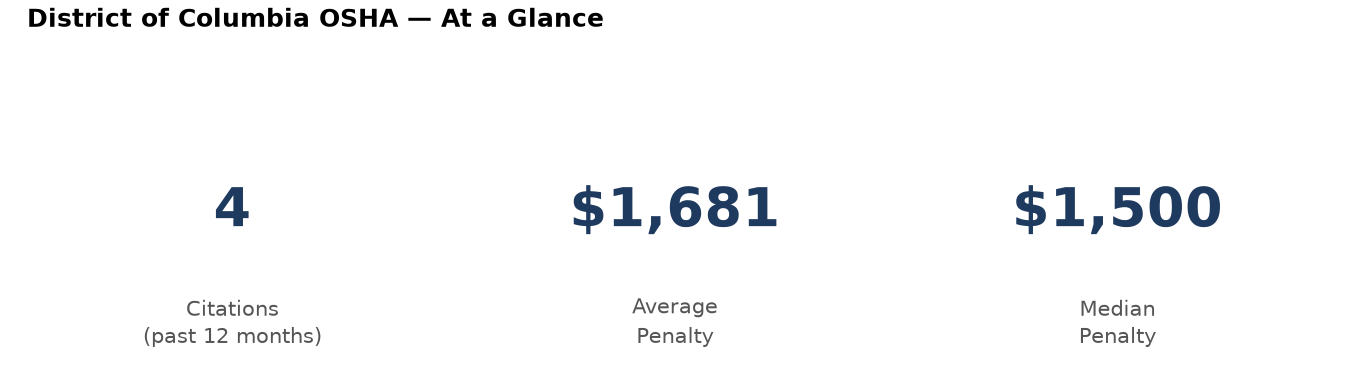
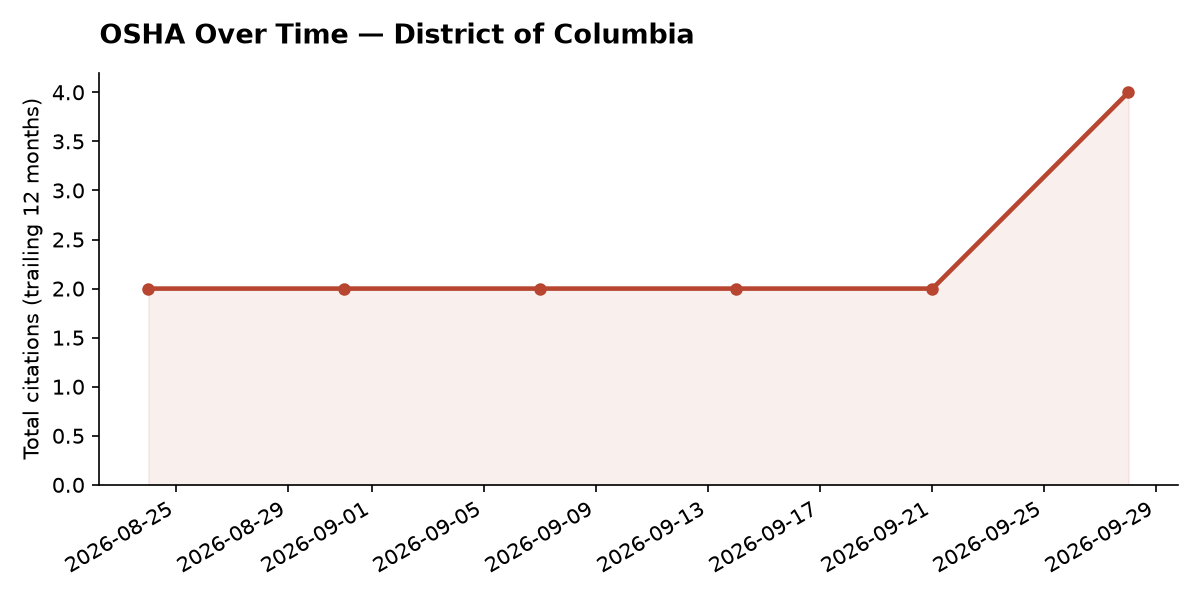
Washington, D.C. contractors racked up just four scaffolding citations under OSHA standard 1926.451 over the past 12 months, but do not let the small number fool you. All four were classified as Serious, the average penalty came in at $1,681, and the median sat at $1,500. Every single citation happened in Washington itself, which is the only city in the district with an active OSHA construction footprint worth mentioning.
If you run a jobsite here and a scaffolding citation just landed on your desk, the clock is already moving. You get 15 working days from the date you receive it to file a Notice of Contest, and once that window closes, your options shrink fast. A brief conversation with a District of Columbia OSHA defense attorney now can save you real money and stress later.
What OSHA Actually Expects From a Scaffold Under 1926.451
The standard behind every one of these citations, 1926.451, is not one narrow rule but a broad set of expectations covering how scaffolds get built, how much weight they can hold, how workers get on and off them safely, and what fall protection and guardrail setups look like. Inspectors check planking gaps, capacity ratings, access points, and whether guardrails and toe boards are actually in place, not just promised. You can review the full breakdown of what the 1926.451 standard requires in practice, since most citations trace back to one of a handful of recurring gaps rather than some exotic failure.
In D.C.’s case, both cited companies fell under specific subsections of this rule. One citation referenced 19260451 G01 I, and the other cited 19260451 F07 — both point to concrete, fixable configuration issues rather than vague compliance language. That is actually good news for anyone trying to understand exposure: these are known, correctable problems, not open-ended judgment calls.
Small Numbers, Concentrated Industries: Who Is Getting Cited
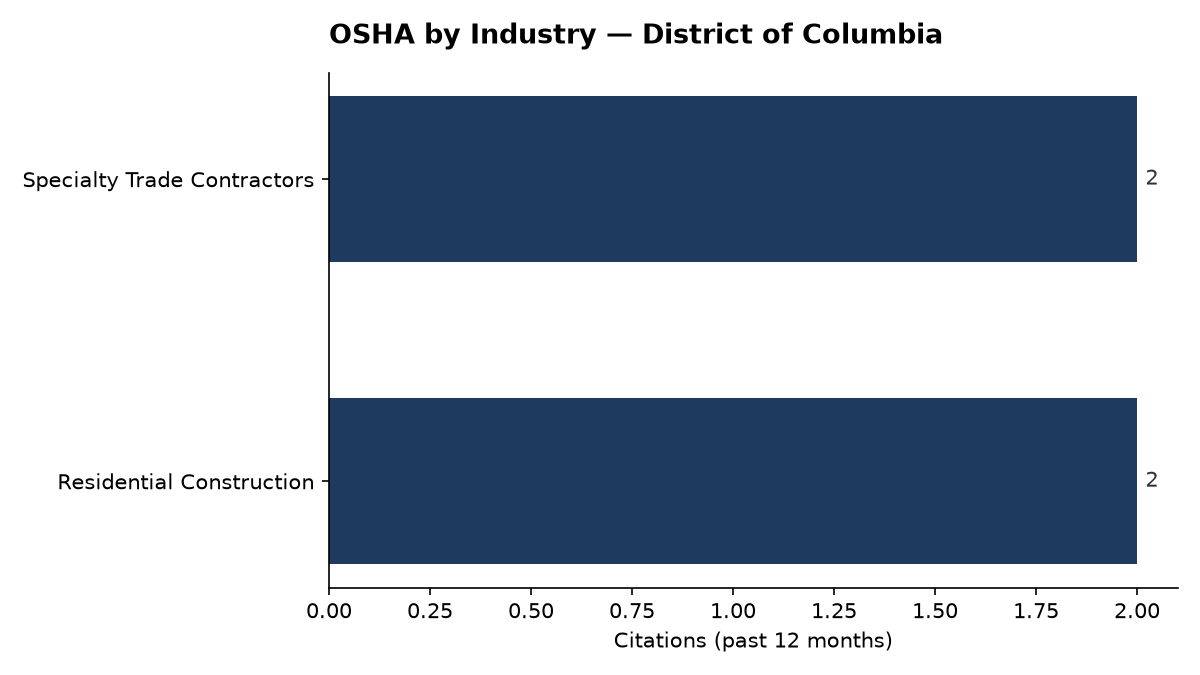
With only four citations total, D.C. does not have a sprawling enforcement pattern the way some larger states do. But the split is telling. Specialty trade contractors accounted for two of the four citations, and residential construction picked up the other two. That is a clean 50/50 split, which tells you scaffolding enforcement here is not chasing one type of crew — it is following wherever scaffolds get erected, whether that is a home renovation or a subcontracted trade job.
If you work in specialty trade contracting, you are looking at the same enforcement odds as a residential builder in this district right now. Smaller crews and short-term scaffold setups on rowhouse renovations and rowhouse-adjacent commercial jobs tend to be exactly where inspectors catch gaps in planking or missing guardrails, because these setups often go up fast and come down fast, with less time built in for a careful safety check.
What These Citations Actually Cost
The dollar figures in D.C. are modest compared to some jurisdictions, but modest does not mean painless. The average penalty of $1,681 and median of $1,500 reflect Serious-classification citations, meaning OSHA determined there was a real chance of injury or death tied to the violation, even if it did not rise to Willful or Repeat status. Two real examples from Washington show the range: Td Properties Llc was cited $3,724 for a violation issued July 17, 2026, under 19260451 G01 I, and Jose Luis Lozano was cited $3,000 for a violation issued January 7, 2026, under 19260451 F07. Both are well above the district average, which tells you the $1,681 figure includes some smaller citations pulling the mean down.
Here is the number that matters most if you are deciding whether to just pay and move on: the average penalty reduction between initial and final amounts in D.C. was 20 percent. That is not a rounding error. It means a meaningful share of cited employers who pushed back, negotiated, or contested ended up paying noticeably less than the number on the original citation. You can see how these figures typically break down on the OSHA scaffolding violations penalty amounts page, but the short version is simple: the initial number is rarely the final number, and reflexively writing a check without checking your options leaves money on the table.
Before you decide how to respond to your citation, it is worth getting an outside read on your specific case. A District of Columbia OSHA defense attorney can tell you within one conversation whether your citation looks like a strong candidate for reduction or contest.
Your 15-Day Window and What to Do With It
Once a citation is issued, OSHA does not wait around. You have 15 working days from receipt to file a Notice of Contest, and if you let that deadline pass, the citation and penalty become final, no further argument accepted. That is true whether your case involves a $500 paperwork gap or a $3,724 Serious violation like Td Properties Llc’s.
The process for contesting is specific and has to be done correctly, in writing, within that window. The page on how to contest an OSHA citation walks through what that filing actually requires and what happens after you submit it. But the practical first step, especially with a short deadline like this, is not to try to figure out the paperwork alone. Get someone who has handled these cases before to look at your citation, your subsection, and your options while you still have time to act.
If a scaffolding citation is sitting on your desk right now, do not let the 15 working-day clock run out while you decide what to do. Reach out to a District of Columbia OSHA defense attorney today and find out exactly where you stand before that window closes.