

Data last updated: September 21, 2026
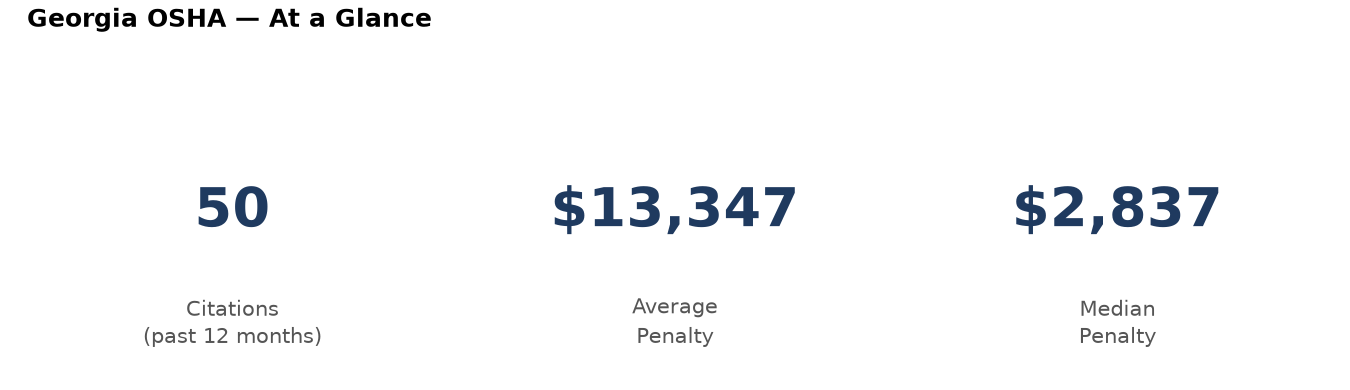
Georgia contractors racked up 50 scaffolding citations under OSHA standard 1926.451 over the past 12 months, with penalties averaging $13,347 and a median closer to $2,837. Three of those citations were classified Willful and one was a Repeat violation — the two categories that push fines into the six-figure range, as one Richmond Hill company found out the hard way. Mcdonough saw more scaffolding enforcement activity than any other city in the state.
If you’re staring at a citation right now, the numbers above aren’t abstract — they’re your exposure. Talk to a Georgia OSHA defense attorney before you respond to OSHA, not after.
What OSHA Actually Expects From a Scaffold Under 1926.451
Standard 1926.451 is the backbone rule for every scaffold used on a construction site in Georgia, whether it’s a frame scaffold on a siding job or a suspended platform on a commercial building. In plain terms, it requires that scaffolds be built to hold at least four times their intended load, that workers have safe access such as a ladder or stair rather than climbing the frame, that guardrails and proper planking be in place wherever there’s a fall hazard, and that a competent person inspect the setup before each shift. Most citations under this standard trace back to one of those basics being skipped — a missing guardrail, an overloaded platform, or planking that doesn’t fully span the bay. You can read more on the mechanics of the rule at the 1926.451 scaffolding standard hub.
Siding and Specialty Trade Crews Are Carrying the Weight of Georgia’s Enforcement Numbers
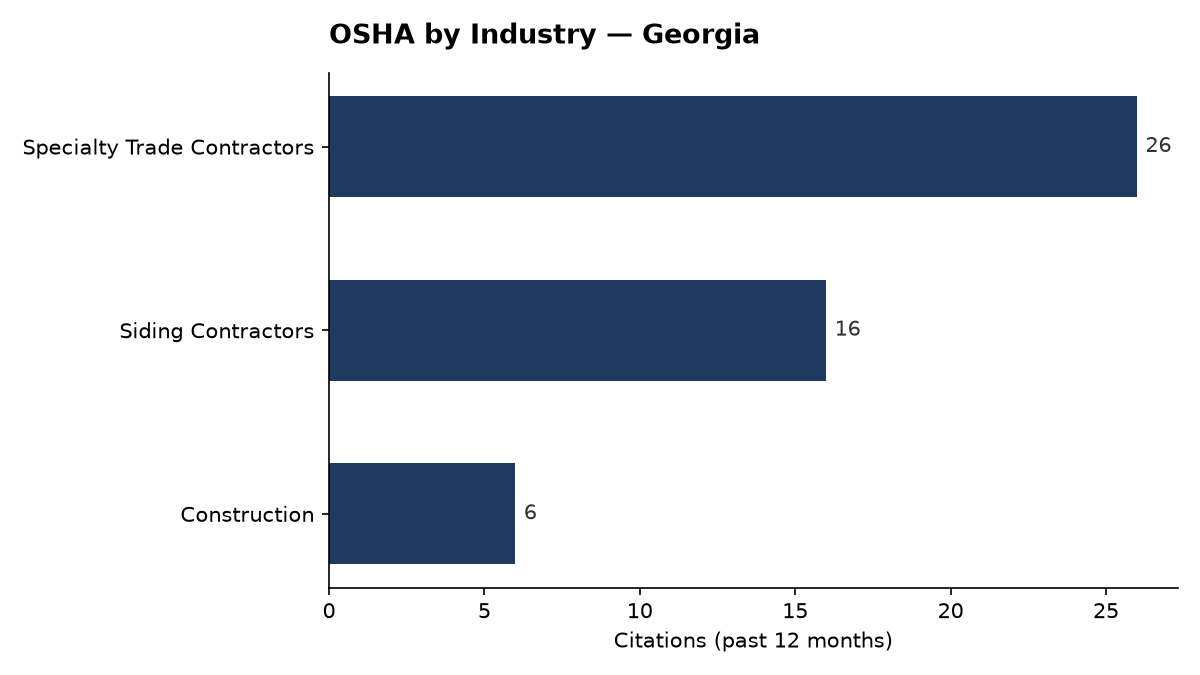
Two industries account for the vast majority of Georgia’s scaffolding citations. Specialty trade contractors were cited 26 times, and siding contractors alone picked up 16 citations — a striking concentration for one narrow trade. Add general construction firms at 6 citations and you’ve covered nearly every case in the state.
The pattern makes sense once you think about the work itself. Siding and exterior trim crews spend entire days moving frame scaffolds along a building’s exterior, raising and re-decking platforms multiple times a day. Every one of those moves is a chance to skip a guardrail or leave a plank short. Specialty trade contractors, covering everything from stucco to steel erection, face the same exposure across a wider range of job types. If your company falls into either bucket, it’s worth reviewing how OSHA treats specialty trade contractors under this standard specifically, since the citation patterns for that group are well documented.
What a Scaffolding Citation Actually Costs in Georgia
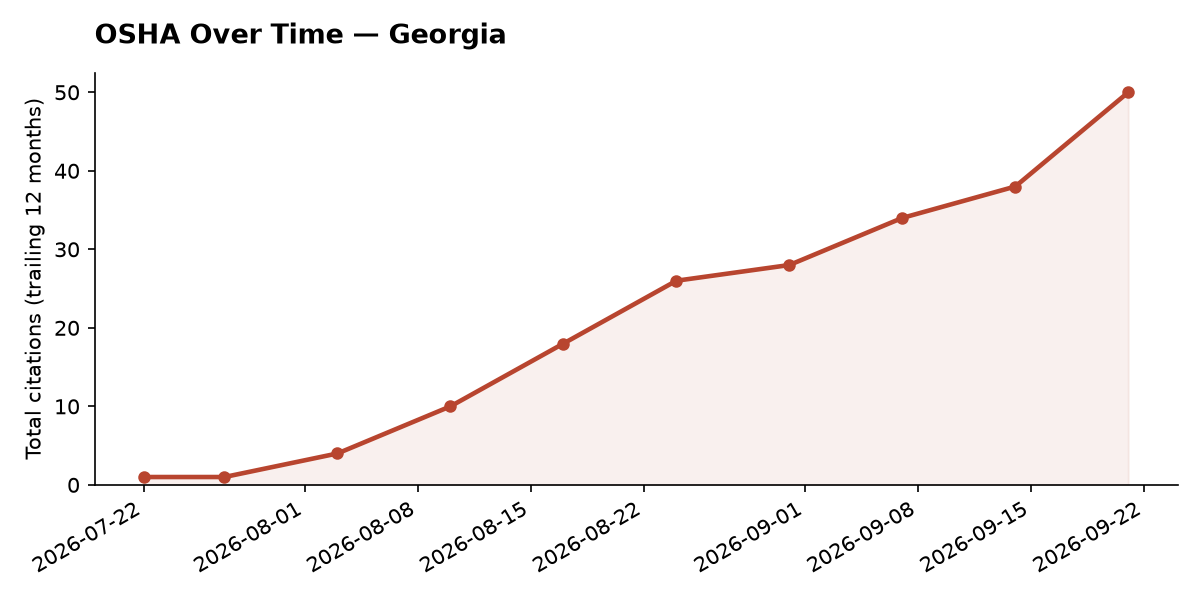
The spread between Georgia’s average penalty of $13,347 and its median of $2,837 tells you something important: most citations are modest, garden-variety Serious violations, but a small number of Willful or Repeat cases pull the average way up. Of the 50 citations counted, 46 were Serious, 3 were Willful, and 1 was Repeat — a small slice of cases, but one that changes the math dramatically.
Consider Seminole Equipment, Inc. in Richmond Hill, cited $165,514 for a Willful violation under 19260451 G01 VII, issued September 26, 2025. Compare that to Roman Construction Company LLC in Conyers, fined $6,809 for a Repeat violation under 19260451 G01 in mid-2026, or three separate Serious citations that landed closer to $5,000-$6,800: Southeast Restoration & Fire Proofing Co., Inc. in Atlanta ($6,753, code F03, issued November 14, 2025), Best Stucco in Savannah ($4,965, code G01, issued December 12, 2025), and Weaver Steel Buildings, Inc. in Americus ($4,965, code C02 IV, issued March 3, 2026). The gap between the smallest and largest fines here is more than 30-fold, driven almost entirely by classification.
One more number worth knowing: Georgia’s average penalty reduction between initial and final assessment is only 4%. That’s low compared to many states, which means employers who simply wait and hope for a quiet negotiation aren’t getting much relief on their own. Understanding how OSHA scaffolding violation penalty amounts are calculated — and where there’s actually room to negotiate — matters more here than in states where reductions run higher.
A 4% average reduction means most employers aren’t successfully pushing back on their own. A Georgia OSHA defense attorney can tell you within a short conversation whether your citation has real room to be reduced or contested outright.
The 15-Day Window You Don’t Want to Waste
Once your company receives a citation, the clock starts immediately. You have 15 working days from receipt to file a Notice of Contest. Miss that window and the citation, the classification, and the penalty become final — no appeal, no negotiation, no second look. That’s true whether you’re facing a $2,800 Serious citation or a six-figure Willful one.
Given that Georgia’s three Willful citations and single Repeat citation carried some of the steepest penalties in the state, the classification on your citation matters as much as the dollar amount. A Serious citation and a Repeat citation can stem from a nearly identical scaffold issue, but the penalty and the long-term record impact are worlds apart. Before you decide whether to pay, negotiate, or contest, it’s worth understanding how to contest an OSHA citation and what evidence actually moves the needle during that process.
If you’re inside that 15-working-day window right now, don’t spend it guessing. Get in touch with a Georgia OSHA defense attorney and find out what your options actually look like before the deadline closes on you.
Whatever the classification on your citation, the paperwork you file in the next 15 working days will shape what happens for months afterward — get a professional opinion on it now, not after you’ve already responded on your own.