Data last updated: September 07, 2026
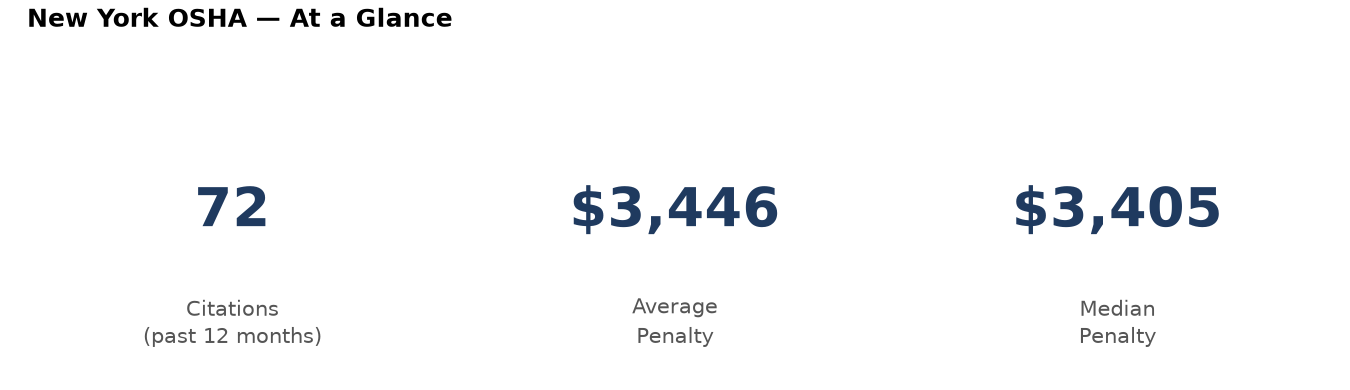
Over the past 12 months, OSHA issued 72 scaffolding citations across New York under 29 CFR 1926.451, with penalties averaging $3,446 and a median of $3,405. Sixty of those citations were classified as Serious, four as Repeat, and three as Willful — and Willful findings carry the steepest fines and the most lasting consequences for a company’s compliance record. Syracuse logged more scaffolding citations than any other city in the state this period, but the numbers show enforcement reaching contractors from Goldens Bridge to Saratoga Springs.
If you’ve just received a citation, or you suspect one is coming, the clock is already running. Talk to a New York OSHA defense attorney before you respond to OSHA in writing or agree to anything over the phone.
What OSHA’s Scaffolding Rule Actually Demands on New York Job Sites
The standard behind all 72 of these citations, 1926.451, is the general rulebook for scaffold use in construction. It’s not one narrow requirement — it’s a set of baseline conditions that every scaffold on a job site has to meet, covering how the structure is built and rated for load, how workers get on and off it safely, what fall protection looks like once they’re up there, and how planking and guardrails have to be arranged so nobody steps into an open gap. Inspectors lean on this standard constantly because scaffold failures are one of the more common and preventable ways construction workers get seriously hurt, and OSHA treats gaps here as high priority.
In practice, that means a citation can come from something as specific as an unsecured platform, a missing guardrail section, or a scaffold erected without adequate footing. The subsections cited in New York’s recent cases — things like B01 (platform construction) and G01/G04 (fall protection) — show inspectors are checking both the physical build of the scaffold and whether workers on it are actually protected from falling.
Specialty Trade and Roofing Contractors Draw the Most Scrutiny
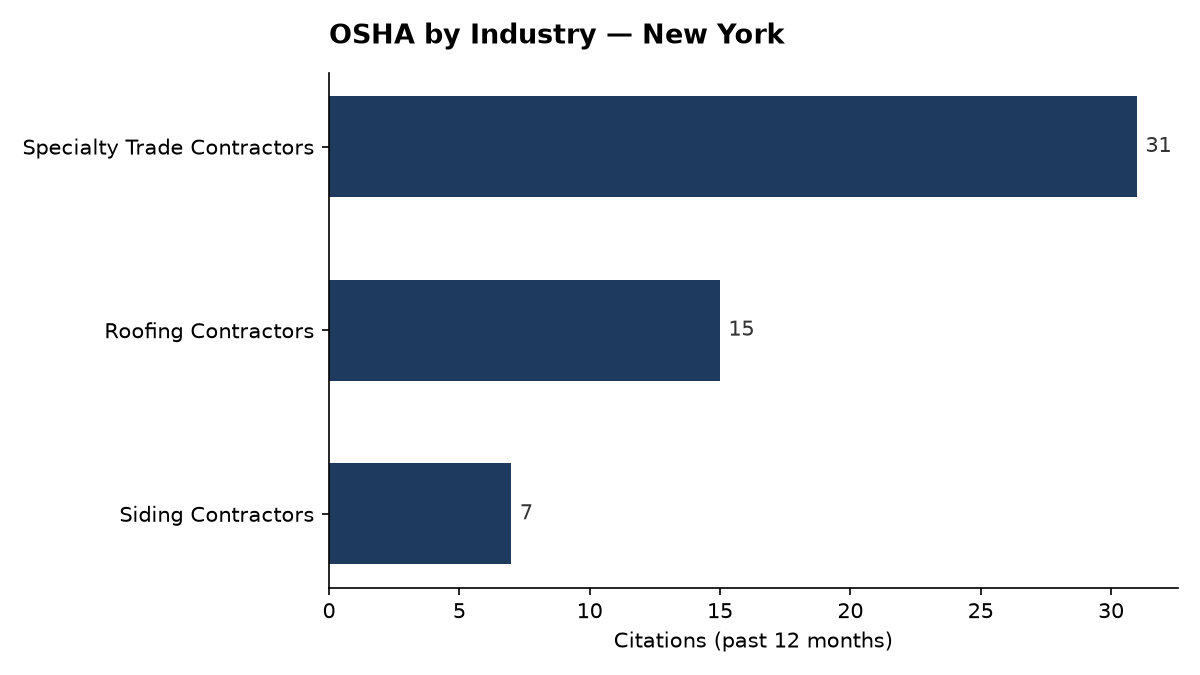
New York’s citation pattern is heavily weighted toward one sector: specialty trade contractors accounted for 31 of the state’s 72 scaffolding citations, more than double the next closest group. Roofing contractors followed with 15 citations, and siding contractors added another 7. Together, these three trades make up nearly three-quarters of all scaffolding enforcement in the state.
That concentration isn’t random. Specialty trade crews, roofers, and siding installers are the workers most likely to be up on scaffolds for extended stretches, often on tight residential or commercial jobs where schedule pressure can push crews to skip a guardrail section or reuse a platform that wasn’t rated for the load. Inspectors know this, which is part of why these trades see disproportionate attention during routine sweeps and complaint-driven inspections alike.
The Price Tag: From a $3,446 Average to a $17,024 Willful Citation
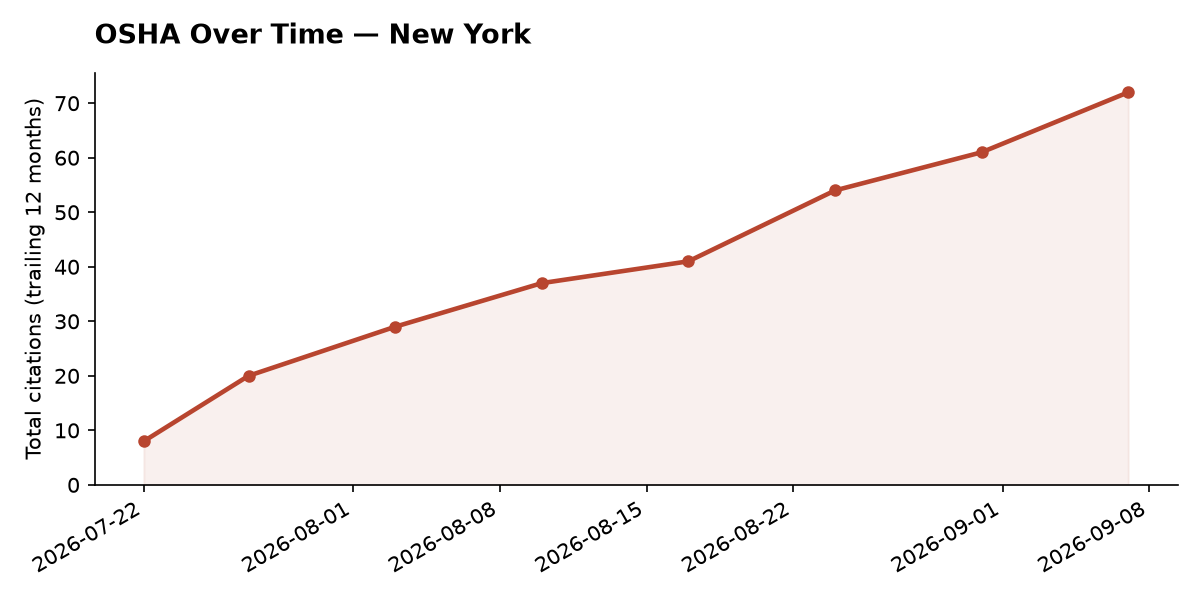
The average penalty of $3,446 doesn’t tell the whole story once you look at the actual range of cases. Several recent New York citations illustrate how much the classification — Serious, Repeat, or Willful — changes the number on the page:
- Opportunity Headquarters (Syracuse): $17,024, Willful, cited under 19260451 C02 IV, issued September 9, 2025
- Perfect Wall Systems Inc. (Goldens Bridge): $11,916, Repeat, cited under 19260451 B01, issued September 24, 2025
- Orange County Superior Concrete Inc (Monsey): $11,585, Serious, cited under 19260451 B01, issued July 29, 2026
- Architectural Glass And Metal, Inc. (Saratoga Springs): $7,414, Other-than-Serious, cited under 19260451 G04 I, issued January 14, 2026
- Barreras Contracting Inc (Ardsley): $7,296, Repeat, cited under 19260451 G01, issued October 21, 2025
Notice how far above the state average the Willful and Repeat cases land. A single Willful citation, like the one issued to Opportunity Headquarters, can run five times the average Serious penalty because OSHA treats it as evidence the employer knew about the hazard and chose not to fix it. Repeat citations climb fast too, since they mean the same or a substantially similar violation was already found once before. For a fuller breakdown of how these multipliers work, see this explanation of OSHA scaffolding violations penalty amounts.
There’s also real room to negotiate: statewide, the average penalty reduction between the initial citation and the final settled amount was 21%. That gap exists because employers who engage — through an informal conference, negotiation, or formal contest — routinely get classifications reduced or penalties lowered, especially when documentation and abatement steps are handled correctly from the start.
A 21% average reduction is not automatic, and it rarely happens without someone pushing for it. Before you pay a citation at face value, it’s worth a conversation with a New York OSHA defense attorney to see what’s realistically negotiable in your case.
Fifteen Working Days: What to Do the Moment New York OSHA Cites You
Once a citation lands, the deadline that matters most is 15 working days from the date you receive it. That’s the window OSHA gives employers to file a Notice of Contest — miss it, and the citation becomes a final order, penalties and all, with almost no way back. This is true whether your citation was classified Serious, Repeat, or Willful, and it doesn’t pause for the holidays or a busy job schedule.
Inside that window, you generally have a few paths: pay the citation as issued, request an informal conference with the OSHA area office to negotiate terms, or file a formal Notice of Contest to preserve your right to challenge the citation before an administrative law judge. Each path has different consequences for your compliance history and your insurance and bidding profile going forward. For a closer look at how the contest process actually works step by step, read this guide on how to contest an OSHA citation.
Given the stakes — a Willful citation in New York recently topped $17,000, and Repeat citations aren’t far behind — this isn’t a decision to make alone or on a tight deadline without guidance. Reach out to a New York OSHA defense attorney as soon as you have the citation in hand, so someone experienced with these cases can review the specific subsection cited and map out your options before the 15 working days run out.
Whatever stage you’re at — a citation just arrived, or you’re bracing for an inspection after a near-miss on scaffolding — the smartest move is getting the paperwork in front of someone who handles these cases regularly, before any deadline closes your options.