
Data last updated: September 07, 2026
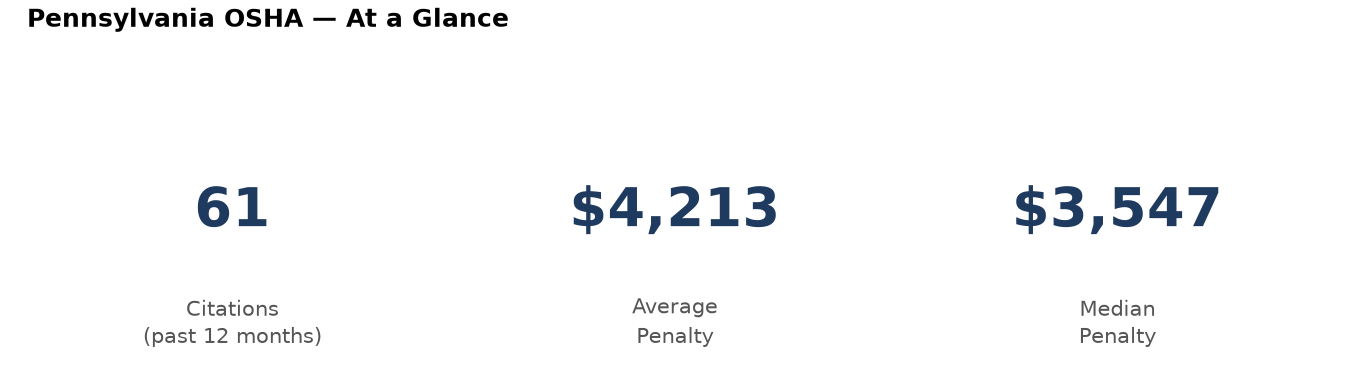
Pennsylvania employers racked up 61 scaffolding citations under 1926.451 over the past 12 months, with an average penalty of $4,213 and a median of $3,547. Fifty of those 61 cases were classified as Serious, two came back as Repeat violations, and Philadelphia logged more citations than any other city in the state. If you are holding a citation right now, or you suspect one is coming, the numbers below tell you exactly what you are up against.
A citation like this does not have to end in the number OSHA first writes down. Talk to a Pennsylvania OSHA defense attorney before your response window closes — the clock starts the day you receive the paperwork, not the day you decide to deal with it.
What 1926.451 Actually Demands on a Pennsylvania Job Site
The 1926.451 standard is the backbone of all scaffold enforcement in construction, and it is the rule inspectors reach for on almost every scaffold-related visit. In plain terms, it requires that any scaffold be built to hold at least four times its intended load, that workers have safe means of getting up and down rather than climbing cross-braces, that fall protection be in place once someone is working above a certain height, and that platforms be fully planked with proper guardrails rather than partial decking. You can read the full breakdown of how this standard applies across scaffold types on the 1926.451 standard hub, which is worth reviewing before you respond to any citation referencing this section.
Most Pennsylvania citations this year trace back to a handful of recurring gaps: missing or incomplete guardrail systems, platforms that were not fully planked, and scaffolds erected without an adequate access point. None of these are exotic requirements — they are the basic construction and use provisions that inspectors check first.
Which Pennsylvania Trades Are Drawing the Most Scrutiny
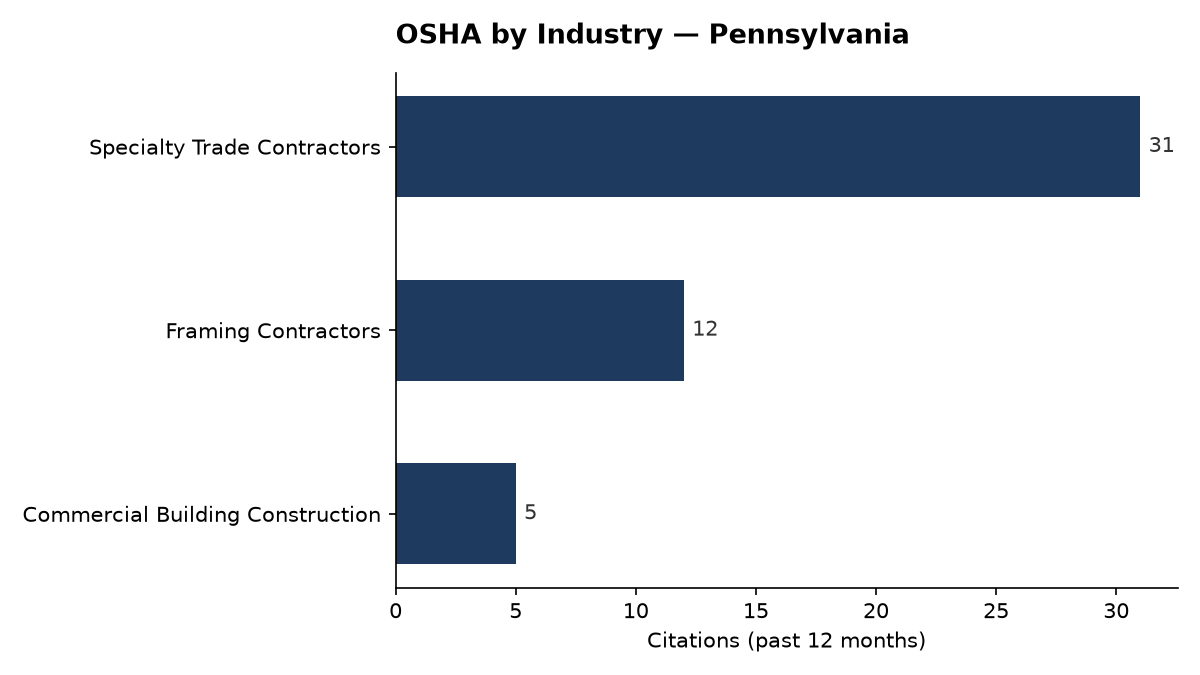
The citation pattern in Pennsylvania is heavily weighted toward one sector. Specialty trade contractors accounted for 31 of the state’s 61 citations, more than half the total. That is not surprising given how much scaffold work — masonry, siding, exterior finishing, and similar trades — falls under this broad category and involves crews building and modifying scaffold systems daily, often on tight timelines that push safety checks to the back burner.
Framing contractors were the second most-cited group with 12 citations, followed by commercial building construction firms with 5. Together these three categories cover the bulk of scaffold-related enforcement in the state, which tells you that the exposure is not limited to large commercial builders — small and mid-size trade crews doing repetitive exterior and structural work are just as likely, if not more likely, to end up in an inspector’s file.
What These Citations Cost, and Why the Type Matters
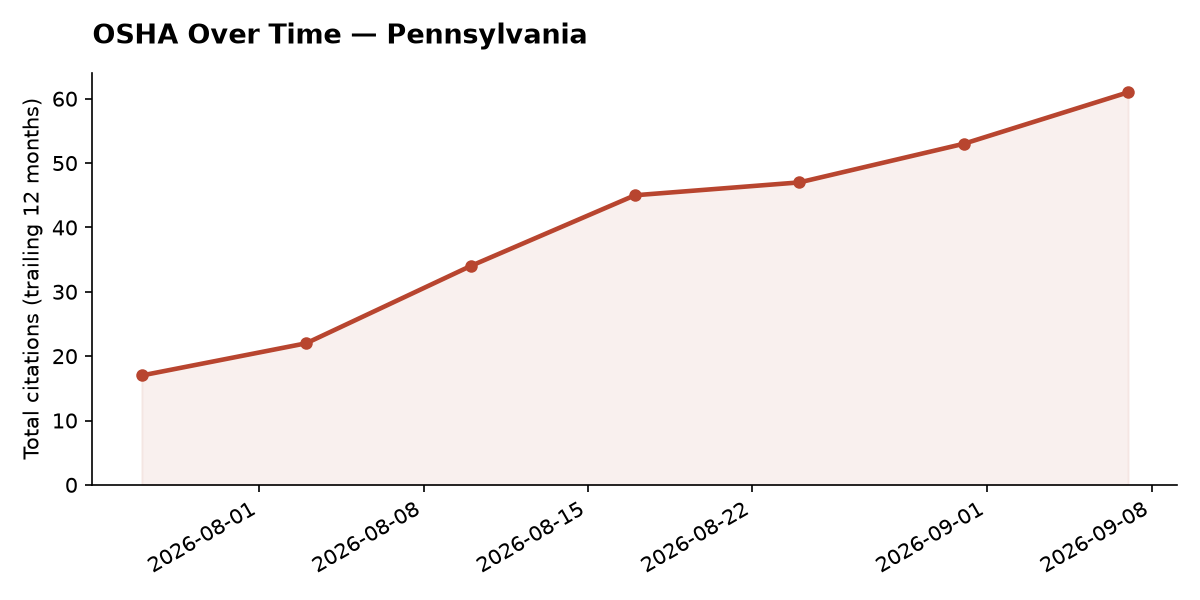
Of the 61 citations issued statewide, 50 were Serious, 9 were classified as Other-than-Serious, and 2 came back as Repeat. That distinction matters because Repeat violations draw penalties on a completely different scale — OSHA treats a second citation for the same or a similar hazard as evidence the first warning did not stick, and the fine reflects that.
You can see this play out in the real cases from the past year. Jamscar Construction in Philadelphia was cited under 19260451 G01 VII as a Repeat violation and hit with a $29,790 penalty, issued February 19, 2026 — by far the largest figure among recent Pennsylvania cases. Dan Lepore & Sons Company, also in Philadelphia, received a Serious citation under 19260451 B01 for $16,550 in December 2025. Amelie Construction & Supply, LLC of Oakland was cited $8,513 under 19260451 G04 I, classified Serious, in May 2026. Shafars Masonry, LLC in Hatboro faced a $7,803 Repeat citation under the same 19260451 G04 I provision in September 2025. And MLH General Contractors, LLC in Philadelphia was cited $5,958 under 19260451 B01, Serious, in February 2026.
Notice how much the Repeat classification moves the number — Jamscar’s penalty is roughly four times MLH’s, even though both involve scaffold construction and use provisions. Statewide, the average penalty reduction between initial and final citation amounts sits at 14%, which means most employers who push back, negotiate, or contest do see the number move, though rarely by half. For a full explanation of how OSHA calculates and adjusts these figures, see this breakdown of OSHA scaffolding penalty amounts.
A four- or five-figure penalty is rarely the whole story. Add in the cost of downtime while you fix the cited condition, the reputational hit of a public citation record, and the risk that a second violation for the same issue gets classified as Repeat instead of Serious. That is the point where getting professional legal input pays for itself. A Pennsylvania OSHA defense attorney can review your citation and tell you within a conversation whether you have grounds to push back on the classification or the amount.
Your Window to Respond Is Shorter Than You Think
Once a citation lands in your hands, you have 15 working days to file a Notice of Contest. Miss that window and the citation becomes a final order automatically — no hearing, no negotiation, no appeal. That deadline does not pause for the holidays, does not extend because you are waiting on a supervisor’s schedule, and does not care whether you were still gathering documentation.
Before that clock runs out, walk through how to contest an OSHA citation so you understand what a contest actually involves and what evidence strengthens your position. In many cases, an informal conference with the area office can resolve or reduce a citation faster than a formal contest, but you need to know which path fits your situation, and that decision is much easier with someone who has handled these cases before.
If you are staring down a scaffolding citation in Pennsylvania right now, the smartest move is also the fastest one: get a Pennsylvania OSHA defense attorney to look at the specific paragraph you were cited under before you file anything or pay anything. The 15 working days you have will pass whether you use them or not.
Pull your citation paperwork, note the exact date you received it, and start that 15-day countdown today — the earlier you get a second set of eyes on the case, the more options you have left on the table.