
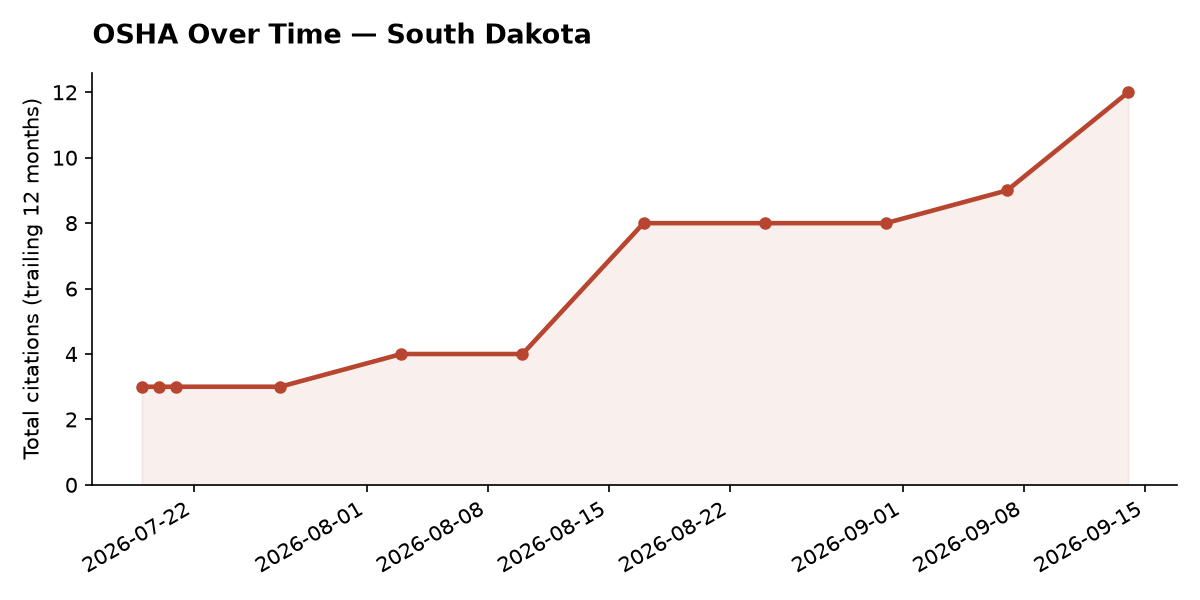
Data last updated: September 14, 2026
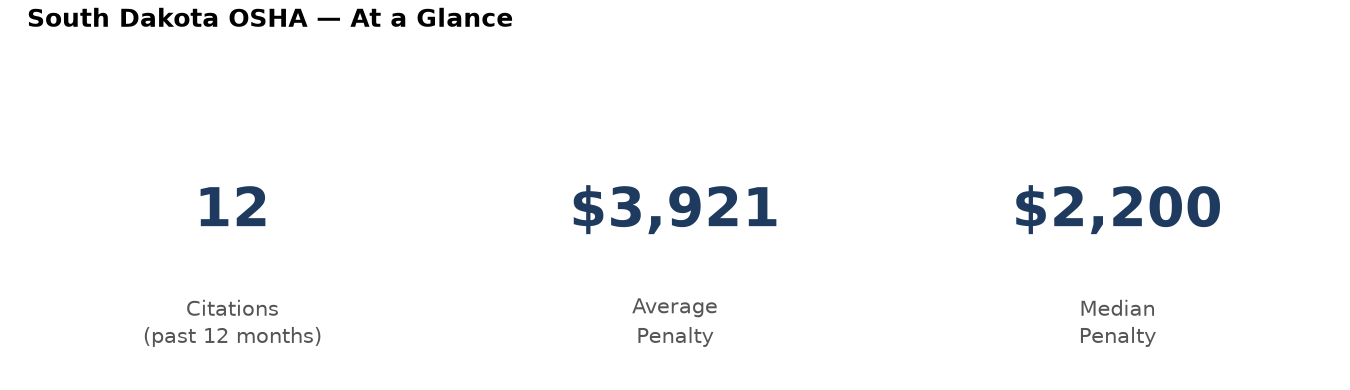
Over the past 12 months, OSHA issued 12 fall protection citations to South Dakota employers under the 1926.501 standard, with an average penalty of $3,921 and a median of $2,200. Eight of those 12 were classified as Serious, two as Repeat violations, and two as Other-than-Serious. Sioux Falls had more of these citations than any other city in the state, and roofing contractors were cited more than any other trade.
If you or your company just received one of these citations, the clock is already running. You have a limited window to respond, and the decisions you make in the next few days affect what you end up owing. Talking to a South Dakota OSHA defense attorney before that window closes is the single most useful step you can take right now.
What OSHA Actually Expects Once Someone Is Working Above Six Feet
The standard behind every one of these South Dakota citations, 1926.501, sets the baseline rule for fall protection in construction. Once a worker is exposed to a fall of six feet or more to a lower level, the employer has to have a protective system in place, whether that is guardrails, safety nets, or a personal fall arrest system harnessed to an anchor point. There is no gray area built into the standard for short jobs, quick tasks, or workers who feel confident on a roof or ladder. If the exposure exists, the protection has to exist too.
OSHA inspectors typically find these violations during routine site visits, after a complaint, or following an injury. Once an inspector documents a worker at height without protection, or with protection that is not being used correctly, a citation almost always follows. You can read more about how this rule is written and applied on our 1926.501 fall protection overview.
Roofing Work Is Driving Most of the Citations in the State
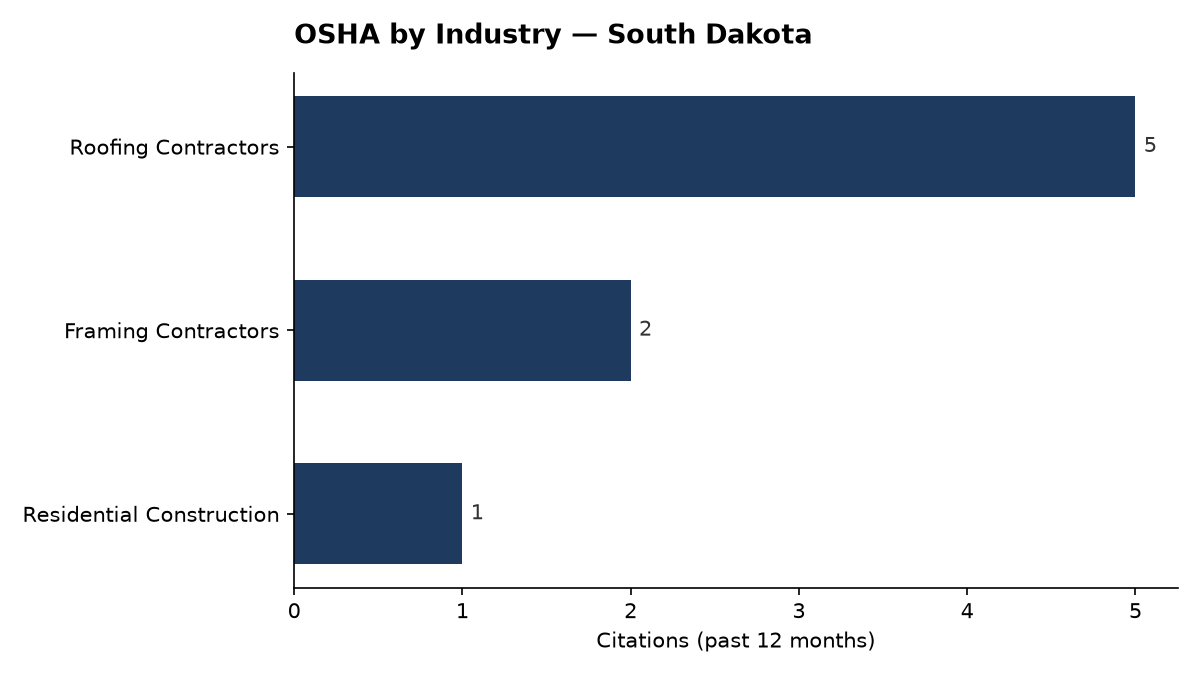
Of the 12 citations issued statewide, five went to roofing contractors, making it the most-cited trade in South Dakota by a wide margin. Framing contractors picked up two citations, and residential construction accounted for one more. This pattern lines up with what shows up nationally: roofing puts workers at height for entire shifts, often on pitched surfaces with limited anchor options, which makes it one of the easiest trades for an inspector to document a violation in.
Framing crews face a similar exposure whenever they are working open floor edges or elevated wall sections before permanent guardrails go up. The margin for error is thin in both trades, and it does not take a serious incident for OSHA to issue a citation — an inspector simply has to observe the exposure.
What These Citations Are Actually Costing South Dakota Employers
The $3,921 average penalty in South Dakota sits below the median penalty seen in some other states, but the individual numbers tell a more useful story. Two of the state’s 12 citations were classified as Repeat violations, and those carry much steeper fines than a first-time Serious citation because OSHA treats a repeat finding as evidence the hazard was known and not corrected.
That gap shows up clearly in the real citations issued this year. Orellana Construction, Inc. in Sioux Falls was cited $11,916 for a Repeat violation under 19260501(B)(10), issued January 13, 2026. Guerra Framing, LLC, also in Sioux Falls, was cited $7,000 for a Repeat violation under 19260501(B)(13), issued May 6, 2026. By comparison, Cardona Construction in Sioux Falls received a Serious citation of $5,958 under the same B13 provision, issued February 9, 2026. Joy Construction LLC in Mitchell was cited $4,965 for a Serious violation under 19260501(B)(11) on May 12, 2026, and Kea Constructors, LLC in Hartford was cited $3,939 for a Serious violation under 19260501(B)(01) on June 29, 2026.
Notice how much the Repeat citations cost compared to the Serious ones for a similar type of exposure. That difference is exactly why the classification on your citation matters as much as the dollar figure. It’s also worth knowing that the average penalty reduction in South Dakota, comparing initial citations to final resolved amounts, runs around 31 percent. That reduction generally does not happen on its own — it comes from employers formally contesting or negotiating, which is covered in more detail on our fall protection penalty breakdown.
A 31 percent reduction on a citation like Orellana’s would mean thousands of dollars back in your pocket. Before you decide to just pay what’s on the page, it is worth a conversation with a South Dakota OSHA defense attorney to see what room there actually is to negotiate or contest.
The 15-Working-Day Window You Cannot Afford to Miss
Once a citation is issued, you have 15 working days from the date you receive it to file a Notice of Contest. Miss that deadline and the citation becomes a final order automatically — no hearing, no negotiation, no appeal. That’s true whether the citation is a $2,200 Other-than-Serious finding or an $11,916 Repeat violation.
Filing a Notice of Contest does not mean you are guaranteed to beat the citation, but it preserves your options. It opens the door to informal settlement conferences with OSHA, reclassification of the violation, and penalty reductions like the 31 percent average seen in South Dakota resolutions this year. Our guide on how to contest an OSHA citation walks through what that process actually looks like step by step.
Given how little time you have and how much is riding on the classification (Serious versus Repeat versus Other-than-Serious), this is not a form you want to fill out without guidance. Reach out to a South Dakota OSHA defense attorney as soon as the citation arrives, not after you’ve already decided how to respond.
If you’re holding a fall protection citation right now, the smartest move is to get it in front of someone who handles these cases regularly before your 15 working days run out. The numbers above show real money was at stake for employers in Sioux Falls, Mitchell, and Hartford this year alone — don’t assume your situation is too small to be worth a second look.