
Alabama Fall Protection Citations: 56 Cases, $4,184 Average

Data last updated: August 24, 2026

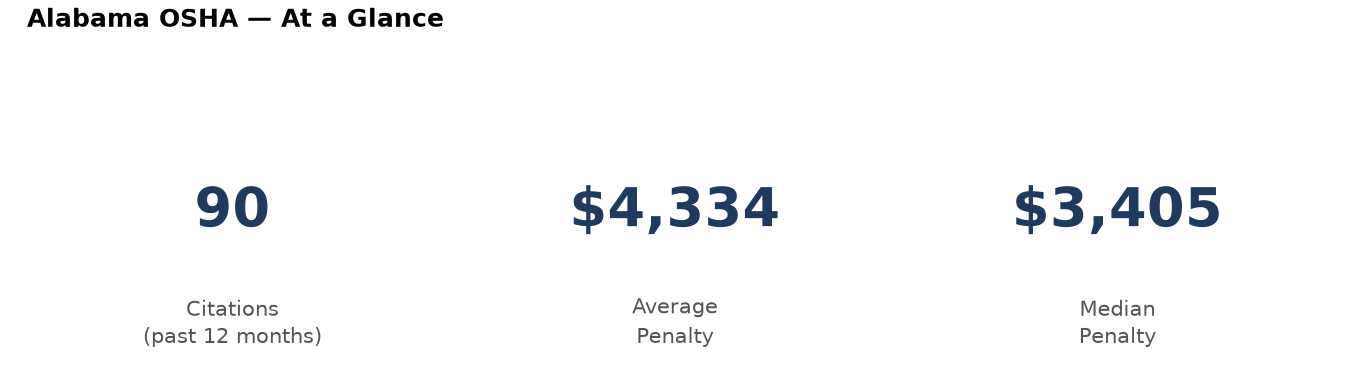
Key statistics: 56 osha citations in Alabama, average penalty $4,184, median $3,405

Over the past 12 months, OSHA issued 56 fall protection citations to employers working in Alabama, with an average penalty of $4,184 and a median of $3,405. Twelve of those citations were classified as Repeat violations — a category that signals OSHA already flagged the same hazard at that employer before and penalizes it much harder the second time. Fairhope shows up more than any other Alabama city in the citation record, though the cases stretch from Trussville to Spanish Fort to Pike Road.

If you run a construction crew in Alabama and a citation just landed on your desk, the clock is already moving. Talking to an Alabama OSHA defense attorney before you respond can change how much you end up paying and what shows up on your record going forward.

What OSHA Actually Requires Once Your Crew Is Off the Ground

Almost every one of these Alabama citations traces back to a single rule: 1926.501, OSHA’s general fall protection standard for construction. The standard is not complicated in concept — once a worker is exposed to a fall of 6 feet or more to a lower level, the employer has to provide protection. That means guardrails, safety nets, or a personal fall arrest system (harness, lanyard, and anchor point), chosen and installed correctly for the task at hand. There’s no grace period and no exception for a quick task or a short height above that 6-foot line. You can read the full breakdown of what this rule covers, and where employers most often get it wrong, on our 1926.501 fall protection standard hub.

What separates a Serious citation from a Repeat one is history, not just hazard. Of Alabama’s 56 citations, 43 were coded Serious, 12 were Repeat, and only 1 fell into the lower Other-than-Serious category. That ratio — over one in five citations being a Repeat — tells you OSHA is watching return visits closely in this state, and second offenses are getting punished at multiples of the first-time rate.

Framing Crews Are Carrying Most of Alabama’s Fall Protection Risk

Bar chart of OSHA osha citations by industry in Alabama

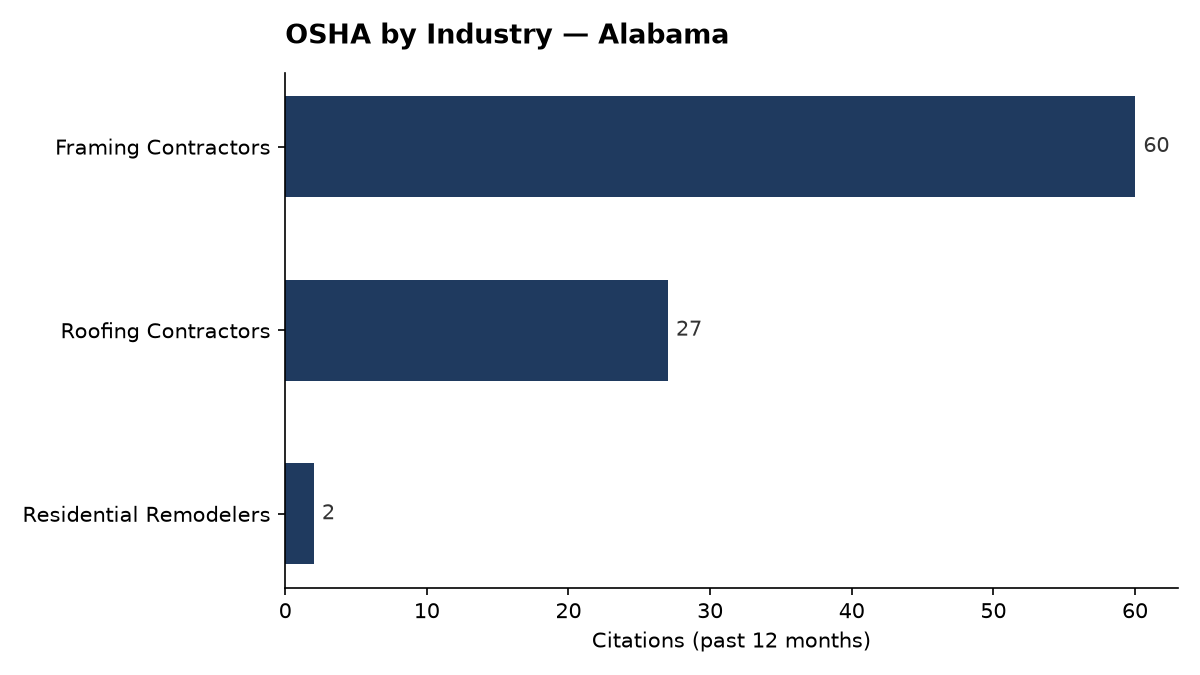
The industry breakdown here is lopsided. Framing contractors accounted for 37 of the state’s 56 citations — roughly two out of every three. Roofing contractors followed with 17, and residential remodelers picked up 2. That pattern makes sense given the nature of the work: framing crews spend entire shifts on open floor systems, roof decks, and exterior walls before any permanent guardrail or fall arrest anchor is in place, and the pace of production framing pushes crews to move fast between fall hazards. Roofing has its own well-known exposure, but in Alabama it’s framing operations generating more than double the citation volume.

If your business falls into either category, it’s worth assuming OSHA compliance officers already know where to look. A crew working roof trusses, wall panels, or open-sided floors without guardrails, nets, or a properly anchored harness system is the exact scenario 1926.501 was written to address.

What These Citations Actually Cost in Alabama

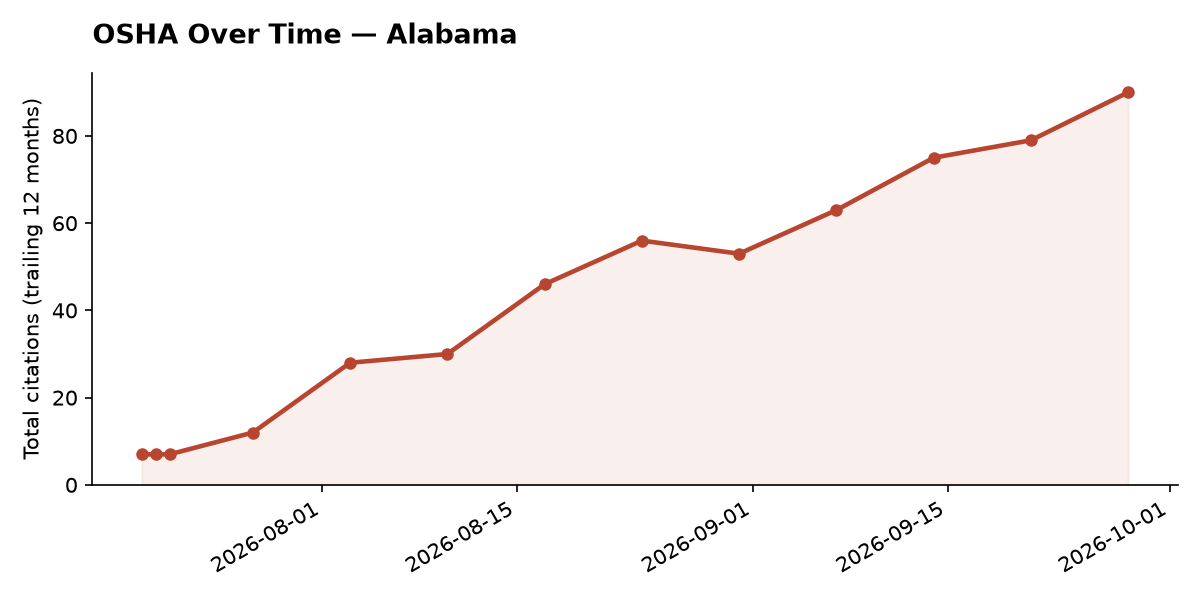
Line chart of OSHA osha citation trends over time in Alabama

The dollar figures in this state run from a few thousand dollars up into five figures per citation, and Repeat classification is what pushes a penalty into that higher range. Five recent Alabama cases illustrate the pattern clearly:

  • Alder Rivera Enriquez, Trussville — $11,916, Repeat, cited under 1926.501(b)(13), issued October 17, 2025
  • Oscar Garduno Rubio, Pike Road — $11,916, Repeat, cited under 1926.501(b)(13), issued April 14, 2026
  • Rene Munoz, Fairhope — $10,215, Repeat, cited under 1926.501(b)(13), issued December 5, 2025
  • Jesus Gonzalez, Spanish Fort — $10,215, Repeat, cited under 1926.501(b)(13), issued April 2, 2026
  • Diego Ventura Padron, Fairhope — $10,215, Repeat, cited under 1926.501(b)(13), issued April 10, 2026

Every one of these five cases falls under the same subsection, 1926.501(b)(13), which addresses fall protection during residential construction activities — and every one is coded Repeat, which is exactly why the penalties sit well above the statewide average of $4,184. For a deeper explanation of how OSHA calculates these figures and what pushes a number up or down, see our page on how fall protection penalty amounts are determined.

One more number matters here: the average penalty reduction in Alabama, from initial citation to final settlement, was just 4%. That’s a thin margin. It means most employers who simply pay what’s on the initial notice are leaving very little on the table for negotiation later, and it means the employers who do see real reductions are almost always the ones who contested or negotiated with legal representation early, not after the fact.

Before you decide whether to pay, negotiate, or fight a citation, get a candid read from an Alabama OSHA defense attorney — especially if your citation is coded Repeat, since that classification alone can multiply what you owe.

The 15-Day Window You Cannot Afford to Miss

Once a citation is issued, the employer has exactly 15 working days from the date it’s received to file a Notice of Contest. Miss that window and the citation — penalty, classification, abatement requirements, all of it — becomes final and largely unappealable. There’s no informal extension for being busy on a job site or waiting to see if OSHA follows up.

Within those 15 days, you have real options: request an informal conference with the OSHA area office, negotiate the classification or penalty, or formally contest the citation and take it to the Occupational Safety and Health Review Commission. Which path makes sense depends on the facts of your case, whether this is genuinely a first offense despite a Repeat label, and whether the underlying hazard was properly documented. Our guide on how to contest an OSHA citation walks through the mechanics, but the short version is: the earlier you get legal input, the more of these options stay open.

Given that Alabama’s average penalty reduction sits at just 4% overall, waiting until after the 15-day window closes is close to guaranteeing you pay the citation as written. Talking to an Alabama OSHA defense attorney while that window is still open is the single most concrete step you can take to change the outcome.

Whether your citation names a framing crew in the Trussville area, a roofing operation near Fairhope, or any other trade covered under 1926.501, the facts of your specific case — how the hazard was documented, whether prior citations genuinely apply to your business, and what abatement actually looks like — will decide what you owe. Get those facts in front of a lawyer before the 15 working days run out.

Leave a Comment