
Data last updated: August 31, 2026
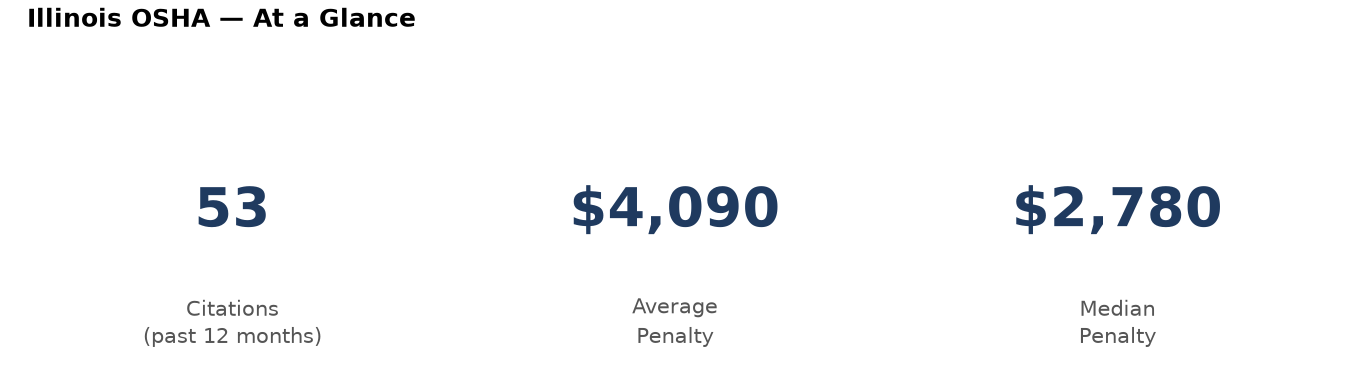
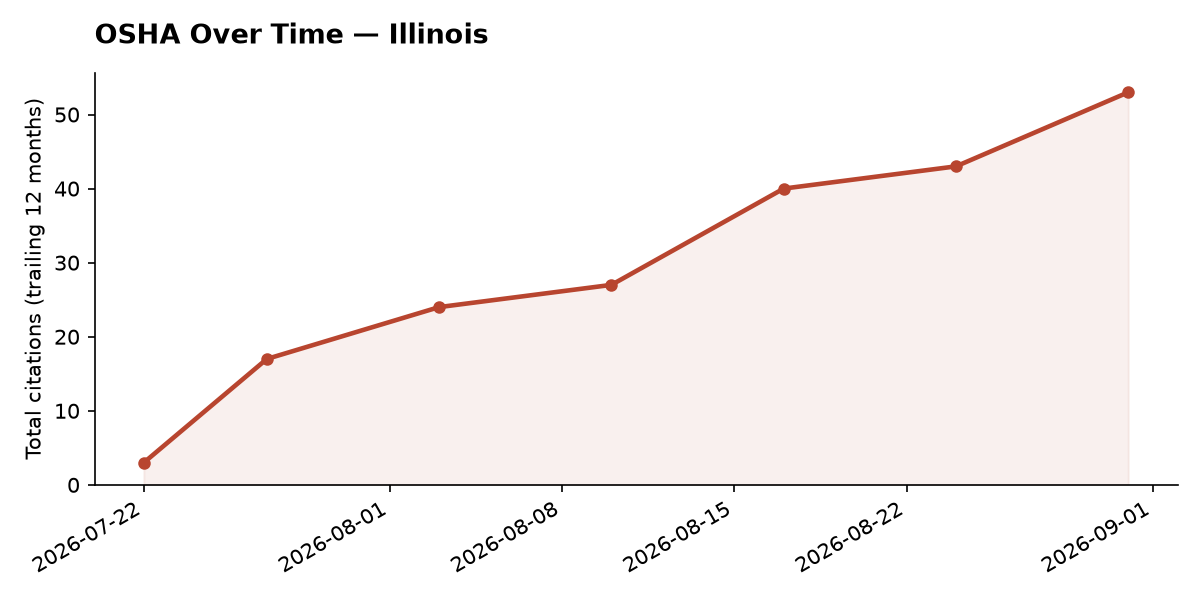
Illinois contractors picked up 53 scaffolding citations over the past 12 months, with Chicago generating more of them than any other city in the state. The average fine came in at $4,090, the median sat lower at $2,780, and one Chicago company was hit with a willful citation worth nearly $40,000. If you’re holding a citation right now, or you suspect one is coming, these numbers tell you exactly how much is at stake and how little time you have to respond.
A citation under this standard is not something to sit on. Once OSHA issues it, the clock starts immediately. Talk to an Illinois OSHA defense attorney before you decide how to respond, because the choices you make in the first two weeks shape everything that follows.
Why 1926.451 Keeps Showing Up on Illinois Job Sites
Nearly every scaffolding citation in Illinois traces back to one rule: 1926.451, OSHA’s general requirements for scaffold construction. This standard sets the baseline for how much weight a scaffold platform has to hold, how workers get on and off safely, when guardrails and planking are required, and what fall protection has to look like once someone is working above ground level on a scaffold. It’s a broad rule by design, which is exactly why it generates so many citations — inspectors can write it up for anything from a missing guardrail to an improperly rated platform to a scaffold that was never inspected before crews started working on it.
What makes 1926.451 dangerous for employers is how many separate ways there are to violate it on a single scaffold. A crew can get the planking right and still get cited for access, or nail the guardrails and still miss the capacity rating. Inspectors know this, and it’s part of why the violation counts stay high year after year.
Who’s Getting Cited: Trade Contractors Lead the List
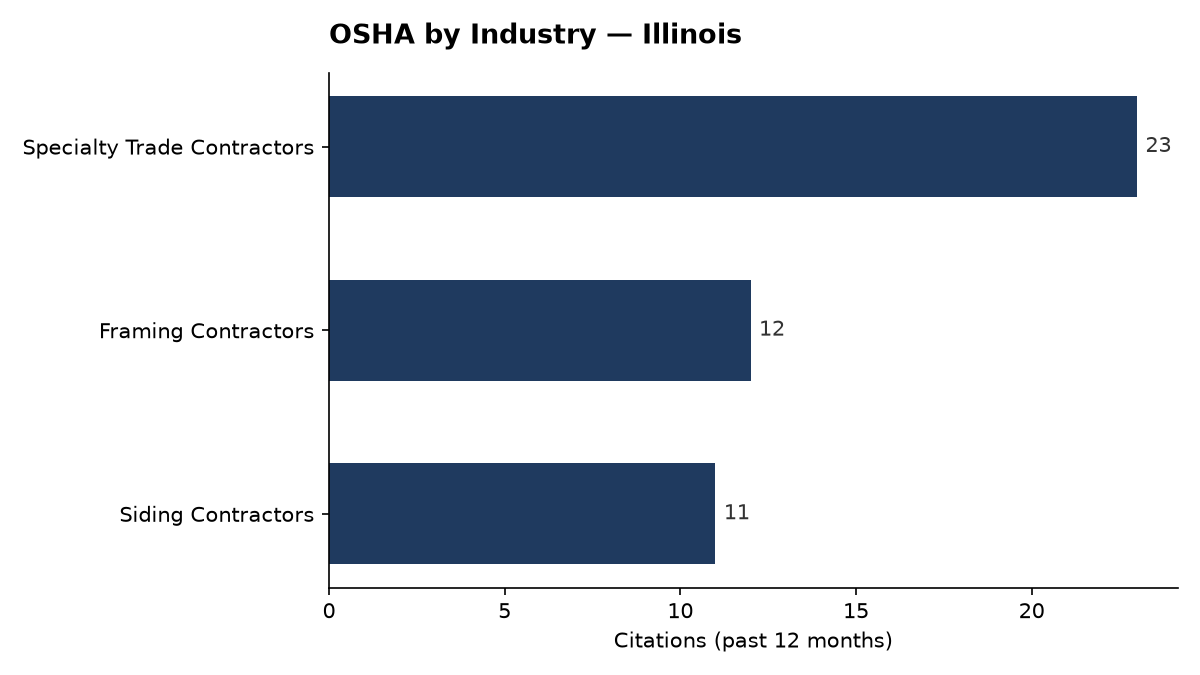
The breakdown by industry in Illinois is not close. Specialty trade contractors accounted for 23 of the 53 citations — more than the next two industries combined. Framing contractors picked up 12, and siding contractors added another 11. Together, these three trades represent more than 85 percent of all scaffolding enforcement in the state.
That pattern makes sense once you consider the work itself. Framing and siding crews are constantly setting up, moving, and tearing down scaffolds as a job progresses, often multiple times a day, on residential and light commercial projects where supervision on any given rig can be thin. Specialty trade contractors span everything from exterior finish work to mechanical installation, and many of them rent or reuse scaffolds across job sites without a consistent inspection routine. Every new setup is a new chance for a guardrail to go missing or a platform to get overloaded.
What These Citations Actually Cost in Illinois
Of the 53 citations issued, 43 were classified as Serious, 7 as Repeat, 2 as Other-than-Serious, and 1 as Willful. That single willful citation belonged to Kimberly Construction, LLC in Chicago, fined $39,723 after being cited under section 19260451 G01 on December 15, 2025 — a figure roughly ten times the state average, which shows exactly how much the classification level drives the penalty.
Repeat violations carry their own weight. Rafal Ropiak Construction in Chicago was fined $11,916 under 19260451 B01, issued September 25, 2025, and Timberview Builders LLC in Urbana was fined the identical $11,916 under 19260451 G01 VII, issued November 21, 2025 — both Repeat classifications, meaning OSHA had already flagged a similar hazard at these companies before. Serious citations still add up fast: Geometric Home Builders, Inc. in New Lenox was fined $13,902 under 19260451 G01 VII on November 28, 2025, and Finest Carpentry Inc. in Glencoe was fined $5,958 under 19260451 G01 on April 17, 2026.
One number worth paying attention to: the average penalty reduction between initial and final amounts in these cases runs about 22 percent. That gap exists because employers who push back — through negotiation or a formal contest — often get somewhere. Nobody gets that reduction by ignoring the citation and hoping it goes away. For more on how these dollar figures get calculated in the first place, see this breakdown of OSHA scaffolding violation penalty amounts.
A 22 percent average reduction is not automatic — it comes from employers who challenge the citation the right way. An Illinois OSHA defense attorney can review your citation and tell you within days whether the classification, the penalty, or the underlying facts are worth contesting.
You Have 15 Working Days — Here’s What to Do With Them
OSHA gives you exactly 15 working days from the date you receive a citation to file a Notice of Contest. Miss that window and the citation becomes a final order automatically, penalty and all, with almost no way back. That’s true whether you were cited for a single missing guardrail or, like Kimberly Construction, a willful violation carrying a five-figure fine.
Before that deadline hits, you want three things sorted out: whether the classification (Serious, Repeat, Willful) is accurate, whether the cited subsection actually applies to the conditions on your site, and whether informal settlement with the OSHA area office makes more sense than a formal contest. Each path has different implications for your OSHA history going forward, which matters because Repeat citations — like the two $11,916 cases above — depend entirely on what’s already in your file. Full detail on this process is covered in this guide to how to contest an OSHA citation.
Fifteen working days is not much runway when a five-figure penalty and your compliance record are both on the line. Speak with an Illinois OSHA defense attorney now so the deadline works in your favor instead of against you.
If you’ve received a scaffolding citation anywhere in Illinois — Chicago, New Lenox, Urbana, Glencoe, or elsewhere — the smartest move is to get someone who handles these cases regularly to look at the paperwork before you respond to OSHA. The classification, the subsection cited, and the timing of your filing all affect what you end up paying and what stays on your record.