
Data last updated: September 28, 2026
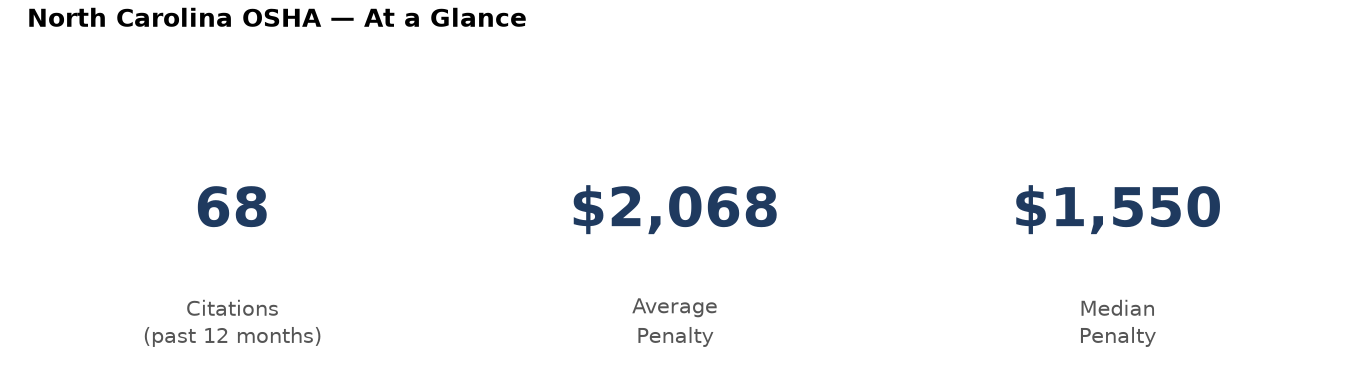
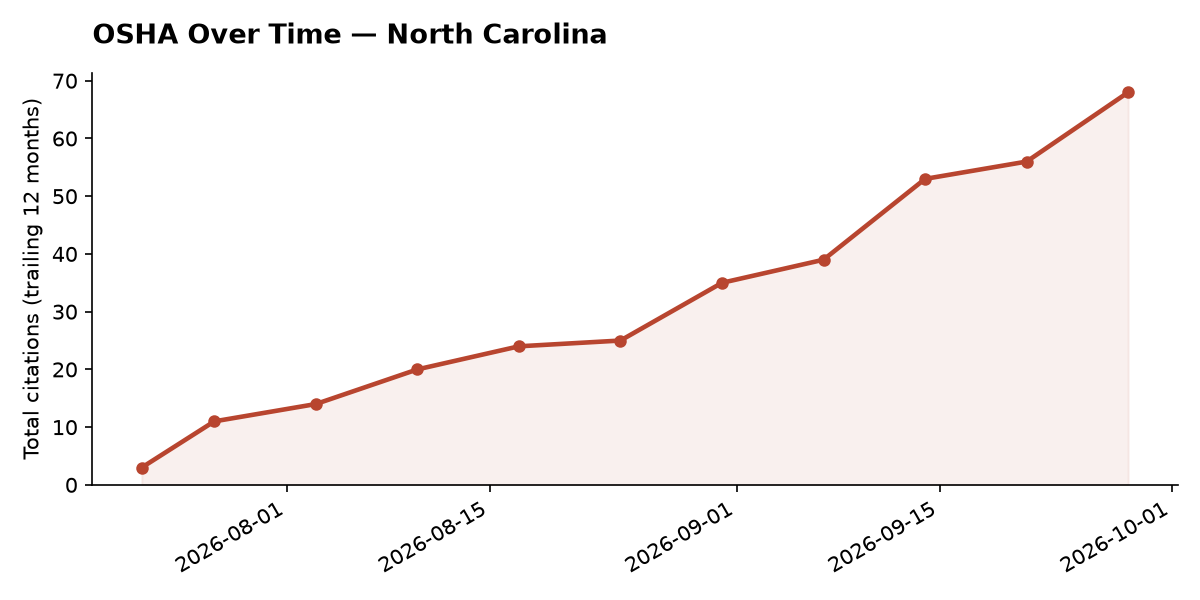
North Carolina construction employers racked up 68 scaffolding citations under OSHA standard 1926.451 in the past 12 months, with the average penalty landing at $2,068 and the median at $1,550. Topsail Beach saw more of these citations than any other city in the state, and siding contractors took the largest share of the enforcement action.
If you or your company just received a scaffolding citation in North Carolina, the clock is already running. Talk to a North Carolina OSHA defense attorney before you decide how to respond — the filing window is shorter than most owners expect.
What OSHA Actually Expects Under 1926.451
Almost every citation in this batch traces back to one rule: 1926.451, the general scaffolding standard. It is not a single narrow requirement — it is the backbone regulation covering how scaffolds get built, how much weight they can hold, how workers get on and off them safely, what fall protection looks like at height, and how planking and guardrails need to be arranged so nobody falls through a gap or off an unsecured platform.
In practice, inspectors show up looking for the basics: is the platform fully planked, is there a guardrail or personal fall arrest system where it is needed, is access safe, and is the whole structure rated for the load it is actually carrying. Miss any one of those and you are looking at a citation, even if the crew never had an incident. You can read more about how this standard is written and applied on the 1926.451 standard hub.
Siding and Framing Crews Are Carrying the Enforcement Weight
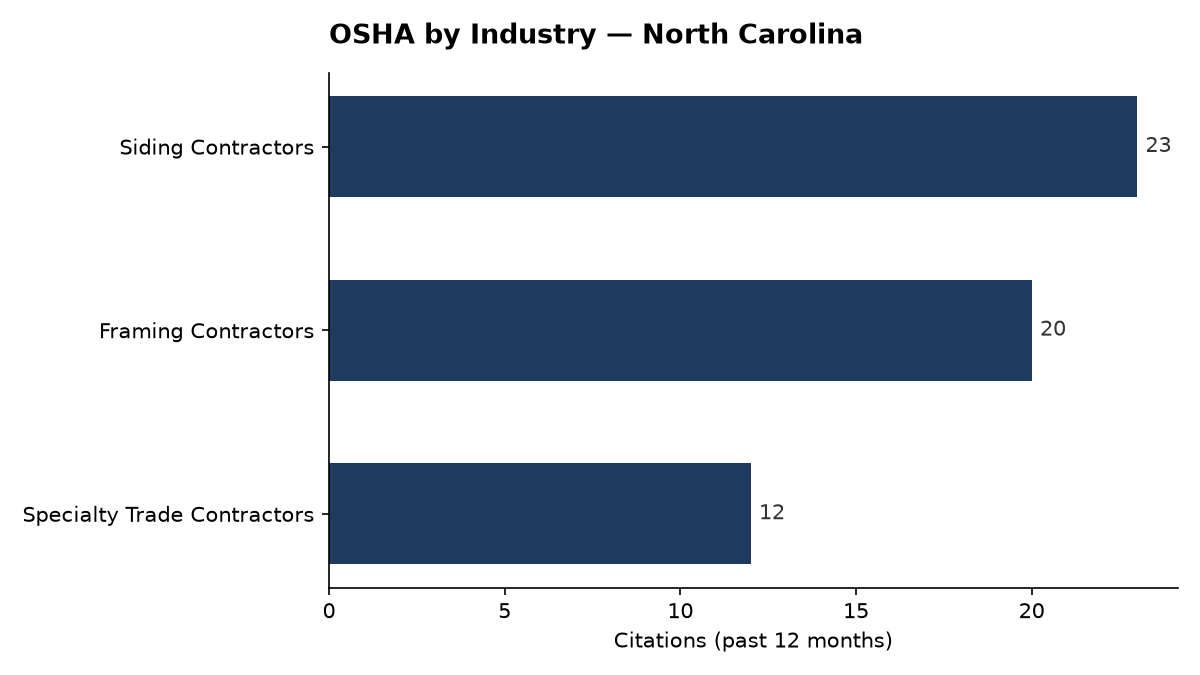
The industry breakdown here is not close. Siding contractors accounted for 23 of the state’s 68 citations, framing contractors picked up 20, and specialty trade contractors rounded out the top three with 12. Together, those three trades make up more than 80 percent of all scaffolding enforcement in North Carolina over the period.
That pattern makes sense given the type of work involved. Siding and framing crews spend long stretches working off scaffolds at exterior heights, often on residential jobs where scaffolds get assembled and torn down repeatedly across a project, increasing the odds that a plank gets skipped or a guardrail never goes back up. If you run a siding operation, it is worth reviewing how siding contractors get cited under this standard so you know exactly where inspectors tend to look first.
What These Citations Actually Cost in North Carolina
Of the 68 citations issued, 65 were classified as Serious, 2 as Other-than-Serious, and 1 as Repeat. That mix matters. A Serious classification means OSHA determined the violation created a real chance of death or significant injury — it is not a paperwork technicality, and it carries a meaningful penalty by design. A Repeat citation is worse: it means the employer was cited for the same or a substantially similar violation before, and penalties for repeat offenses climb sharply compared to a first-time Serious finding.
The real dollar figures back this up. D.R. Horton, Inc. in Castle Hayne was cited $9,000 for a Serious violation under 19260451 E01, issued March 26, 2026. Jedik Siding LLC in Huntersville drew a $6,000 penalty as a Repeat violation under 19260451 G04 I, issued June 30, 2026 — a clear example of how the Repeat classification pushes costs upward. South Masonry Corp in Topsail Beach was fined $4,965 under 19260451 C02, issued November 10, 2025, and Pako Renovation LLC in Clemmons received an identical $4,965 penalty under 19260451 B02, issued June 16, 2026. Natanael Trinidad Martinez in Lexington was cited $3,310 under 19260451 C02, issued October 22, 2025.
Notice that average penalties dropped by about 9 percent between the initial citation and the final settled amount statewide. That gap did not close itself — it reflects employers and their counsel negotiating classifications, correcting records, or contesting specific items rather than simply paying the first number OSHA sent. For a fuller breakdown of how these numbers get calculated and adjusted, see this explanation of OSHA scaffolding penalty amounts.
A citation with your company’s name on it is not a bill you just pay and move past. Before you sign anything or write a check, it is worth a conversation with a North Carolina OSHA defense attorney about whether the classification and penalty amount are actually defensible.
If You Were Just Cited, Here Is Your Actual Timeline
Once a citation lands, you have exactly 15 working days from the date you receive it to file a Notice of Contest. That is a hard deadline, not a suggestion — miss it, and the citation becomes a final order that you generally cannot challenge later, penalty and all. Fifteen working days moves fast, especially if the citation shows up during a busy build season, so this is not something to sit on while you gather paperwork.
Before that window closes, you want to understand your options: whether to contest specific items, whether to request an informal conference with the OSHA area office, or whether to negotiate the classification itself, particularly if you are facing a Repeat tag that you believe does not fit. Our page on how to contest an OSHA citation walks through the process step by step, but the details of your specific citation — the standard cited, the classification, the prior history OSHA is relying on — determine what strategy actually makes sense.
Given that the average North Carolina scaffolding penalty sits at $2,068 and Repeat violations run well above that, the cost of getting a second opinion is small next to what is at stake. Reach out to a North Carolina OSHA defense attorney now, while your 15 working days are still on the table, rather than after the deadline has already passed.
Pull your citation paperwork, check the issuance date against today, and count your remaining working days before you do anything else. That single step determines whether you still have options or whether the final order has already locked in.