

Data last updated: September 21, 2026
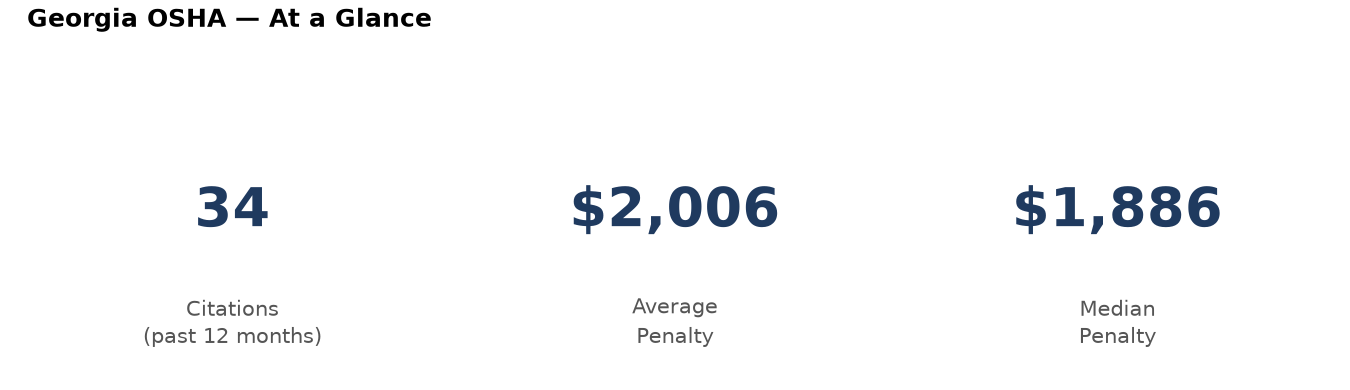
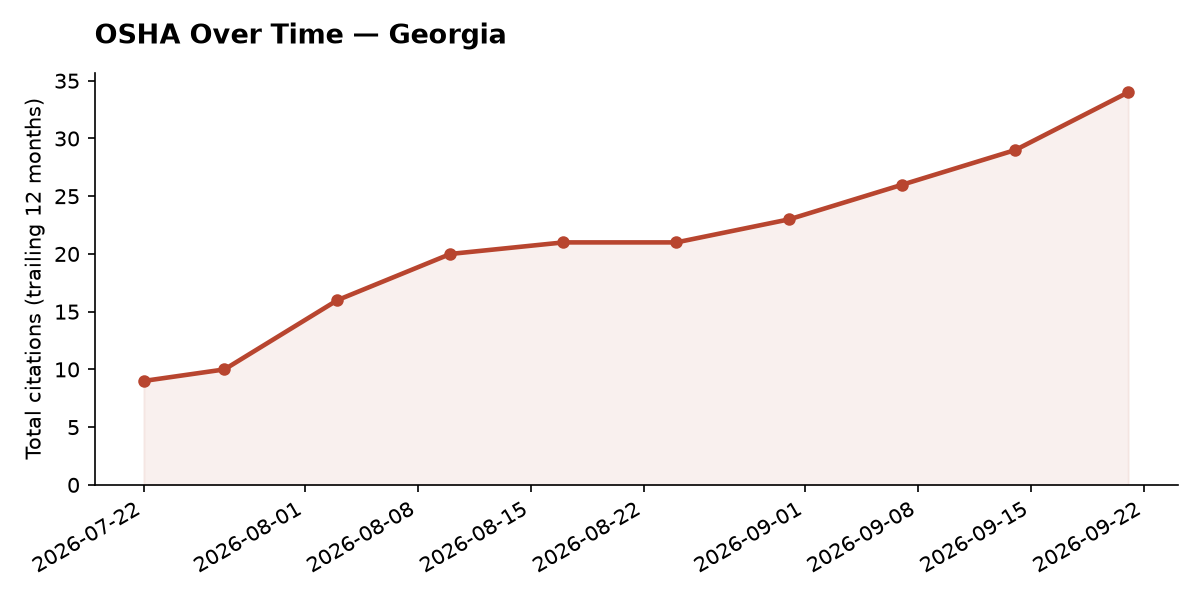
Over the past 12 months, OSHA issued 34 ladder-related citations to Georgia employers under standard 1926.1053, with an average penalty of $2,006 and a median of $1,886. Braselton logged more of these citations than any other Georgia city, and framing contractors took the biggest share of the enforcement activity statewide.
If you’re staring at a citation letter right now, the numbers below explain what you’re dealing with and what your options are. Before you decide how to respond, it’s worth talking to a Georgia OSHA defense attorney — especially since the clock on your response starts ticking the day the citation arrives, not the day you get around to reading it.
What OSHA’s Ladder Rule Actually Requires on a Georgia Job Site
The standard behind every one of these 34 citations is 1926.1053, OSHA’s general ladder rule for construction work. It’s not one narrow requirement — it covers how a ladder has to be set up, how far it needs to extend past a landing surface when workers are climbing on and off a roof or platform, how much weight it’s rated to hold, and the condition it has to be in before anyone steps on it. A ladder with a cracked rail, a missing foot, or one that’s simply too short for the job it’s being used for is enough to trigger a citation, even if nobody gets hurt.
In Georgia, 33 of the 34 citations issued this past year were classified as Serious, meaning OSHA determined the hazard could realistically cause death or serious physical harm. One was a Repeat violation, which means the same employer had already been cited for a similar ladder issue before and it happened again. Repeat classifications matter because OSHA’s penalty math treats them very differently from a first-time Serious finding — the fine multiplies fast.
Framing Crews Are Georgia’s Biggest Target, Roofing Close Behind
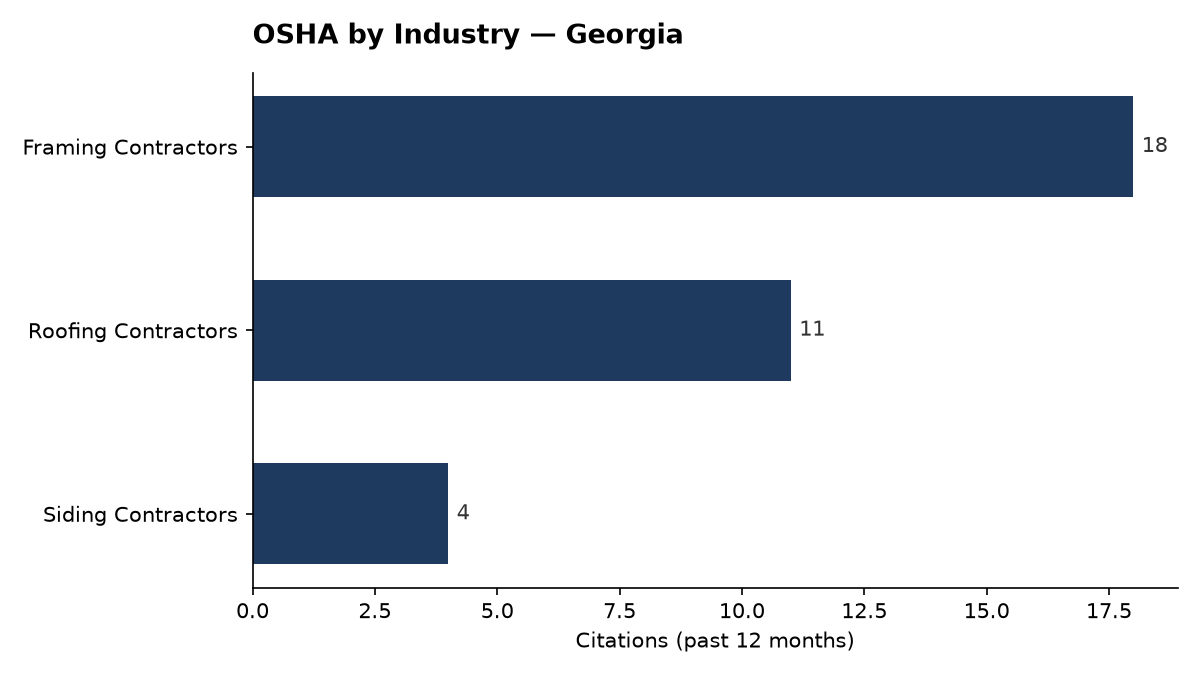
Of the state’s 34 ladder citations, 18 went to framing contractors — well over half. Roofing contractors accounted for 11 more, and siding contractors picked up 4. That pattern isn’t random. Framing and roofing crews spend most of their day on and off ladders, moving between grade level and upper floors or roof edges, often on residential sites where supervision is thinner and ladders get reused across multiple jobs without much inspection.
The real citations back this up. M&V Framing, LLC in Braselton was cited $6,809 for a Repeat violation under 19261053 B01, issued April 21, 2026 — by far the largest penalty in this data set, driven by the Repeat classification. Two individual contractors in Lawrenceville, Luis Alberto Chilel and Jorge Garcia, each received Serious citations of $3,405 under the same subsection, issued about a month apart in April and May 2026. Juan Carlos Saavedra in Flowery Branch was cited $2,837, and Roman Construction Company LLC in Conyers was cited $2,553, both Serious violations under 19261053 B01. Every one of these came down to the same underlying standard — how the ladder was set up or maintained on-site.
What a Ladder Citation Actually Costs in Georgia
On paper, a $2,006 average penalty might not sound like it threatens a business. But that average hides a wide range, from citations near $1,886 (the median) up to the $6,809 Repeat citation against M&V Framing. And penalties on ladder violations rarely stand alone — inspectors who find one ladder problem often find fall protection or scaffolding issues on the same walkthrough, and those add up fast under OSHA’s penalty structure.
Here’s the detail that matters most if you’re deciding how to respond: employers who negotiated or contested their citations in this data set saw an average penalty reduction of 12% between the initial and final amount. That’s not a guarantee, and it’s not automatic — it comes from employers who pushed back, corrected documentation gaps, or challenged the classification rather than paying the first number OSHA sent. On a $6,809 Repeat citation, that difference is real money.
Before you write a check or assume the citation is final, get a Georgia OSHA defense attorney to look at the classification and the paperwork. A Repeat or Serious label that doesn’t hold up under scrutiny can sometimes be knocked down, and that directly changes what you owe.
The 15-Day Window: What to Do the Moment a Citation Arrives
Georgia employers get exactly 15 working days from the date they receive an OSHA citation to file a Notice of Contest. Miss that window and the citation becomes a final order — no appeal, no negotiation, just a bill and a permanent record that can turn a future first-time issue into a Repeat violation years down the road, the same way it did for M&V Framing.
That 15-day clock doesn’t pause for the holidays, doesn’t wait for your insurance broker to call back, and doesn’t care that you’re mid-project. If you think the classification is wrong, the penalty is inflated, or the inspector missed context about how the ladder was actually being used, you need to act inside that window. Walking through how to contest an OSHA citation is a good first step, but given how tight the deadline is, most Georgia employers are better served getting a lawyer involved immediately rather than trying to sort out the timeline alone.
If you’ve received a ladder citation in Georgia, or you suspect one is coming after a recent inspection, don’t wait for the certified letter to sit on your desk while the 15-day clock runs. Talk to a Georgia OSHA defense attorney now, while you still have options on the classification, the penalty amount, and whether the citation gets contested at all.