
Data last updated: September 21, 2026
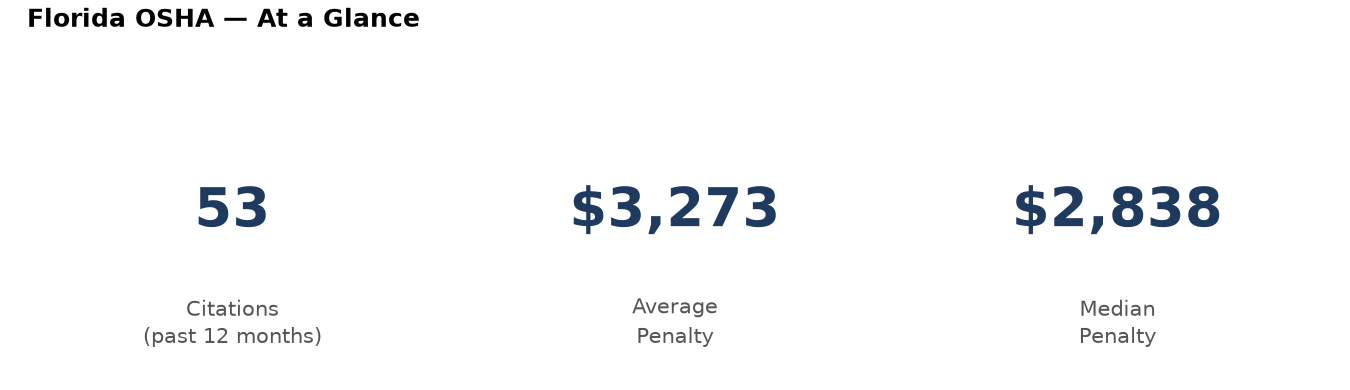
Florida contractors racked up 53 ladder violations under OSHA’s 1926.1053 standard over the past 12 months, with penalties averaging $3,273 and a median of $2,838. Palm Beach Gardens saw more of these citations than any other city in the state. Forty-nine of the 53 were classified as Serious, meaning OSHA determined the violation carried a real risk of death or serious injury.
If you’ve just opened an envelope with a citation number on it, the clock is already running. Talk to a Florida OSHA defense attorney before you decide how to respond — the wrong move in the first two weeks can cost you options you didn’t know you had.
What 1926.1053 Actually Requires On Site
The ladder standard isn’t just about owning the right equipment. It covers how a ladder is set up on the job, how far it needs to extend past a landing or roofline, how much weight it’s rated to hold, what happens when a rung or rail gets damaged, and how workers are expected to use it once it’s in place — things like maintaining three points of contact and not carrying loads that throw off balance. Inspectors check all of this during routine walkarounds, and a single ladder positioned wrong at the edge of a roof is often enough to trigger a citation. You can read the full breakdown of the 1926.1053 standard if you want the complete list of requirements before your next site visit.
Why Roofers Make Up Nearly Half of Florida’s Citations
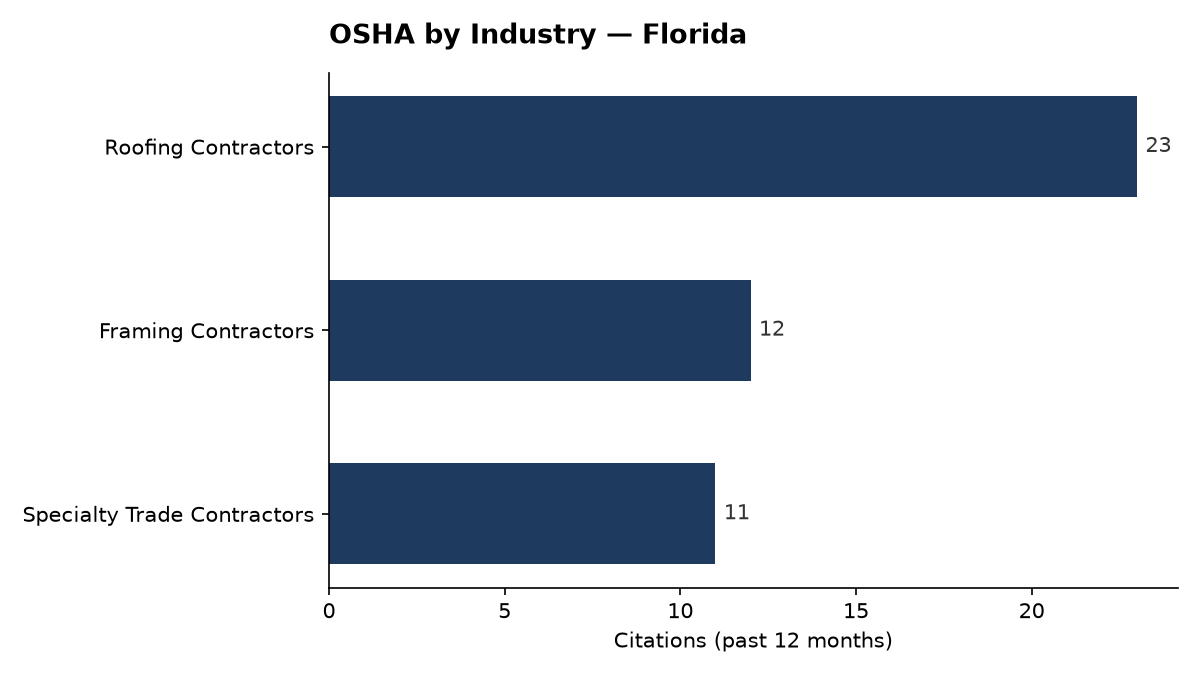
Roofing contractors accounted for 23 of the 53 citations statewide — by far the largest share, followed by framing contractors at 12 and specialty trade contractors at 11. That pattern tracks with the nature of the work: roofers spend the day moving ladders up and down steep or pitched surfaces, often extending them well past a roof edge in conditions where a few inches of misjudgment matters. Florida’s roofing season runs almost year-round, which means more ladder setups, more opportunities for a rushed job to draw an inspector’s attention, and more citations overall. Anyone running crews in this trade should look closely at how roofing contractors get cited for ladder violations before their next OSHA visit.
Recent enforcement actions show how this plays out in practice. Advanced Roofing, Inc. in New Port Richey was cited $13,240 for a Serious violation under subsection B07, issued February 13, 2026. Bill Shields Roofing, Inc. in Tampa received a $7,945 Serious citation under B01 on July 20, 2026. Munoz Roof And More, LLC in Jacksonville was hit with a $6,809 Repeat citation, also under B01, on July 21, 2026 — Repeat classifications typically mean OSHA found a similar violation at that employer before, which pushes penalties higher. Outside roofing, Pjwd Energy LLC in Apopka faced a $6,621 Other-than-Serious citation under B01 in March 2026, and Allen Concrete & Masonry, Inc. in Naples was cited $6,149, also Other-than-Serious, under B04 in late January 2026.
What a Citation Like This Actually Costs You
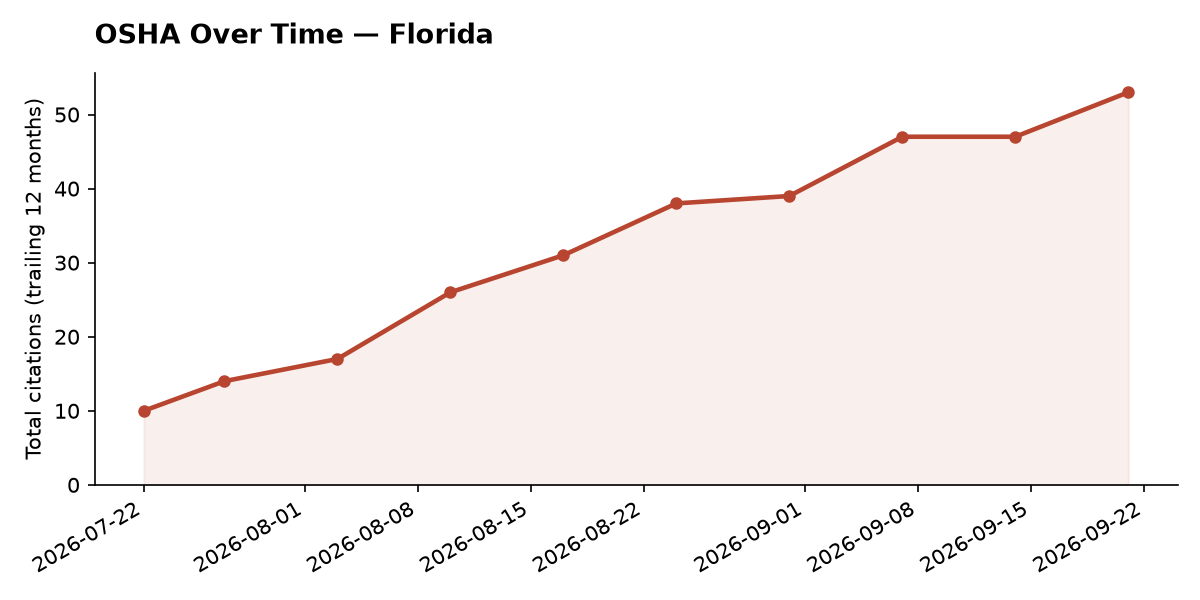
Of the 53 citations issued statewide, 49 were Serious, 3 were Other-than-Serious, and 1 was a Repeat violation. That mix matters because Serious and Repeat citations carry much steeper base penalties than Other-than-Serious findings, and a Repeat classification can multiply the fine several times over compared to a first-time Serious violation. The average penalty across all of these was $3,273, but employers who negotiated or contested their citations saw an average reduction of 12% between the initial penalty and the final amount. That gap is real money, and it’s the clearest evidence that how you respond to a citation changes the outcome. For a full explanation of how these numbers are calculated, see how OSHA ladder violation penalties are determined.
A 12% average reduction doesn’t happen by accident — it happens because someone pushed back on the citation with the right documentation and argument. Before you pay a fine as issued, get a Florida OSHA defense attorney to look at whether your citation holds up.
The 15-Day Window You Can’t Afford to Miss
Once you receive a citation, OSHA gives you exactly 15 working days to file a Notice of Contest. Miss that window and the citation becomes a final order automatically — no appeal, no negotiation, no reduction, regardless of whether the violation was accurately classified or fairly penalized. This is the single most common mistake employers make: they assume there’s time to think it over, or they try to resolve things informally with the area office and let the clock run out. Read through how to contest an OSHA citation to understand what the process actually involves, including what documentation strengthens your case and what an informal conference with OSHA can and can’t accomplish.
Given that Repeat and Serious classifications made up 50 of Florida’s 53 ladder citations this past year, most employers facing this situation are dealing with a penalty level that’s worth fighting, not just paying. The 15-working-day deadline doesn’t leave room for delay, and every day spent deciding is a day closer to losing the right to contest at all.
If you’ve been cited, or you suspect one is coming after a recent inspection, don’t wait to see what shows up in the mail. Speak with a Florida OSHA defense attorney now, while you still have the full 15 working days to act on your citation.