
Data last updated: September 07, 2026
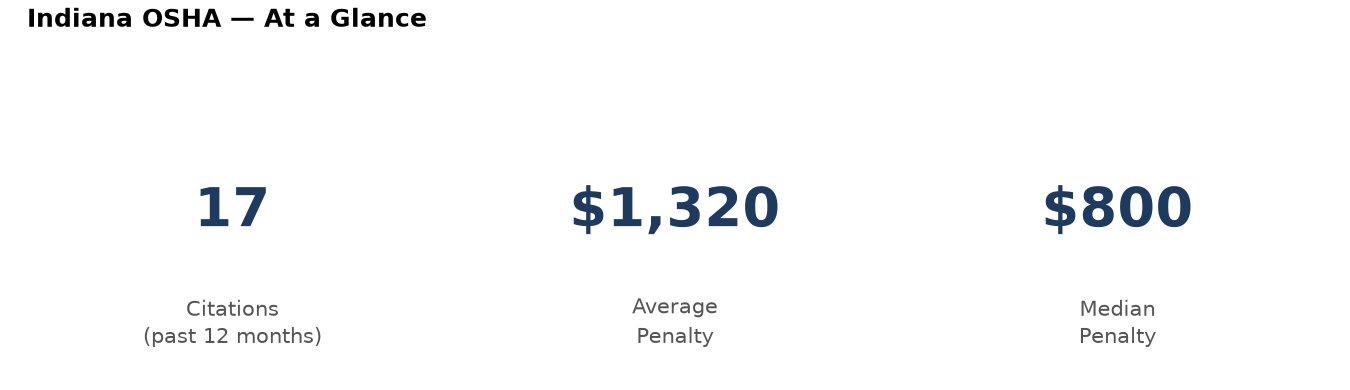
Indiana employers picked up 17 fall protection citations under 1926.501 over the past 12 months. That’s not a flood of paperwork like you’d see in a bigger construction state, but it’s not nothing either — the average penalty came in at $1,320, the median at $800, and the top violation city, Clarksville, shows this isn’t confined to one metro area. Roofing crews took the brunt of it, and at least one citation carried a repeat designation, which is the kind of label that raises the stakes fast.
If you’re holding a citation right now, or you think one is coming, the clock matters more than the paperwork. Talk to an Indiana OSHA defense attorney before you decide how to respond — you have a limited window to contest, and that decision shapes everything that follows.
What 1926.501 Actually Demands From an Indiana Job Site
The standard behind every one of these 17 citations is 1926.501, OSHA’s core fall protection rule for construction. In plain terms: once a worker is exposed to a fall of six feet or more to a lower level, the employer has to do something about it — guardrails, safety nets, or a personal fall arrest system. It’s not a suggestion or a best practice. OSHA treats the absence of any one of those protections, when the exposure exists, as a violation on its own, regardless of whether anyone actually fell.
That’s why so many of these citations show up on roofs and open floor edges. The standard doesn’t care about intent or how long the worker was up there — it cares about whether protection was in place the moment someone was exposed. A five-minute task without a harness is treated the same as an all-day job without one.
Why Roofing Crews Account for Most of Indiana’s Citations
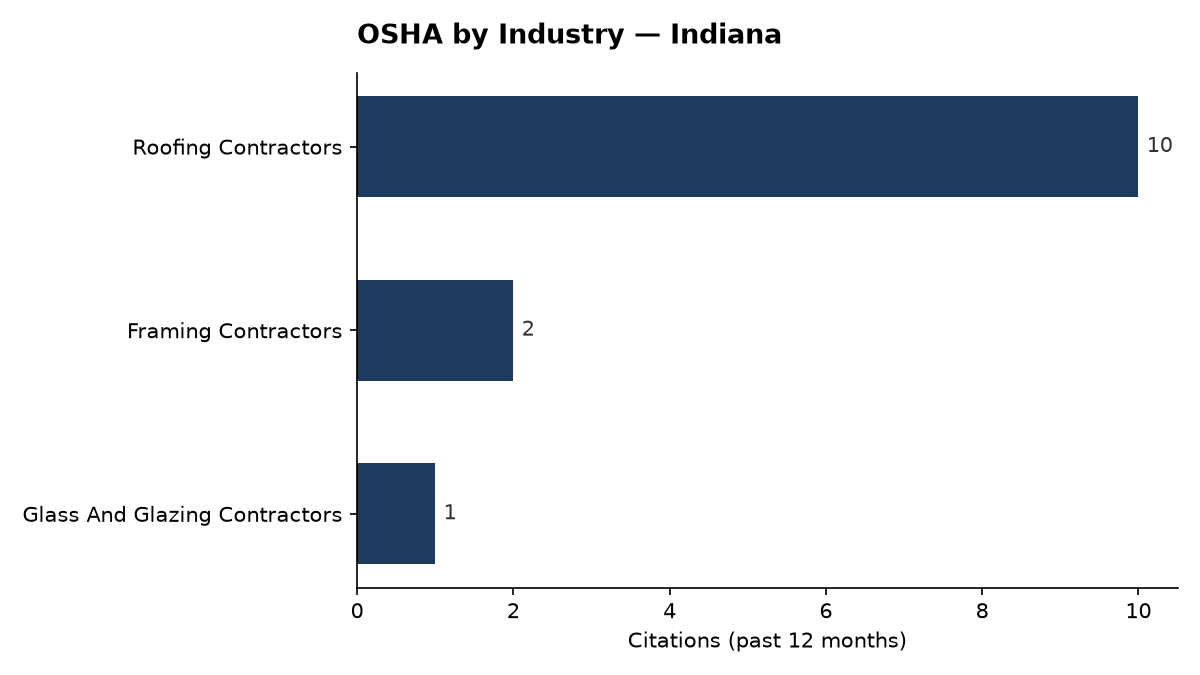
Ten of the state’s 17 citations hit roofing contractors — nearly two-thirds of all fall protection enforcement in Indiana over the period. That’s not surprising. Roofing puts workers at height constantly, often on steep or unstable surfaces, and it’s one of the easiest jobsites for a compliance officer to spot a problem from the ground.
Framing contractors picked up two citations, and one went to a glass and glazing contractor. Both trades share the same basic exposure as roofing — workers moving along open edges or elevated platforms without a fixed reference point — just at a smaller scale in Indiana’s citation numbers.
If your business falls into any of these trades, the odds of a fall protection inspection aren’t hypothetical. OSHA’s local area offices know where to look, and roofing in particular draws attention almost automatically when crews are visible from the street.
What These Citations Actually Cost in Indiana
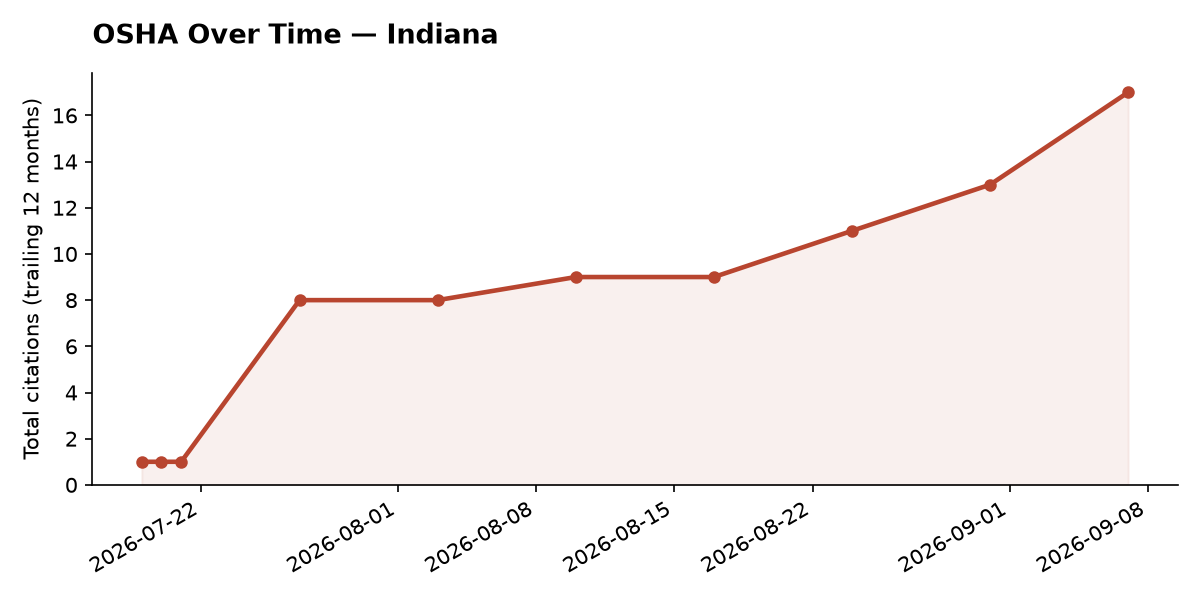
Of the 17 citations, 15 were classified Serious, one was a Repeat violation, and one was Other-than-Serious. That mix matters. A first-time Serious citation might land close to the $800 median, but a Repeat citation signals OSHA has cited the same employer for the same or a similar hazard before — and the penalty reflects it. The Bonilla Group LLC in North Liberty saw exactly that jump: an $8,000 penalty for a Repeat violation under 19260501 B13, issued January 28, 2026, several times the state average.
Other recent examples show the more typical range. Precision Wall Systems Inc in East Chicago was cited $2,730 for a Serious violation (19260501 B04 I) issued November 13, 2025. Hle Construction in Laporte, Bermejo’s Remodeling in Gary, and Olympia Roofing in Schererville each received $1,400 Serious citations — issued February 3, February 10, and February 2, 2026, respectively — all under closely related subsections of 1926.501. Those numbers land right around Indiana’s median, which tells you the $800-to-$1,400 range is where most first-time Serious citations end up.
Worth noting: the average penalty reduction between initial and final assessment in Indiana was only 6%. That’s a modest cushion. It means most citations here aren’t getting substantially negotiated down after the fact — the number OSHA writes on the citation is close to the number that sticks. For a full breakdown of how these amounts get calculated and what drives them up or down, see this guide to OSHA fall protection violations penalty amounts.
A $1,400 citation might feel manageable on its own. But if it’s your second one, or if OSHA reclassifies it upward during the inspection process, you’re looking at Repeat-level exposure — and that’s where the numbers stop being manageable without help. This is a good point to get an Indiana OSHA defense attorney looking at the specifics of your citation before you respond.
The 15-Day Window You Can’t Afford to Miss
Once a citation arrives, you have 15 working days to file a Notice of Contest. Miss that window and the citation — and the penalty attached to it — becomes final. There’s no appeal process after that point, no matter how strong your argument might have been.
Given that Indiana’s average penalty reduction is just 6%, contesting isn’t a guaranteed win, but it’s often the only mechanism that gives you room to negotiate the classification, the amount, or the abatement terms at all. Filing the notice preserves your options; it doesn’t commit you to a drawn-out fight. You can read more about the mechanics of the process in this overview of how to contest an OSHA citation.
The mistake most employers make is treating the citation as final the day it arrives, paying it, and moving on. That might be the right call in some cases — but it should be a decision you make after talking to someone who handles these cases regularly, not a default reaction to a deadline you didn’t know existed.
If you’ve received a fall protection citation in Indiana, don’t let the 15-working-day clock run out while you’re still deciding what to do. Reach out to an Indiana OSHA defense attorney now and find out what your specific citation actually means for your business.