Data last updated: September 07, 2026
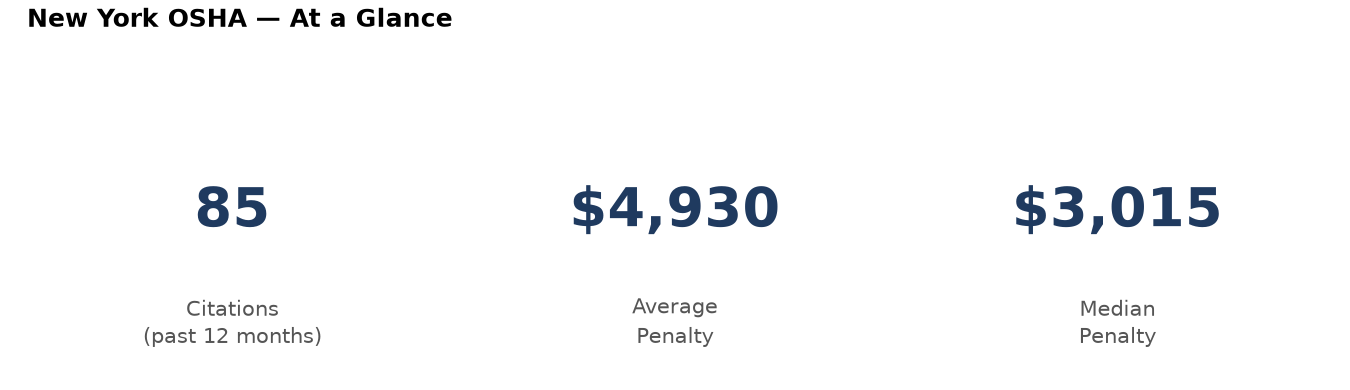
Over the past 12 months, OSHA issued 85 fall protection citations to employers across New York under the general fall protection rule, 1926.501. The average penalty landed at $4,930, with a median of $3,015 — meaning half of all cited employers paid less than that, but a meaningful chunk paid far more. Syracuse stands out as the city with the most citations by a wide margin, and roofing work drives most of the enforcement activity statewide.
If you have already been cited, the clock is running. Talk to a New York OSHA defense attorney before you respond to OSHA, not after.
What OSHA Actually Requires Once Work Moves Above Six Feet
The standard behind every one of these 85 citations, 1926.501, sets the baseline rule for fall protection on construction sites. Once a worker is exposed to a fall of six feet or more to a lower level, the employer has to provide protection — that means guardrails, safety nets, or a personal fall arrest system, chosen based on the type of work being done. There is no gray area built into the rule about whether protection is optional at that height; the obligation kicks in automatically. Inspectors look for exposed edges, open roof perimeters, skylights without covers, and workers tied off incorrectly or not at all. Most citations in New York trace back to one of these same basic gaps.
Roofers Carry the Weight of Enforcement in New York
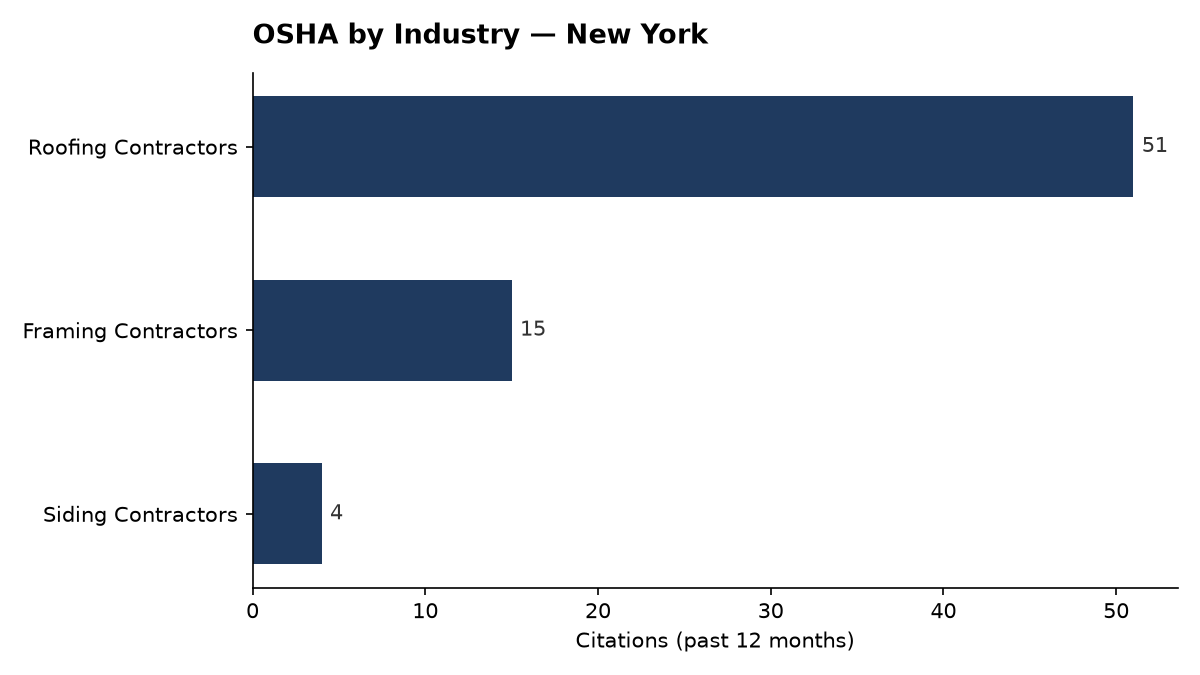
Of the 85 citations issued statewide, 51 went to roofing contractors — roughly 60 percent of every fall protection case in the state. Framing contractors came in a distant second with 15 citations, and siding contractors accounted for 4 more. That pattern is not a coincidence. Roofing work puts crews at height for the entire job, often on sloped or unstable surfaces, and it is one of the industries OSHA’s regional offices actively target for unannounced inspections. If your business does roofing, framing, or siding work anywhere in New York, assume that a compliance officer showing up on site is a real possibility, not a remote one.
What a Citation Actually Costs, and Why the Category Matters
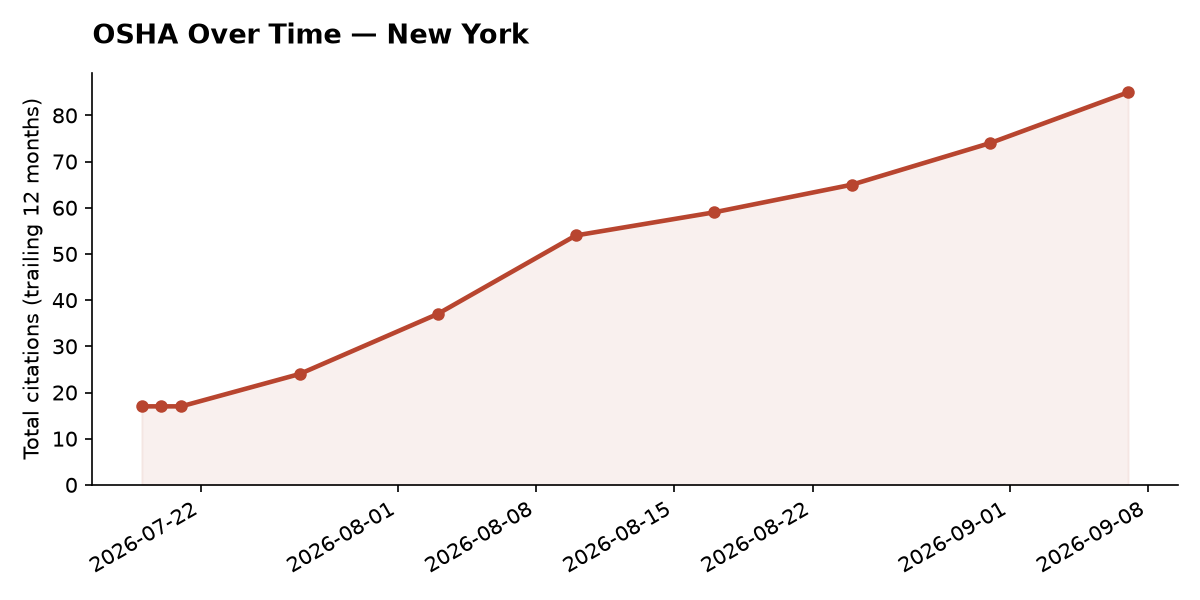
Not all 85 citations were treated the same way. The breakdown looks like this: 67 were classified Serious, 14 were Repeat, 2 were Other-than-Serious, and 2 were Willful. That distinction matters enormously for your wallet. Serious violations carry the standard penalty range, but Repeat and Willful citations multiply the exposure fast, since OSHA treats them as evidence the employer knew about the hazard and failed to fix it.
The real cases on file back this up. Melo Roofing, Inc. in Syracuse was cited $29,790 as a Repeat violation under subsection 1926.501(b)(13), issued December 5, 2025. Highridge Construction, Corp. in Harrison faced a $25,537 Repeat citation under the same subsection, issued November 28, 2025. Daniel Diaz, also based in Syracuse, was cited $25,537, again Repeat, dated June 18, 2026. Z&J Contracting Inc. of Syracuse and Mayden Inc., also of Syracuse, each received Willful citations of $22,698, issued March 17, 2026 and April 2, 2026 respectively. Four of these five largest cases are tied directly to Syracuse, which lines up with the city’s position as the top location for fall protection enforcement in the state.
There is one more number worth knowing: penalties in New York get reduced by an average of 20 percent between the initial citation and the final resolved amount. That gap does not close itself — it happens through negotiation, evidence, and formal contest procedures, which is exactly the kind of process OSHA fall protection violations penalty amounts data helps put in context. A $22,698 Willful citation and a $29,790 Repeat citation are not fixed numbers — they are starting points.
A 20 percent average reduction on a Repeat or Willful citation can mean thousands of dollars, but only if someone challenges the citation the right way, on time. Get a New York OSHA defense attorney to review your citation before that window closes.
The 15-Day Clock Starts the Moment You Receive the Citation
If your business has just been cited, you have exactly 15 working days from the date you receive it to file a Notice of Contest. Miss that deadline and the citation, along with the full penalty, becomes final — you lose the right to challenge the classification, the penalty amount, or the underlying facts. Given that Repeat and Willful citations in New York have run as high as $29,790, that is not a deadline to let slip while you gather paperwork.
The process for contesting is specific: you have to respond in writing within that window, and the way you frame the contest affects what can still be negotiated later. Reviewing how to contest an OSHA citation before you file anything will help you understand what is actually at stake and what options remain open once the clock starts.
With 85 citations issued statewide and average penalties nearing $5,000 — climbing far higher for Repeat and Willful cases — this is not the moment to guess at your next move. Speak with a New York OSHA defense attorney while your 15 working days are still running.
Whatever stage you are at — a citation just arrived, or you are trying to get ahead of an inspection — the smartest step is getting someone who handles these cases regularly to look at your specific paperwork before you sign or respond to anything.