Data last updated: September 21, 2026
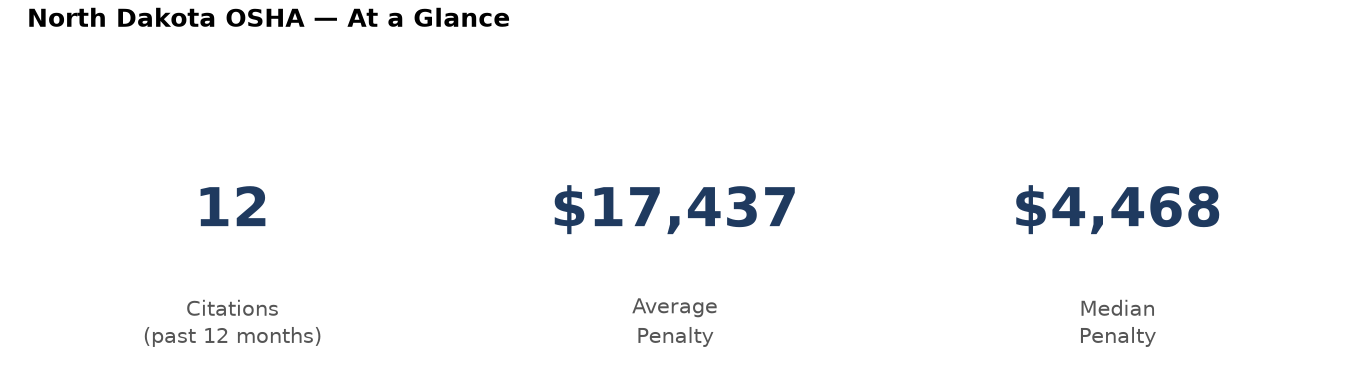
North Dakota regulators issued 12 fall protection citations under standard 1926.501 over the past 12 months, with an average penalty of $17,437 and a median of $4,468. That gap between average and median tells you something: most cases settle in the low thousands, but a handful of serious cases pull the average way up — including one Bismarck case that closed at $119,170.
If you or your company just received a citation like this, the clock is already running. Talk to a North Dakota OSHA defense attorney before you decide how to respond — the deadlines here are shorter than most business owners expect.
What Employers Are Actually Required to Do at Height
Standard 1926.501 is the backbone rule for fall protection on construction sites. In plain terms, it says that once a worker is exposed to a fall of 6 feet or more to a lower level, the employer has to do something concrete about it — not just tell workers to be careful. That something has to be a guardrail system, a safety net, or a personal fall arrest system (harness, lanyard, anchor point) that’s actually rated and set up correctly for the task.
OSHA inspectors don’t just check whether equipment exists on the jobsite. They check whether it was being used correctly at the moment of the inspection, whether it matched the specific hazard (roof edge, floor opening, leading edge, skylight, etc.), and whether supervisors were enforcing it. A citation usually means an inspector found a gap between what the crew was doing and what the standard demands. You can read the full breakdown of the 1926.501 standard for more detail on how the rule is structured.
Roofers Account for Most of the State’s Cases
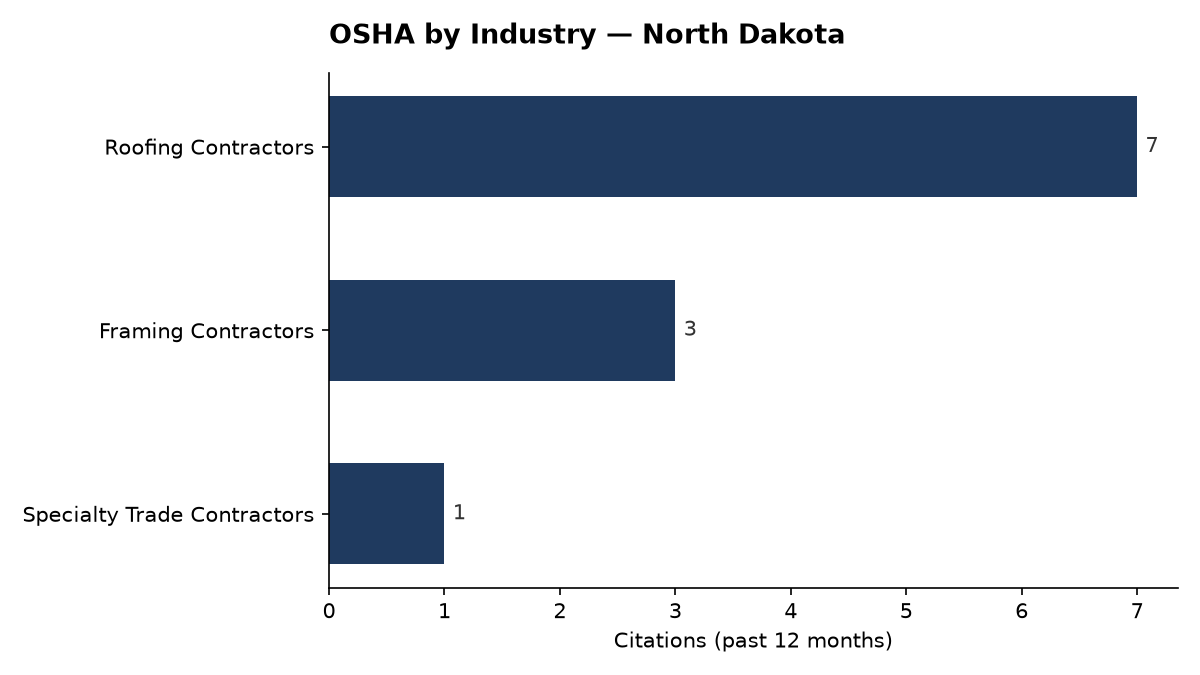
Of the 12 citations issued statewide, 7 went to roofing contractors, 3 to framing contractors, and 1 to a specialty trade contractor. That lopsided split isn’t surprising — roofing work puts crews at the roof edge or on steep pitches for hours at a time, which is exactly the kind of exposure 1926.501 is written to address. Framing crews show up too, mostly for gaps at floor openings and unprotected leading edges during multi-story builds.
Fargo was the city with the most citations in this dataset, which lines up with it being the state’s largest construction market. If you run a roofing contractors business anywhere in North Dakota, assume your crews are already on OSHA’s radar more than most trades in the state.
Serious, Repeat, and One Willful — Why the Violation Type Matters
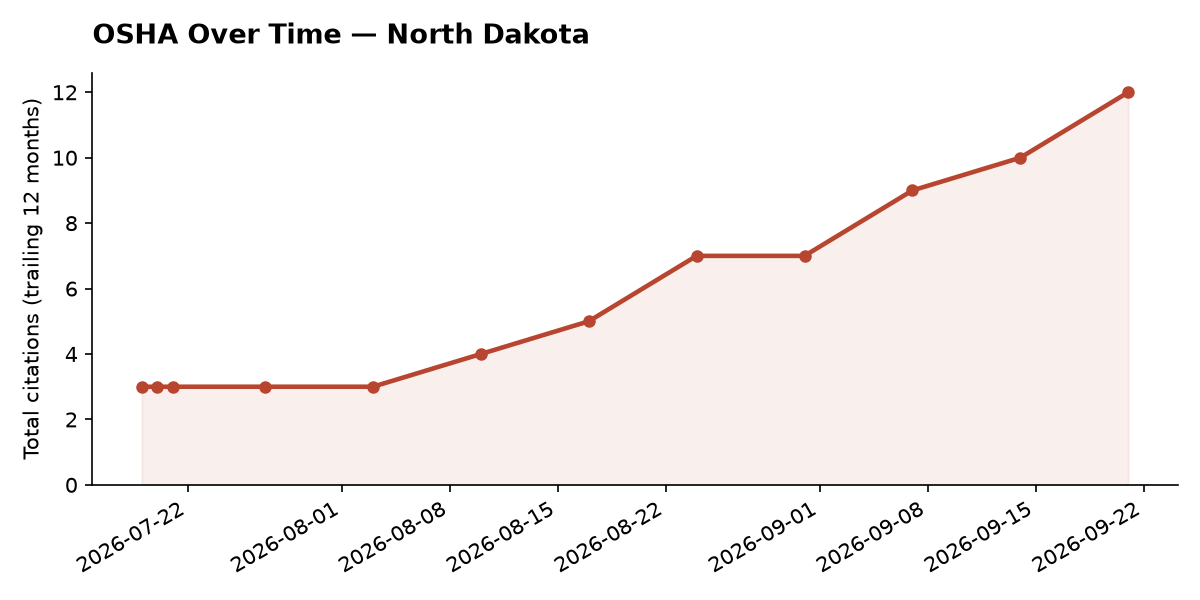
Of the 12 citations, 8 were classified Serious, 3 were Repeat, and 1 was Willful. That single Willful citation belongs to Fargo Glass & Paint Company in Bismarck, cited under 19260501 B04 I and issued May 4, 2026, with a penalty of $119,170. Willful means OSHA concluded the employer knew about the hazard or the requirement and disregarded it — and the penalty math reflects that; it’s typically several times higher than a first-time Serious violation.
Repeat citations aren’t cheap either, because OSHA treats a second violation of the same or a substantially similar standard as evidence the first fix didn’t stick. That shows up clearly in this data: Lolandiz Construction, LLC in Bismarck was cited $29,790 under 19260501 B13, issued December 12, 2025. E & O Builders LLC in Fargo was cited $21,281 under the same provision, issued November 13, 2025. OA Roofing LLC in Jamestown drew a $7,150 Repeat citation under 19260501 B11, issued January 26, 2026. On the lower end, Right Temp Mechanical Inc. in Fargo received a Serious citation under 19260501 B04 I for $6,488, issued January 28, 2026 — a reminder that even a single, first-time violation carries real cost.
What These Citations Actually Cost North Dakota Employers
The average penalty in this dataset, $17,437, sits well above the median of $4,468 because a few Willful and Repeat cases skew the number upward. If your citation is a straightforward first-time Serious violation, expect something closer to the median. If it involves a prior citation on the same standard, or an inspector’s finding of willful disregard, expect it to track toward the average or beyond — as the Bismarck case shows.
Here’s the detail that matters most for anyone deciding how to respond: the average penalty reduction between the initial and final citation amount in this data is 13%. That’s not automatic, and it’s not large without effort, but it shows that initial penalty amounts are negotiable and that outcomes shift once an employer pushes back with documentation, corrective action, or legal representation. For more on how these figures get calculated in the first place, see this breakdown of OSHA fall protection violations penalty amounts.
A citation with a five- or six-figure number attached is not something to sit on. A North Dakota OSHA defense attorney can review the citation language, the classification, and the underlying inspection before you commit to a response.
The 15-Day Window You Cannot Afford to Miss
Once a citation is issued, the employer has exactly 15 working days from receipt to file a Notice of Contest. Miss that window and the citation, and the penalty attached to it, becomes final — there’s no informal appeal process after that point. This applies whether the citation is a $6,488 Serious finding or a $119,170 Willful one.
Filing a Notice of Contest doesn’t mean you’re picking a fight with OSHA for the sake of it. It preserves your options: you can still negotiate an informal settlement, challenge the classification (Serious vs. Repeat vs. Willful matters enormously to the final number), or dispute specific facts in the inspection report. Once the 15 days pass, none of that is on the table. If you want the full mechanics of the process, this guide on how to contest an OSHA citation walks through the steps.
Given how tight that deadline is, the smart move is to get legal input before it closes, not after. Speak with a North Dakota OSHA defense attorney now so your options stay open while there’s still time to use them.
Pull your citation paperwork, note the issuance date, and count backward from the 15-working-day deadline today. Whether your case looks more like the $6,488 Right Temp Mechanical citation or the $119,170 Fargo Glass & Paint case, the earlier you get a legal read on it, the more room you have to negotiate the outcome.