Data last updated: September 28, 2026
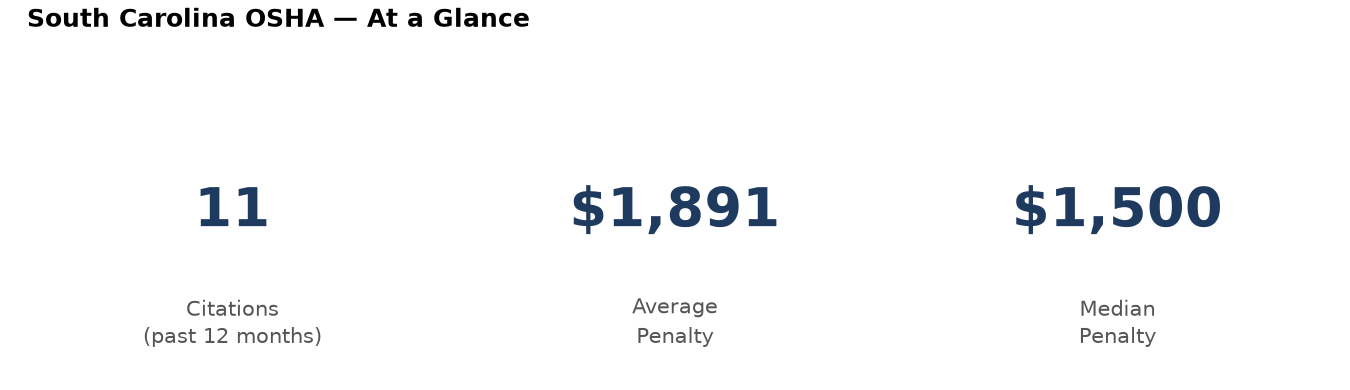
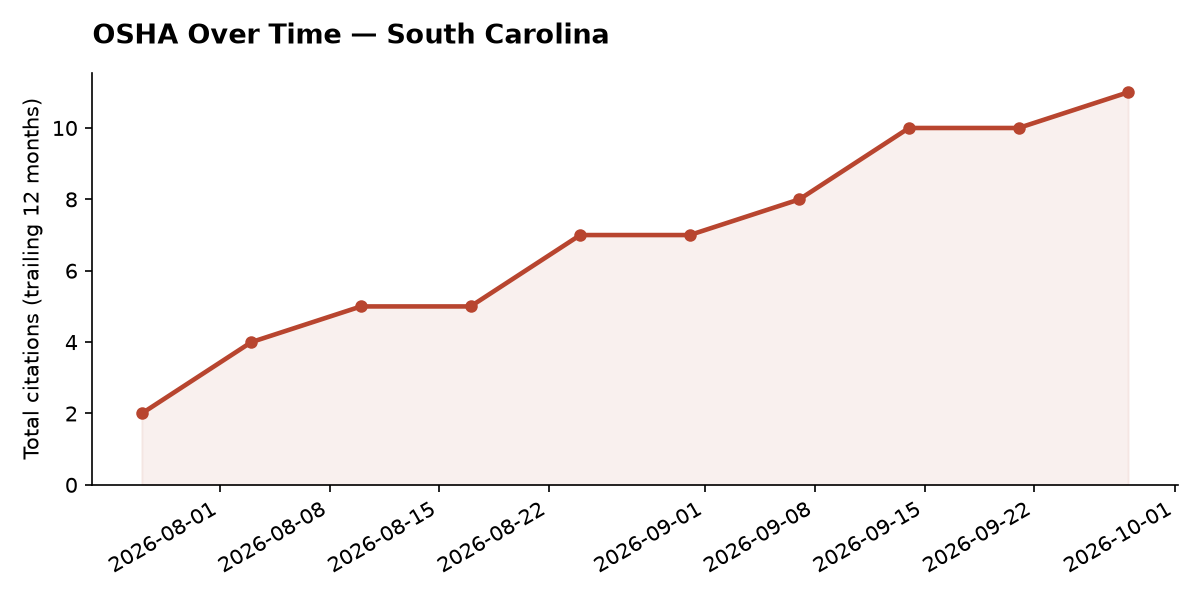
South Carolina employers racked up 11 fall protection citations under standard 1926.501 over the past 12 months, with an average penalty of $1,891 and a median of $1,500. Every single one of those 11 citations was classified as Serious — meaning OSHA determined there was a real chance of death or serious injury tied to the exposure. Sheldon logged more of these citations than any other city in the state, and framing contractors took the brunt of the enforcement.
If you are staring down a citation letter right now, the clock is already moving. Before you decide how to respond, it makes sense to talk to a South Carolina OSHA defense attorney about what your specific citation actually means and what your options are.
What Standard 1926.501 Actually Requires On Site
Standard 1926.501 is the backbone requirement for fall protection under the 1926.501 standard. In plain terms, it says that once a worker is exposed to a fall of six feet or more to a lower level on a construction site, the employer has to have a system in place to stop that fall before it happens or catch it if it does. That means guardrails around the edge, a safety net system underneath, or a personal fall arrest system — harness, lanyard, anchor point — properly rigged and actually used.
It sounds simple on paper. In practice, most citations happen because a crew was working near a roof edge, a floor opening, or a leading edge without any of those three protections in place, even briefly. OSHA compliance officers do not need to see an injury occur — they only need to document the exposure. That is why so many of these citations, including all 11 in South Carolina this period, land in the Serious category rather than a lesser Other classification.
Framing Crews Are Carrying Most Of The Exposure In This State
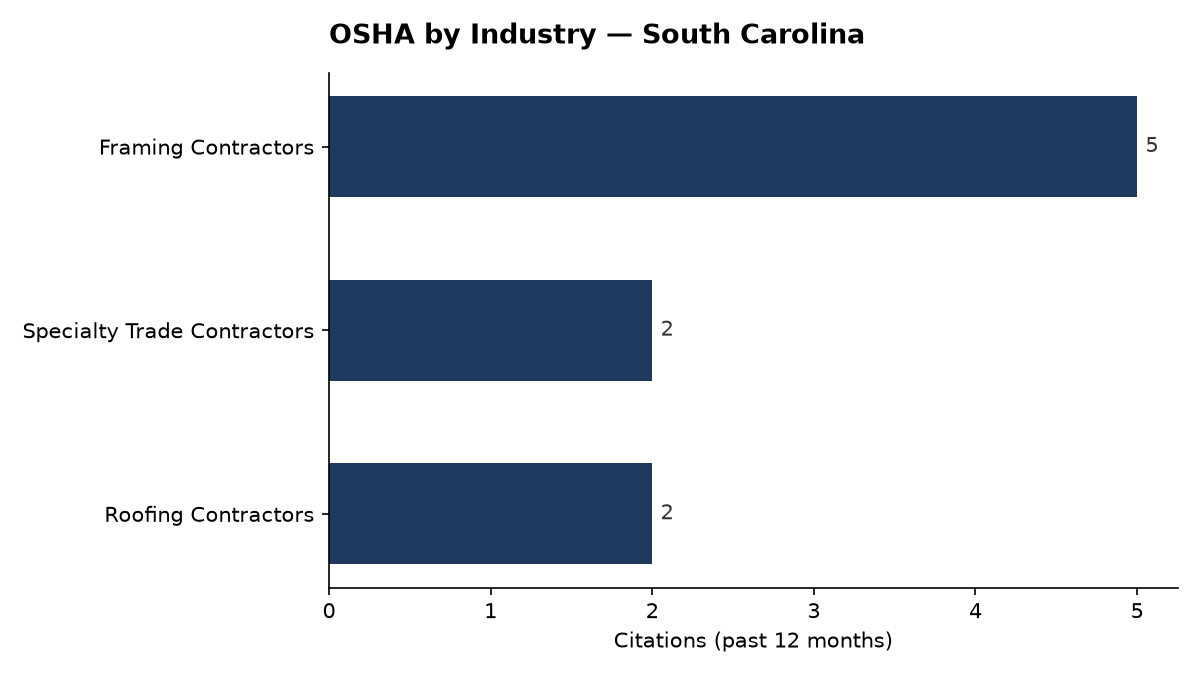
Of the 11 citations issued statewide, five went to framing contractors, making them the single most cited group by a wide margin. Specialty trade contractors and roofing contractors each accounted for two citations apiece. The pattern lines up with the nature of the work: framing crews spend entire shifts moving across open floor systems, walking beams, and unprotected edges before decking or guardrails go up, which is exactly the window where 1926.501 exposure happens.
Roofing crews carry similar risk for the obvious reason — they are working at height by definition, often on sloped or low-slope surfaces where a slip has nowhere good to go. Specialty trade contractors, which cover a broader mix of subcontracted work, show up here too, usually when a crew is doing short-duration tasks at height without setting up full fall protection because the job was expected to take only a few minutes.
What These Citations Actually Cost In South Carolina
The dollar figures in this state’s record show a fairly tight range. Centurion Industries Inc in Kershaw was cited for $4,900 under subsection B04(II), issued October 15, 2025 — the highest amount among the recent cases here. Heritage Construction Consulting Inspections – Mit in Columbia was cited $2,800 under B13, issued January 9, 2026. Jam Investments LLC in Myrtle Beach and Dcd Framing Corp in Little River each received $2,800 citations, under B01 and B10 respectively, both classified Serious. Mz7 LLC in Sheldon — the city with the most activity this period — was cited $1,500 under B13, issued February 10, 2026.
Notice that the gap between initial and final penalty amounts in South Carolina has averaged only a 3% reduction. That is a meaningfully small number. In many states, negotiation and contest strategies bring penalties down much further, but a 3% average here suggests employers either are not contesting effectively, are not contesting at all, or are dealing with fact patterns OSHA is not willing to move much on. For a full breakdown of how these numbers get calculated and adjusted, see this explanation of OSHA fall protection violations penalty amounts.
Whatever the final number ends up being, it rarely stops at the check. A citation on your OSHA record affects your experience modification rate, your standing on bids that require a clean safety history, and your exposure if a second citation turns this into a Repeat violation down the line — which carries penalties several times higher than a first-time Serious. That escalation risk is exactly why it is worth getting a South Carolina OSHA defense attorney to look at your paperwork before you pay or sign anything.
The 15-Day Window You Cannot Afford To Miss
Here is the part that catches people off guard: once you receive a citation, you have only 15 working days to file a Notice of Contest. Not 15 calendar days — 15 working days, and the clock starts the moment you receive the citation, not when you get around to reading it carefully. Miss that window and the citation, along with the proposed penalty, becomes a final order automatically. At that point you have essentially no path left to argue the classification, the abatement date, or the amount.
Given that all 11 South Carolina citations this period were Serious, and the average penalty reduction sits at just 3%, waiting is not a neutral move. The details behind how to contest an OSHA citation matter here — there are specific steps for filing, and the citation itself often contains errors in the cited subsection, the abatement period, or the characterization of the hazard that a knowledgeable review can catch.
If you are inside that 15-day window right now, do not sit on the letter. Talk to a South Carolina OSHA defense attorney today so someone can review the specific subsection you were cited under, check the penalty math against your size and history, and file the Notice of Contest before the deadline closes on you.
Pull your citation letter out now and check the issuance date against the 15-working-day deadline — that single number determines whether you still have options or whether this becomes final by default.