

Data last updated: September 21, 2026
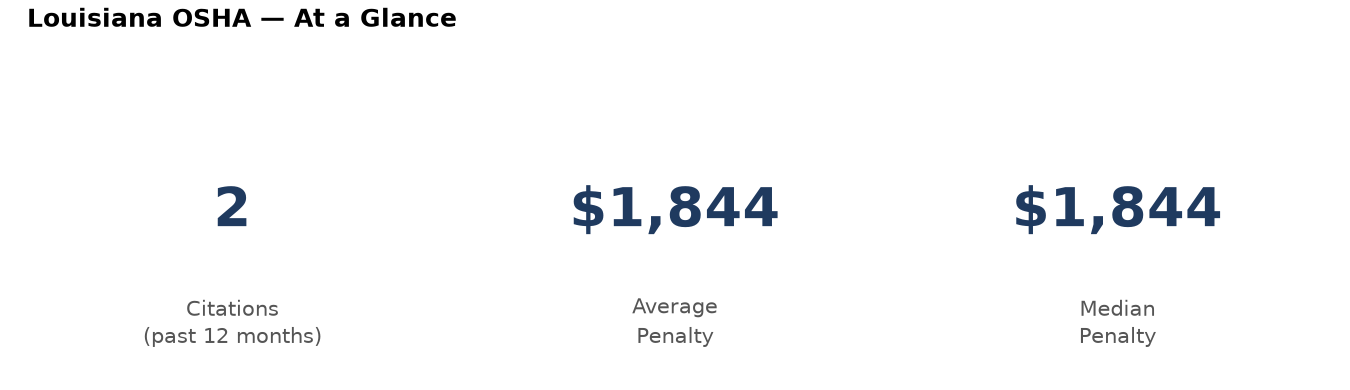
Louisiana employers saw just two ladder-related OSHA citations issued in the past 12 months, but do not mistake that low count for low risk. Both citations were classified as Serious, and the average penalty landed at $1,844, with Baton Rouge posting the most activity of any city in the state.
If you have already received a citation, the clock matters more than the count. You have a limited window to respond, and getting it wrong can cost you far more than the original fine. Talking to a Louisiana OSHA defense attorney before that window closes is the single most useful step you can take right now.
Why Ladder Setup Keeps Landing Employers in Trouble
Every one of these citations traces back to the same rule: 29 CFR 1926.1053. This is OSHA’s general ladder standard, and it is not complicated in concept even though violations keep happening. It requires that ladders be set up on stable footing, extend far enough past a landing to give workers something solid to grab onto, hold the rated load without damage, and be pulled from service the moment they are cracked, bent, or otherwise compromised. It also covers how workers are supposed to actually use the ladder on site, such as keeping three points of contact and not standing on the top rungs.
In practice, most citations under this standard come down to something simple getting skipped on a busy job: a ladder that is a foot too short at the landing, a damaged rung that never got tagged out, or a crew member improvising a climb instead of setting the ladder up correctly. OSHA inspectors treat these as Serious because a fall from even a modest height can cause real injury, and that classification shows up clearly in Louisiana’s record this year.
Roofing and Framing Crews Account for Both Cases
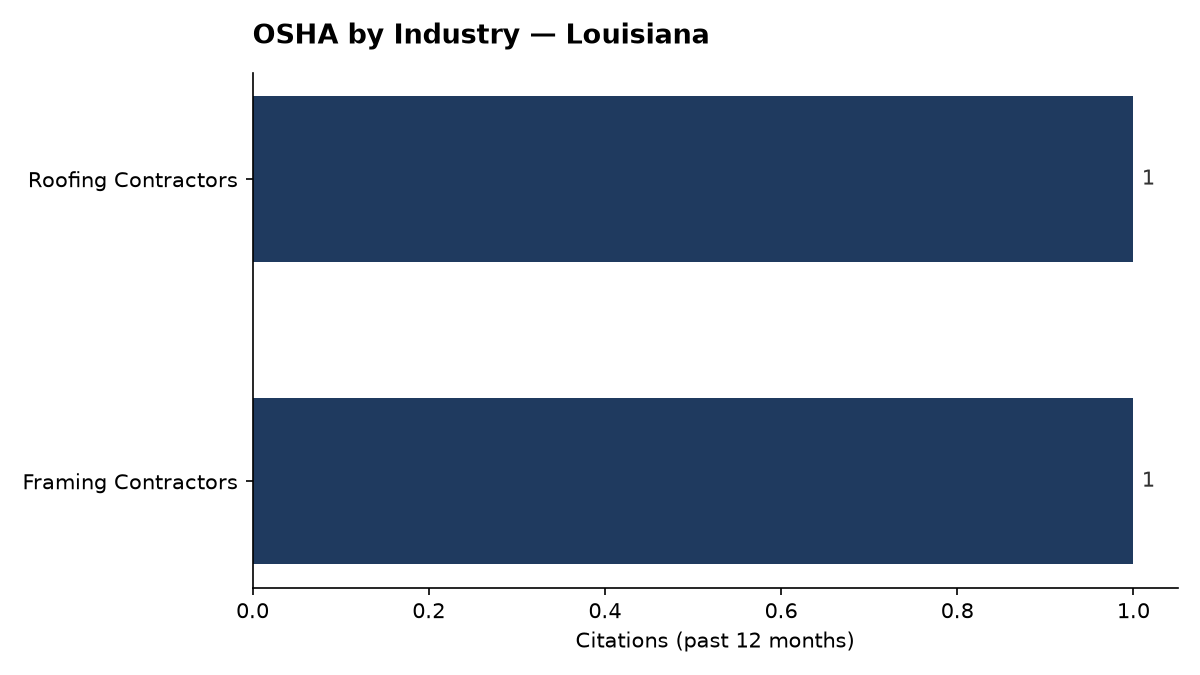
With only two citations statewide, the industry breakdown is narrow but telling: one went to a roofing contractor, the other to a framing contractor. That lines up with what shows up nationally, since roofing contractors spend more time on ladders per job than almost any other trade, moving up and down repeatedly to access roof edges, gutters, and steep-slope work areas. Framing crews face a similar exposure during early-stage construction, when scaffolding is not yet in place and ladders are the fastest way to reach upper floors and rafters.
Both trades share a common risk factor: fast-moving jobs where ladder placement gets treated as a minor detail instead of a safety-critical setup step. That is exactly the gap OSHA inspectors are trained to look for.
What These Citations Actually Cost
The numbers here are small in count but not in weight. Louisiana’s average and median penalty both sit at $1,844, meaning there was no wide spread between the two cases, just two Serious citations landing in a similar dollar range. Two real examples from the state’s record show how this plays out:
- Hernandez Baez Construction LLC (Houma) — $2,412, Serious, cited under 19261053 B04, issued March 27, 2026
- Hebert-Gattuso Construction Company (Baton Rouge) — $1,277, Serious, cited under 19261053 B01, issued January 15, 2026
Notice the gap between the two amounts even though both were Serious violations. That is common with OSHA penalties, since the final figure depends on specifics like company size, prior history, and how the violation was documented. Statewide, employers who pushed back or negotiated saw penalties drop by an average of 20% from the initial amount to the final settled figure. That is not a small margin. On a citation in the $1,800 to $2,400 range, a 20% reduction is real money, and it usually only happens when someone challenges the citation properly instead of just paying it. You can see how these numbers get calculated in more detail on our OSHA ladder violations penalty amounts page.
A penalty reduction like that rarely happens by accident. It comes from someone who knows how to challenge the citation’s classification or documentation. Before you decide whether to just pay what OSHA billed you, it is worth a conversation with a Louisiana OSHA defense attorney to see if your case has room to move.
The Deadline That Matters More Than the Fine
If you have a citation in hand, the number on it is not the most urgent detail. The date on it is. OSHA gives employers only 15 working days from the date they receive a citation to file a Notice of Contest. Miss that window and the citation becomes final, penalty and all, with almost no room left to argue classification, negotiate the amount, or push back on the underlying facts.
Fifteen working days sounds like a lot until you factor in gathering documentation, talking to the crew who was on site, and figuring out whether the citation was even correctly classified as Serious versus something lesser. Our page on how to contest an OSHA citation walks through the mechanics of that process, but the timeline itself does not bend for anyone.
If that clock is already running on your citation, do not wait to see how many days you have left. Reach out to a Louisiana OSHA defense attorney now, while there is still time to actually change the outcome instead of just accepting it.
Whether you run a roofing crew in Houma or a framing operation near Baton Rouge, the lesson from this year’s Louisiana ladder citations is the same: the violations are not exotic, the penalties are not random, and the deadline to fight back is short. Get your paperwork together, check the date on your citation, and get a professional opinion before that 15-working-day window runs out.