
Data last updated: September 28, 2026
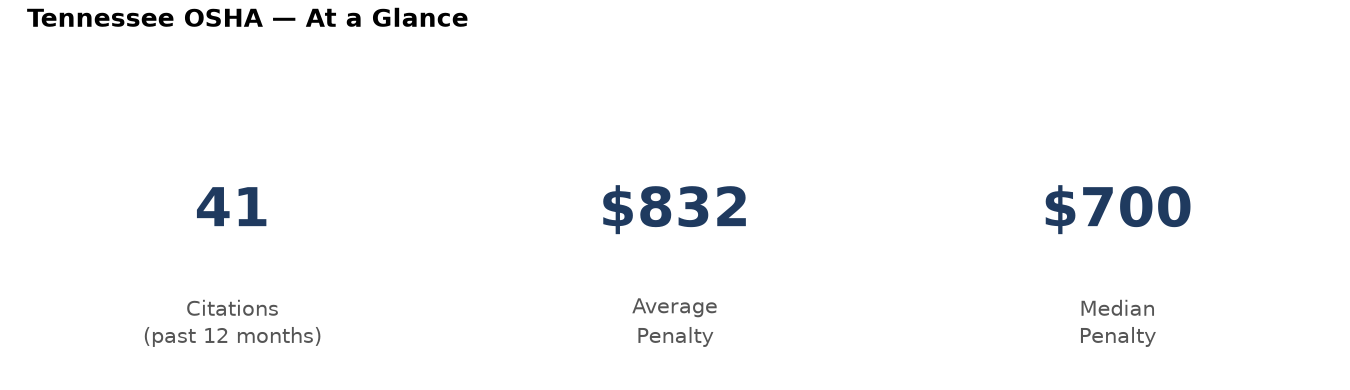
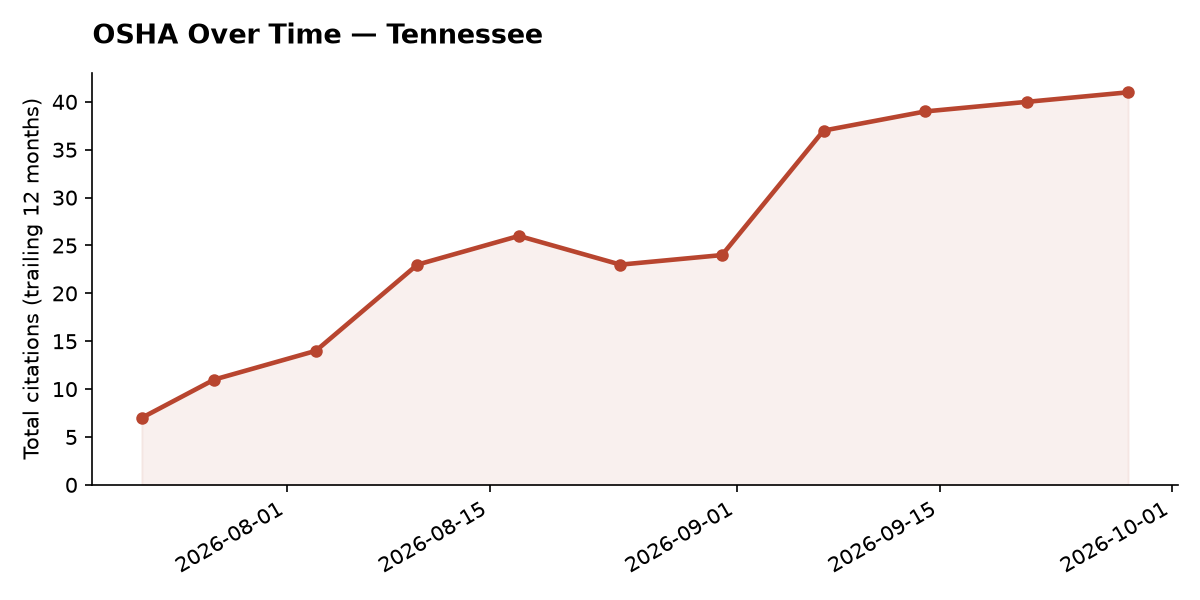
Tennessee OSHA enforcement logged 41 ladder violations over the past 12 months, with an average penalty of $832 and a median of $700. Kingsport shows up more than any other city in the state’s citation record, and two industries — specialty trade contractors and roofing contractors — are tied at the top with 13 citations apiece.
If you’ve just been handed a citation like this, the clock is already running. Talk to a Tennessee OSHA defense attorney before you decide how to respond — the options you have today shrink fast.
What the ladder standard actually demands on a Tennessee jobsite
Nearly every citation in this dataset traces back to one rule: 1926.1053, OSHA’s general requirements for ladders. This is the standard covering how ladders get set up on-site, how far they need to extend past a landing surface, what load they’re rated to hold, whether damaged units get pulled from service, and how workers are expected to use them day to day. The 1926.1053 hub page breaks down each subsection in plain language, but the short version is this: inspectors are looking for ladders that are the wrong length, damaged, improperly secured, or being climbed in ways that put a worker at risk of a fall. None of it is exotic. It’s the kind of thing a five-minute pre-shift check catches.
That’s part of why these citations sting when they land. They’re rarely about equipment nobody could have predicted would fail. They’re about setup and maintenance details that compliance officers know to check first.
Roofing and specialty trades are carrying this number in Tennessee
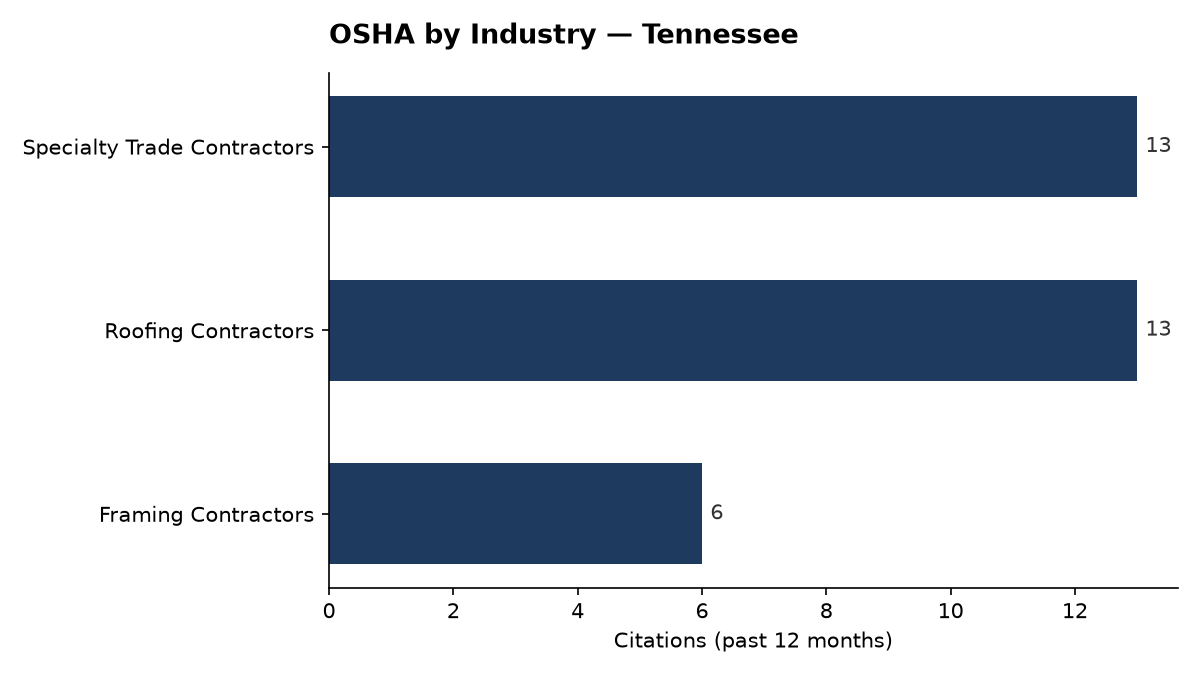
Specialty trade contractors and roofing contractors are tied for the most citations in the state, 13 each, with framing contractors a distant third at 6. That split makes sense given the work: both trades put people on ladders constantly, often at height, often on exterior work where a ladder is the only way up. The specialty trade contractors page goes deeper into why this group specifically draws inspector attention — frequent short-duration jobs, multiple crews rotating through a site, and ladder setups that get adjusted throughout the day as work moves.
Kingsport stands out as the city with the most citations in the state, and three of the five named examples below come out of that area. That’s not a coincidence — where OSHA runs more inspections, more violations surface, and Kingsport has clearly seen a concentrated push.
What a ladder citation actually costs in Tennessee
Of the 41 violations recorded, 39 were classified Serious, one was Other-than-Serious, and one was a Repeat violation. That single Repeat citation matters more than the number suggests — Repeat and Willful classifications carry substantially higher penalties than a first-time Serious finding, because OSHA treats a second violation of the same standard as evidence the hazard wasn’t actually fixed the first time. This breakdown of how OSHA calculates penalty amounts walks through how classification, company size, and prior history all factor into the final number.
The real citations on record show how wide the range gets even within one state. My 6 Construction LLC in Gray was cited $4,000 for a Serious violation under 19261053 B01, issued January 15, 2026. Adolfo Torres in Kingsport drew a $3,200 penalty for a Repeat violation under the same subsection, issued February 3, 2026 — the higher amount reflects that Repeat classification directly. 31-W Insulation Co., Inc. in Blountville was cited $2,520 for a Serious violation under 19261053 B13 on March 23, 2026. Horizon Construction Company in Kingsport and ABG Caulking and Waterproofing of Morristown, Inc., also in Kingsport, were each cited $1,600 for Serious violations under 19261053 A24, issued March 17 and March 20, 2026 respectively.
Worth noting: the average penalty reduction between initial and final amounts statewide is only 5%. That’s a modest number — it tells you these penalties mostly stick once issued, which is exactly why getting ahead of the process with the right response matters more than hoping it gets negotiated down later.
A $700 median penalty might look manageable on paper, but stacked citations, repeat findings, or an inspector who broadens the scope of a visit can push the number well past what shows up in the averages. Before you assume yours will land on the low end, get a Tennessee OSHA defense attorney to look at exactly what you were cited for and why.
The 15-day window you can’t afford to sit on
Once a citation is issued, you have 15 working days to file a Notice of Contest. That deadline is not flexible, and it is not a suggestion — miss it, and the citation and penalty become a final order, no matter how strong your underlying argument might have been. This guide on how to contest an OSHA citation lays out what that filing actually requires and what happens procedurally once it’s submitted.
Given that the statewide reduction rate on these penalties is only 5%, waiting to see if the number quietly shrinks isn’t a strategy. If you’re going to push back on the classification, the subsection cited, or the facts the inspector recorded, that work needs to start immediately — not after the 15 days have already run out.
This is a genuine legal deadline with real consequences attached, and it’s exactly the kind of decision that benefits from someone who handles these cases regularly. Reach out to a Tennessee OSHA defense attorney now, while you still have options on the table, rather than after the window has closed.
Pull your citation paperwork, note the exact date it was issued, and count forward 15 working days — that’s your real deadline, not a rough estimate. Whatever you decide to do next, decide it with someone who knows this process, not on your own.