

Data last updated: September 21, 2026
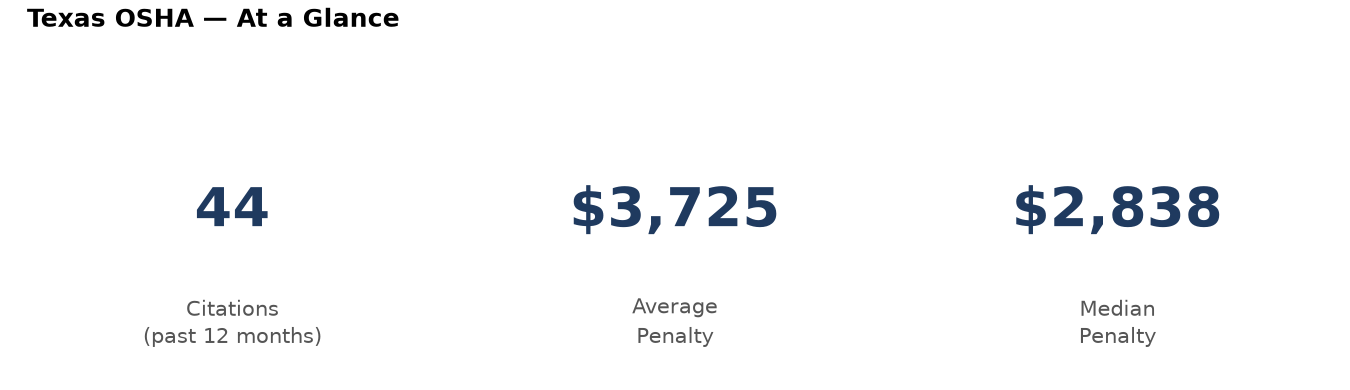
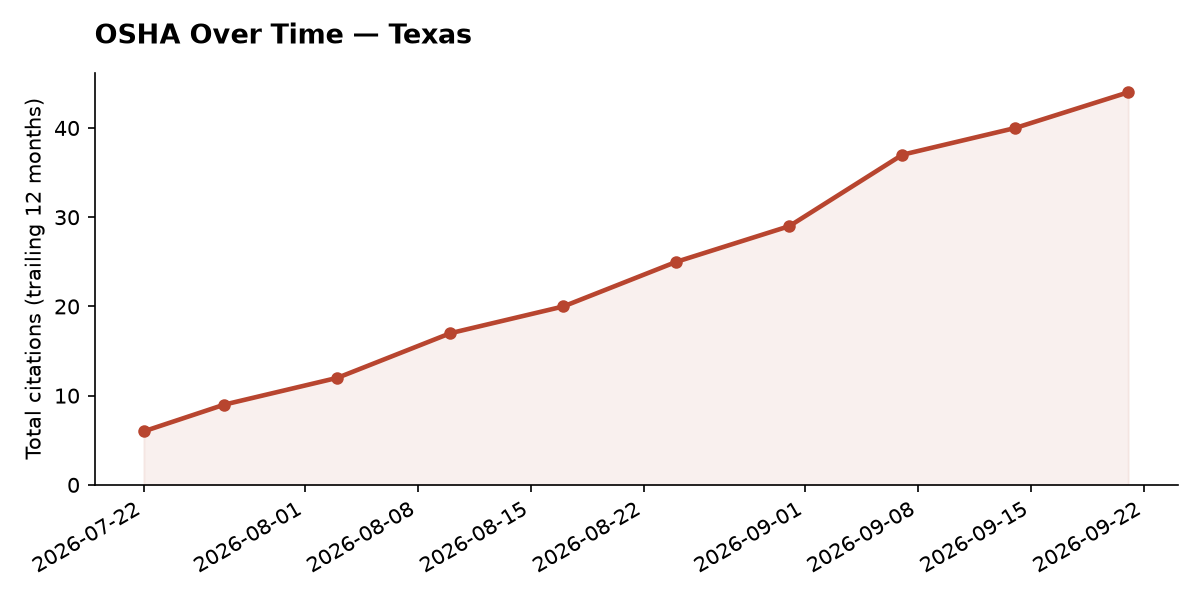
Over the past 12 months, OSHA issued 44 ladder-related citations to Texas employers under standard 1926.1053, with the average penalty landing at $3,725 and the median at $2,838. Thirty-four of those 44 citations were classified as Serious, four were Repeat violations that carry steeper fines by design, and six were Other-than-Serious. Parker recorded more citations than any other Texas city in this dataset, but the cases stretch from Midland to Wylie, and the industries behind them are overwhelmingly roofing and framing.
If you or your company just received one of these citations, the clock is already running. Before you decide how to respond, it helps to talk with a Texas OSHA defense attorney who can look at the specific citation language and tell you whether it’s worth contesting.
What OSHA’s Ladder Rule Actually Demands on a Texas Jobsite
The standard behind all 44 of these citations, 1926.1053, covers the basics of ladder use on construction sites: how a ladder must be set up, how far it needs to extend past a landing surface, how much weight it’s rated to carry, when damaged equipment has to be pulled from service, and how workers are expected to use it once it’s in place. It sounds simple, but it’s one of the most frequently cited standards in construction because inspectors can spot a violation from the ground — a ladder tied off wrong, a rung that’s cracked, an extension ladder that doesn’t reach three feet above the roofline. For the full text and context of the rule, the 1926.1053 standard hub breaks down each subsection in plain language.
Roofing and Framing Crews Account for Most of the Citations
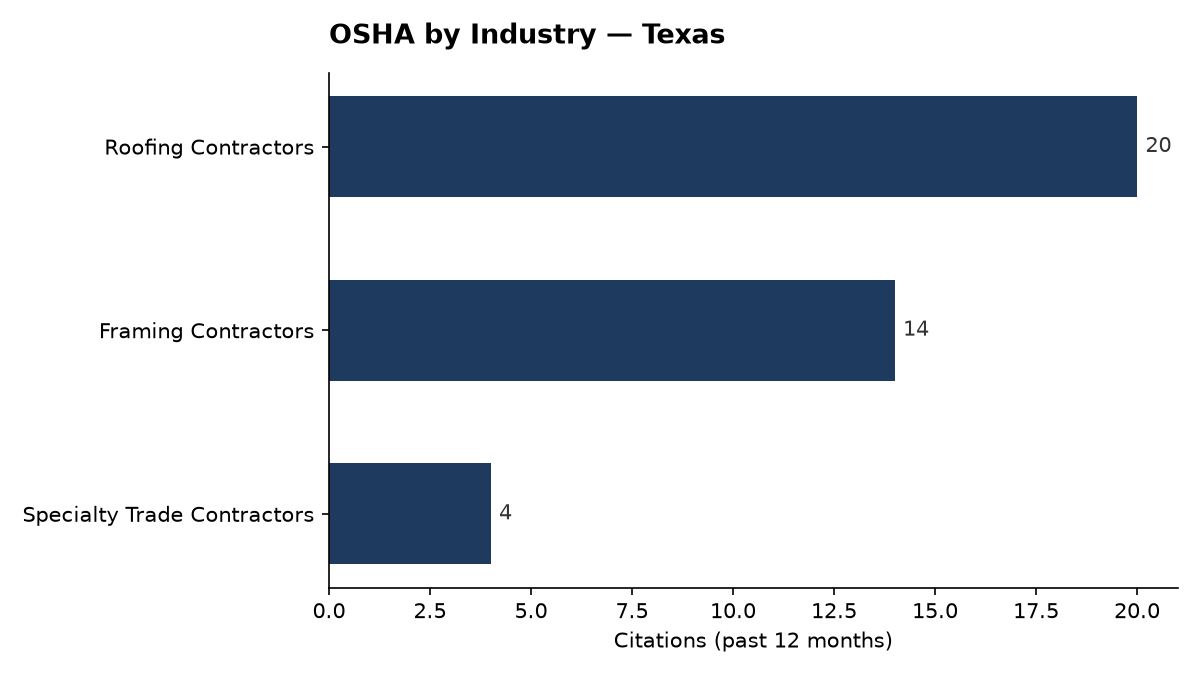
Roofing contractors alone picked up 20 of the state’s 44 ladder citations, nearly half the total. Framing contractors weren’t far behind at 14, with specialty trade contractors making up another 4. That pattern tracks with the nature of the work: roofers and framers are on and off ladders constantly, often on uneven ground or in a hurry to finish a section before weather turns, which is exactly when setup mistakes and worn-out equipment get missed. If you run a roofing operation in Texas, it’s worth reviewing the roofing contractor citation trends to see how inspectors in this industry are approaching enforcement right now.
What a Ladder Citation Actually Costs in Texas
The $3,725 average across all 44 cases hides a wide range. Several recent Texas cases show just how far penalties can climb once Repeat or multi-item findings are involved:
- Luis Cerda, Midland — $12,767, Repeat violation under 19261053 B01, issued March 5, 2026
- Porfirio Vargas-Brito, Royse City — $11,916, Repeat violation under 19261053 B01, issued October 16, 2025
- Optimize Electric, Inc, Magnolia — $11,585, Serious violation under 19261053 B04, issued January 2, 2026
- Csa Construction, Inc., Manvel — $10,641, Other-than-Serious violation under 19261053 B01, issued June 29, 2026
- Santiago Ortiz, Wylie — $9,930, Repeat violation under 19261053 B01, issued October 20, 2025
Notice that three of these five cases are Repeat violations — meaning OSHA had already cited that employer for a similar problem before. Repeat findings routinely push penalties well past the state average, sometimes to three or four times the median. On the other hand, the data also shows an average penalty reduction of 14% between the initial citation amount and the final settled amount, which tells you that negotiation and contest do move the number in a meaningful share of Texas cases. For a breakdown of how OSHA calculates these figures and where the room to negotiate usually is, see this guide to OSHA ladder violations penalty amounts.
A 14% reduction on a $10,000-plus Repeat citation is real money, but it doesn’t happen by accident — it happens when someone challenges the classification or the underlying facts before the deadline passes. That’s a conversation worth having with a Texas OSHA defense attorney while you still have options on the table.
The 15-Working-Day Window You Can’t Afford to Miss
Once a citation is issued, federal OSHA rules give an employer exactly 15 working days to file a Notice of Contest. Miss that window and the citation — along with the proposed penalty and any Repeat or Serious classification attached to it — becomes final, with almost no room left to argue the point later. Given that Repeat violations in Texas have run as high as $12,767 in the cases above, this isn’t a deadline to sit on while you gather paperwork.
The right first move is to read the citation closely: which subsection of 1926.1053 is cited, whether it’s marked Serious, Repeat, or Other-than-Serious, and what abatement date OSHA has set. Then get a second opinion on whether the classification actually fits what happened on your jobsite — inspectors don’t always get it right, and a Repeat tag in particular depends on OSHA correctly tying your case to a prior citation. The process for filing and what happens after is laid out step by step in this overview of how to contest an OSHA citation.
If you’re inside that 15-working-day window right now, don’t wait until it’s almost gone to get advice. Talk to a Texas OSHA defense attorney today about your specific citation number, classification, and penalty amount before the deadline closes on your options.
Whatever you decide — pay it, negotiate it, or contest it — do it with a clear read on what the citation actually says and how much time you realistically have left to act.