
Data last updated: September 21, 2026
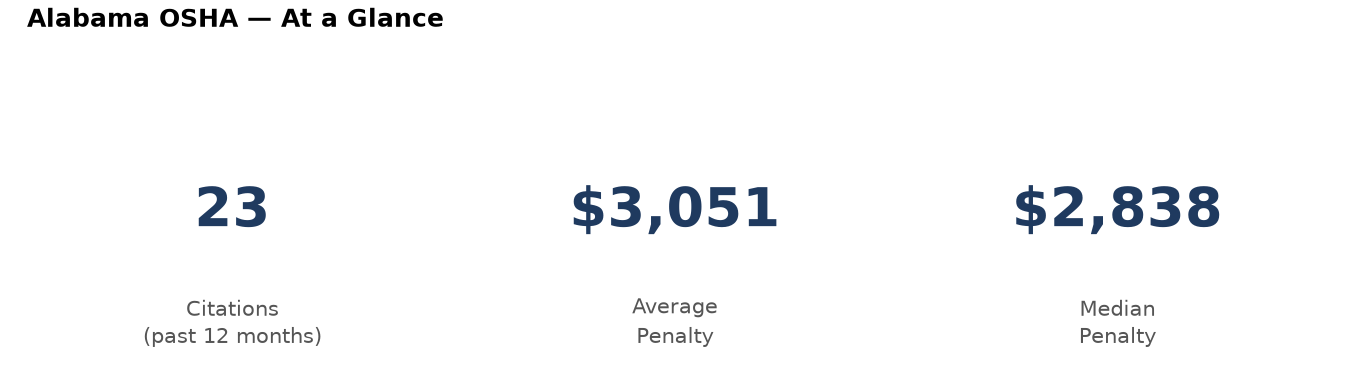
Alabama OSHA inspectors issued 23 scaffolding violations over the past 12 months, and every single one was classified as Serious. The average penalty came in at $3,051, with a median of $2,838. Spanish Fort saw more of these citations than any other city in the state. If you build, side, or frame houses in Alabama and someone was working off a scaffold platform when an inspector showed up, this is the exact citation history you need to understand before you decide how to respond to your own paperwork.
If you have already received a citation, the clock is already running. You get 15 working days from the date on the citation to file a Notice of Contest, and once that window closes, the penalty and the violation become final. Talking to an Alabama OSHA defense attorney before that deadline passes is the single most useful thing you can do right now.
What 1926.451 Actually Demands on a Jobsite
Every one of Alabama’s 23 scaffolding citations falls under 1926.451, OSHA’s baseline rulebook for scaffold safety in construction. This is not a niche or obscure standard — it is the foundation that governs how a scaffold has to be built, how much weight it can carry, how workers get on and off it safely, and when guardrails, midrails, and proper planking are required. It also sets the rules for fall protection specific to scaffold work, which is where a lot of inspectors focus their attention because a fall from even a modest scaffold height can be catastrophic.
In practice, inspectors are looking for things like incomplete platforms, missing or improperly installed guardrails, scaffolds that were not fully planked, and workers accessing platforms without a proper ladder or stairway. You can read the full breakdown of what falls under the 1926.451 standard to see exactly which subsections tend to generate citations and why.
Why Framing Crews Account for Most of Alabama’s Citations
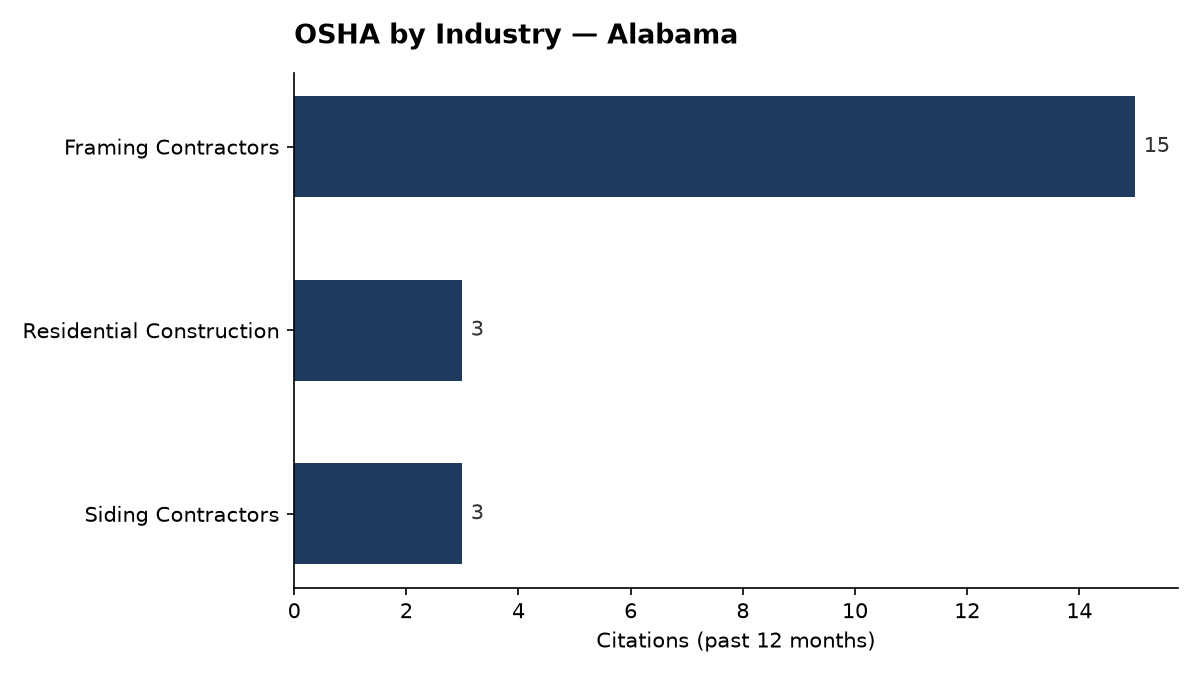
Of the 23 citations issued statewide, 15 went to framing contractors — nearly two-thirds of all activity. Residential construction and siding contractors each picked up 3 citations. That concentration makes sense once you think about how framing work actually happens: crews are often working at height on partially built structures, moving scaffolding frequently as walls go up, and under pressure to keep pace with a schedule. That combination — frequent scaffold relocation, changing crew members, and time pressure — is exactly where guardrail and planking shortcuts tend to creep in.
If you run a framing crew, it is worth taking a hard look at how your framing contractors set up and inspect scaffolding before each shift, not just when a job starts. A scaffold that was compliant on Monday can be missing a plank or a guardrail by Thursday if it has been broken down and reassembled in between.
What These Citations Actually Cost in Alabama
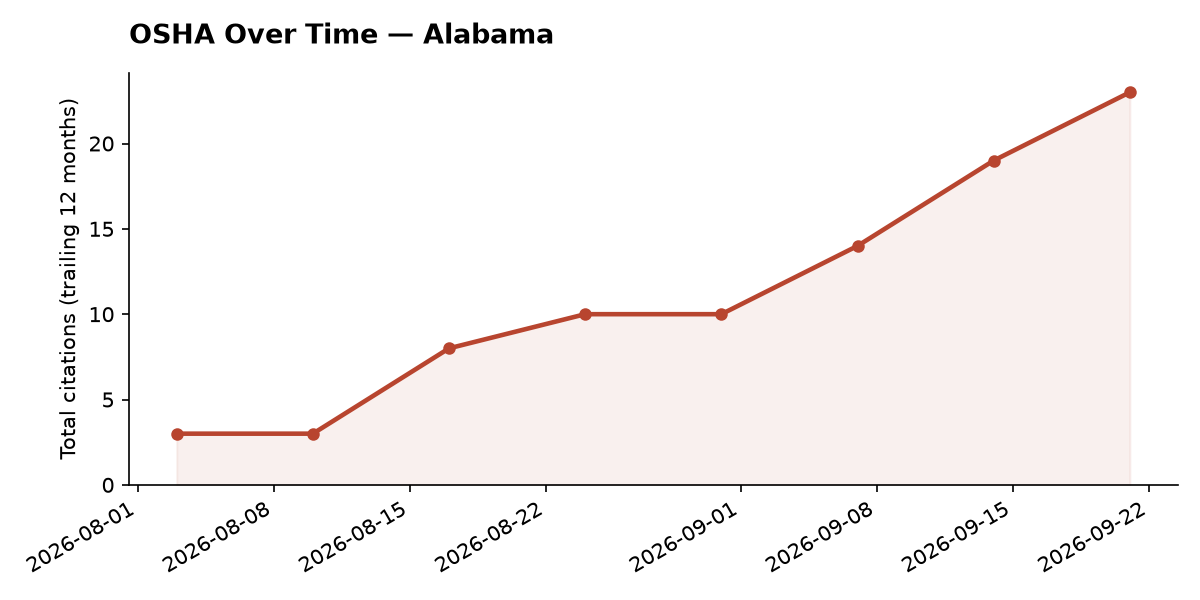
The numbers tell a fairly consistent story. With an average penalty of $3,051 and a median of $2,838, most Alabama scaffolding citations are landing in a fairly tight band — not the kind of six-figure Willful or Repeat penalty you might see in more serious cases, but not trivial either. All 23 citations here were coded Serious, which means OSHA determined there was a real probability of death or serious physical harm connected to the hazard, even if it was the employer’s first citation of this kind.
Here are five real, recently issued examples from the public record:
- Crom, LLC (Mobile) — $8,038, Serious, cited under 1926.451(b)(2), issued January 20, 2026
- Jesus Gonzalez (Spanish Fort) — $5,107, Serious, cited under 1926.451(b)(2), issued April 2, 2026
- Francisco Diego Martinez (Spanish Fort) — $4,256, Serious, cited under 1926.451(b)(2), issued May 6, 2026
- Francisco Martinez (Trussville) — $3,972, Serious, cited under 1926.451(e)(1), issued June 1, 2026
- Carlos Turcios (Silverhill) — $3,547, Serious, cited under 1926.451(g)(1), issued December 22, 2025
Notice that the penalties on this list run well above the state average, from just under $3,600 up to over $8,000. That spread is a reminder that the $3,051 average is not a ceiling — it is a midpoint pulled down by smaller cases. A single missing guardrail combined with inadequate planking can push a citation into the higher end of that range fast. Also worth knowing: the average penalty reduction after negotiation or contest in Alabama has been only about 2%, which tells you these amounts are not moving much on their own. Employers who want a real reduction generally need someone actively arguing the case, not just hoping OSHA softens the number. You can see how these figures compare statewide on the OSHA scaffolding violations penalty amounts page.
A citation in the $3,000 to $8,000 range might feel manageable to absorb and move on from, but it also sits on your OSHA inspection history, and a second scaffolding issue later can be treated as a Repeat violation with a much steeper penalty. Before you decide to just pay it, talk to an Alabama OSHA defense attorney about whether the citation was properly documented and whether the classification actually holds up.
Your Move If a Citation Just Landed on Your Desk
The 15-working-day Notice of Contest deadline is not flexible, and it starts counting from the date you receive the citation, not the date you get around to reading it carefully. Missing that window means you lose your right to challenge the classification, the penalty amount, or the underlying facts — the citation simply becomes final.
Before that deadline hits, it is worth understanding exactly what your options look like, including informal conferences with OSHA, negotiated settlements, and formal contests. The process for how to contest an OSHA citation walks through each of those paths in plain terms, but the fastest way to know which one fits your situation is to get someone with direct experience in Alabama OSHA cases looking at your specific citation.
Given that Alabama’s average penalty reduction sits at just 2% without a real challenge, and given how little time you actually have to act, the smart move is to get an Alabama OSHA defense attorney reviewing your citation today, not after the contest window closes.
Whether you run framing crews in Spanish Fort, siding operations near Mobile, or a residential build anywhere in between, the pattern in this data is clear: scaffold citations in Alabama are consistently Serious, consistently in the thousands of dollars, and rarely reduced without someone pushing back. Get your citation reviewed now while your options are still open.