
Minnesota OSHA Scaffolding Citations: What the Numbers Show

Data last updated: August 31, 2026

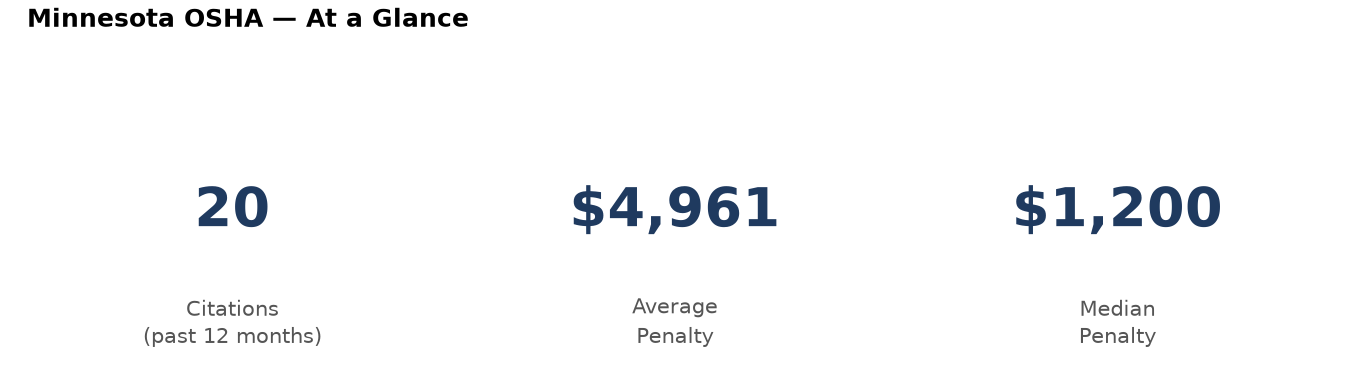
Key statistics: 15 osha citations in Minnesota, average penalty $5,986, median $1,350

Minnesota contractors racked up 15 scaffolding citations under 1926.451 over the past 12 months. That might sound like a small number, but the penalties tell a bumpier story: the median fine was just $1,350, while the average sat at $5,986 — pulled way up by a single $25,000 citation against a drywall contractor in Elk River. Fourteen of the 15 citations were classified Serious, meaning OSHA determined there was a real chance of death or serious injury tied to the condition found. Minneapolis had more of these citations than any other city in the state.
If you’ve just opened a citation letter, the clock is already running. Talking to a Minnesota OSHA defense attorney before you respond can change how much you end up paying and what stays on your record.

What 1926.451 Actually Requires on a Jobsite

The standard behind every one of these citations, 1926.451, is OSHA’s general rulebook for scaffolds used in construction. It’s not one narrow rule — it covers how a scaffold has to be built to hold its load, how workers get on and off it safely, when guardrails and planking are mandatory, and what fall protection has to be in place before anyone steps onto the platform.

Most of the Minnesota citations cite subsection (g), which deals with fall protection on scaffolds — missing guardrails, unprotected edges, workers exposed to a fall with nothing arresting it. That’s the pattern in citations from Duluth, Lakeville, and Hamel this year, each landing in the same subsection. When an inspector shows up and finds a plank without a rail or a platform without proper access, this is the standard that gets applied, and it doesn’t take much for a routine walk-through to turn into a Serious citation.

Which Minnesota Trades Are Drawing Scrutiny

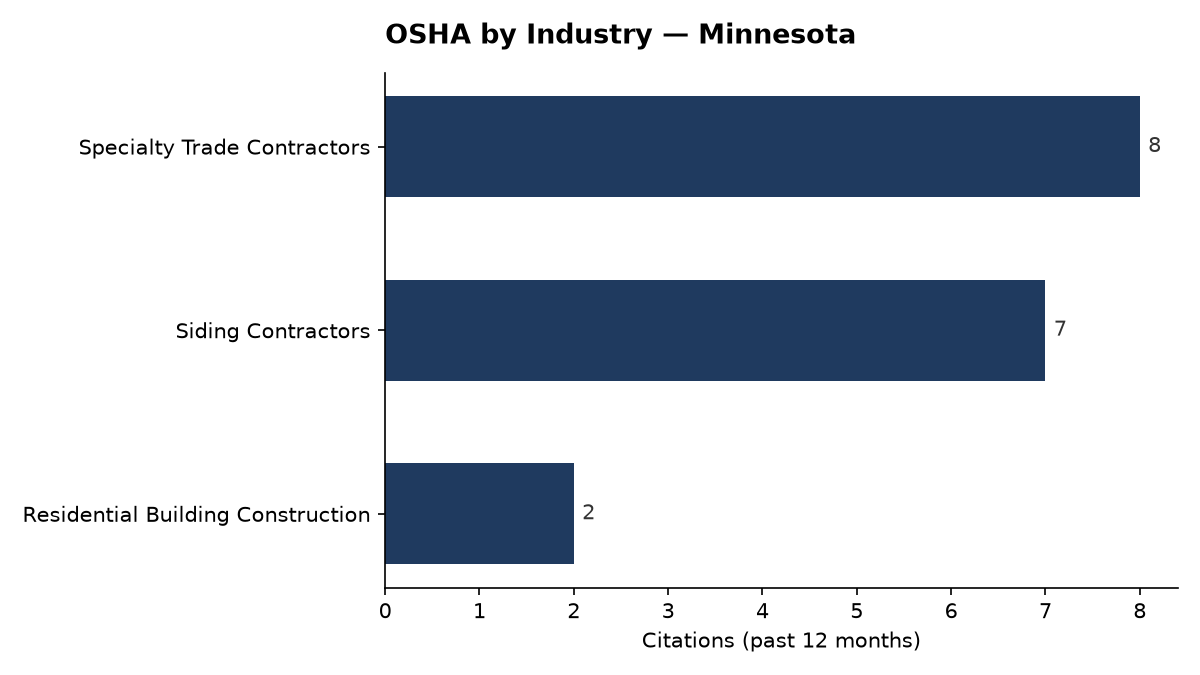
Bar chart of OSHA osha citations by industry in Minnesota

The citation pattern in Minnesota points squarely at one sector. Specialty trade contractors accounted for 8 of the 15 citations — more than half. Commercial building construction and siding contractors followed with 3 each.

That mix makes sense once you think about the work. Specialty trades — drywall, masonry, framing, siding — are the crews actually standing on scaffolding for hours at a time, often on residential and light commercial jobs where scaffold setup gets handled fast and sometimes by whoever’s available that morning, not necessarily a dedicated competent person. Masonry and siding work in particular means repeated setup and teardown as the crew moves along a wall, which multiplies the chances that a rail gets skipped or a platform gets left short of full decking.

What These Citations Actually Cost

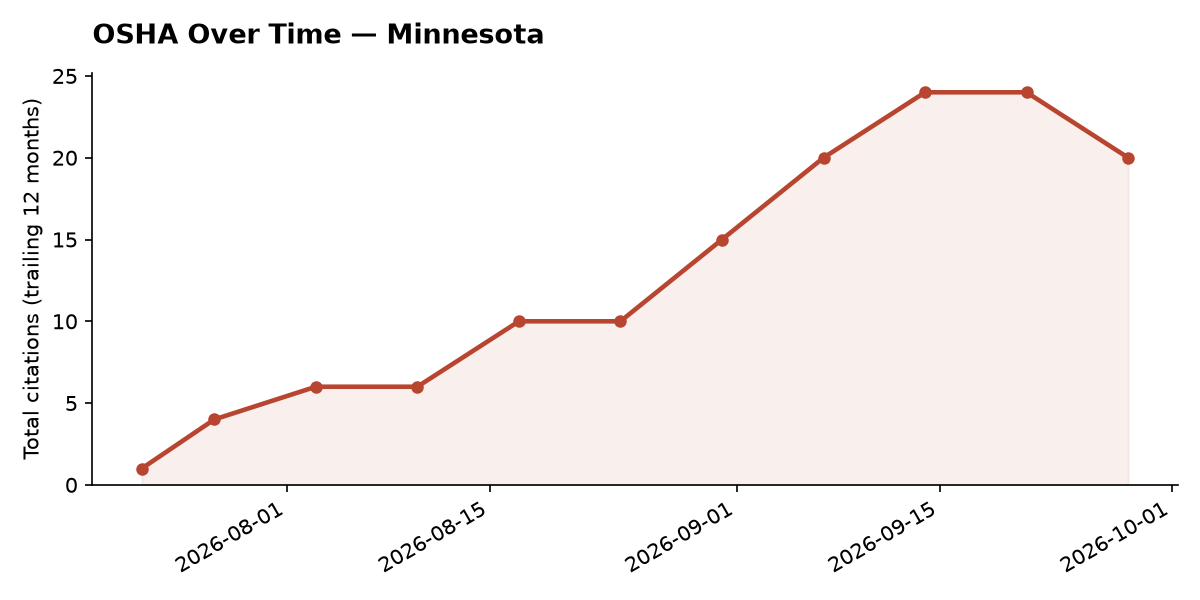
Line chart of OSHA osha citation trends over time in Minnesota

Here’s where the real named examples matter more than a statewide average. Pro Drywall Inc Dba Pro Drywall — Painting Inc in Elk River was hit with a $25,000 Serious citation issued April 24, 2026, under 1926.451(a)(6) — by far the largest penalty in this dataset. Thriving Craftsmen Design — Remodeling LLC in Minneapolis was cited $2,100 under 1926.451(b)(2)(i), issued June 12, 2026. Three other companies — Ladue Construction Inc in Hamel ($1,350), Blackburn Masonry LLC in Duluth ($990), and Mesenbrink Construction — Engineering Inc in Lakeville ($750) — were all cited under the same fall-protection provision, 1926.451(g)(1), with penalties ranging from $750 to $1,350.

That spread shows how much a citation’s final cost depends on the specifics: how many workers were exposed, whether it’s a first offense, and how the initial inspection findings get documented. Statewide, employers who pushed back or negotiated saw an average penalty reduction of 12% between the initial citation and the final resolved amount. That’s not automatic — it comes from actually engaging with the process, not from waiting it out. You can see how OSHA scales these numbers on the penalty amounts page, but the short version is that a $25,000 citation and a $750 citation can come from the same standard, and where you land often depends on how the case is handled after the citation arrives.

A gap between $750 and $25,000 for citations under the same standard is exactly why it’s worth getting a second set of eyes before you decide how to respond. Talk to a Minnesota OSHA defense attorney about your specific citation while there’s still time to shape the outcome.

You Have 15 Working Days — Not Calendar Days

If you’ve received a citation, the single most important fact is this: you have only 15 working days from the date you receive it to file a Notice of Contest. Miss that window and the citation becomes a final order — no appeal, no negotiation, penalty locked in. Weekends and holidays don’t count toward the 15 days, but they also don’t give you extra room; the deadline arrives faster than most business owners expect once they’re dealing with it alongside everything else on a jobsite.

Filing a Notice of Contest doesn’t mean you’re picking a fight with OSHA. It preserves your options — to negotiate a lower penalty, correct the classification if it was overstated, or push back on findings you disagree with. Once that window closes, none of that is available anymore. The process for filing, along with what happens after you contest, is laid out on the how to contest an OSHA citation page, but the practical move is to get someone who handles these cases regularly to review the citation before that clock runs out.

Given that 14 of the 15 scaffolding citations issued in Minnesota this year were classified Serious, and given that the average penalty of $5,986 doesn’t reflect how much variation there is between individual cases, this isn’t a situation where guessing your way through the paperwork is a good bet. Get a Minnesota OSHA defense attorney to look at your citation now, while the 15-working-day deadline still gives you room to act.

Leave a Comment