
Data last updated: September 21, 2026
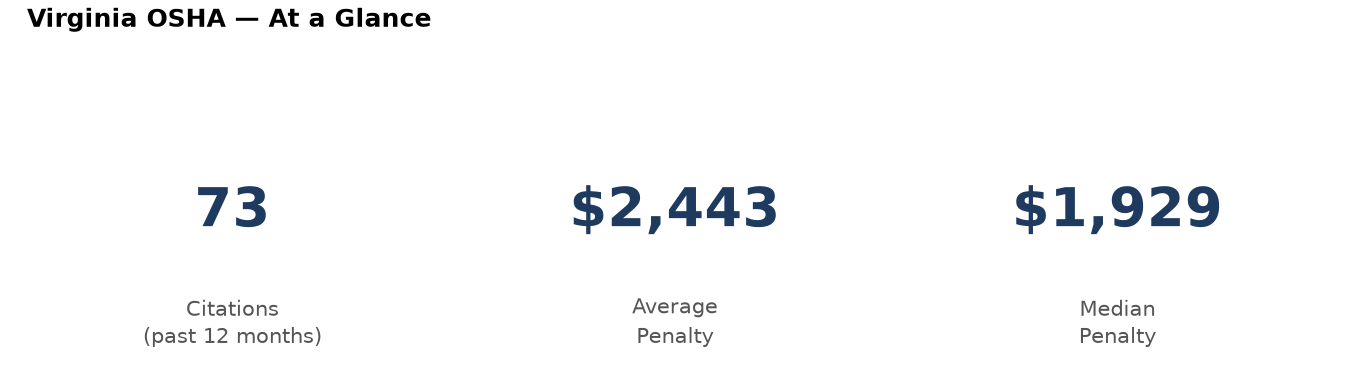
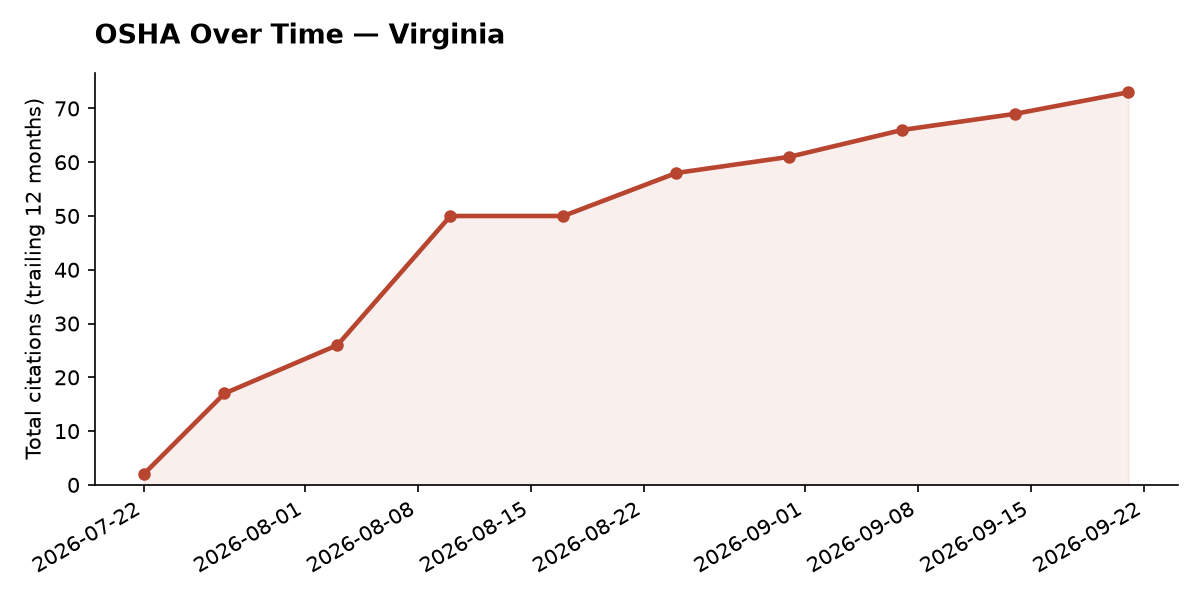
Virginia contractors racked up 73 scaffolding violations under OSHA standard 1926.451 over the past 12 months, with the average penalty landing at $2,443 and the median at $1,929. Henrico led all Virginia localities in citation volume, but the fines themselves ranged much wider than those averages suggest — some Virginia employers paid well over $16,000 for a single citation.
If you have just been handed a scaffolding citation in Virginia, the clock is already running. Talk to a Virginia OSHA defense attorney before you decide how to respond.
What Section 1926.451 Actually Demands on a Virginia Jobsite
Almost every scaffolding citation in Virginia traces back to the same rule: 1926.451, OSHA’s general scaffolding standard. This is not a narrow technical rule — it covers how a scaffold has to be built and capacity-rated, how workers get on and off it safely, what fall protection has to be in place while they work at height, and how guardrails and planking need to be arranged so nothing shifts or gives way underfoot.
In practice, inspectors show up looking for the basics: is the platform fully planked, is there a guardrail or personal fall arrest system where it’s required, is access safe, and was the whole structure erected and inspected by someone who actually knows what they’re doing. When any one of those pieces is missing, a citation follows — and in Virginia, that happened 73 times in the last year alone.
Who’s Getting Cited: Specialty Trades Dominate the List
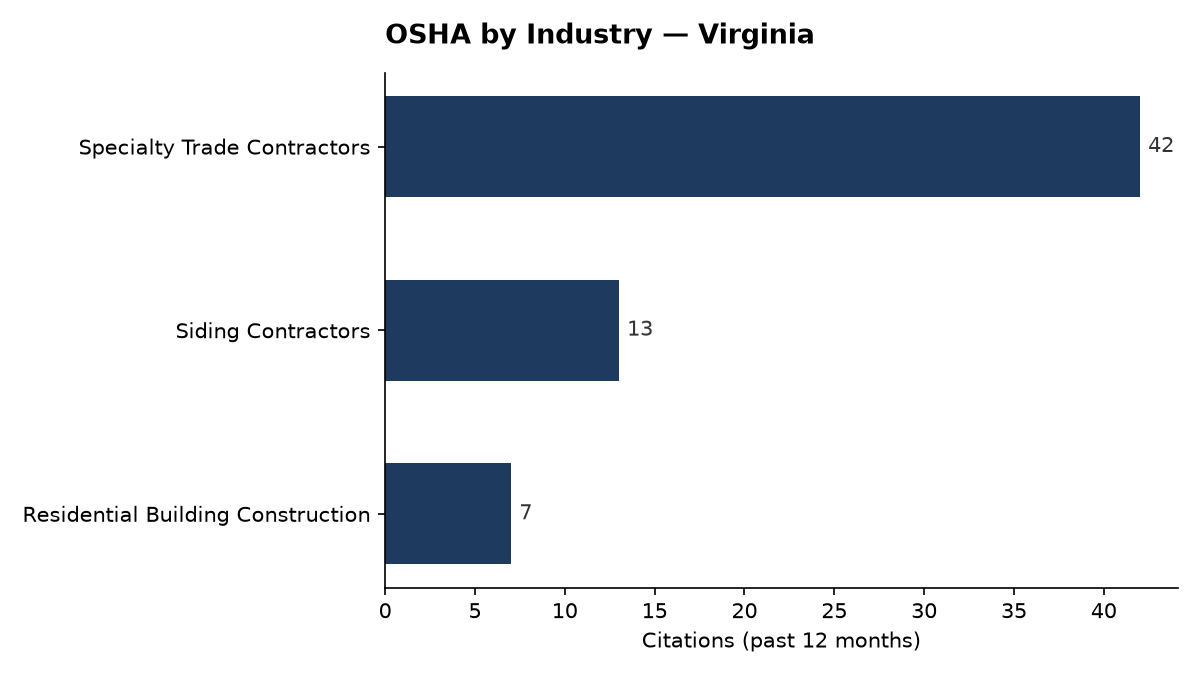
The pattern in Virginia is not subtle. Specialty trade contractors account for 42 of the state’s 73 citations — well over half. Siding contractors added another 13, and residential building construction brought in 7 more. Together, these three categories cover almost every citation issued in the state.
That concentration makes sense once you think about the work itself. Siding, masonry, exterior finishing, and other specialty trades routinely put crews on scaffolds for extended stretches, often on residential and light commercial jobs where scaffold setup gets rushed to keep the schedule moving. Those are exactly the conditions where guardrails get skipped, planking gets left incomplete, or a scaffold gets used before it’s fully inspected.
Virginia’s breakdown by violation severity backs this up: 62 of the 73 citations were classified Serious, 10 were Other-than-Serious, and 1 was a Repeat violation. A Serious classification means OSHA determined there was a real probability of death or serious physical harm — not just a paperwork gap. That’s the majority of what’s happening on Virginia scaffolding jobs right now.
What a Citation Actually Costs in Virginia
The $2,443 average and $1,929 median penalty figures are useful benchmarks, but they don’t capture how much individual cases can vary. Recent Virginia citations show that range clearly:
- Atlantic Refinishing & Restoration, Inc. in Lynchburg: $16,285, Other-than-Serious, cited under 19260451 G04 I, issued May 8, 2026
- R A Masonry Co. in Chesapeake: $8,260, Repeat, cited under 19260451 G04 I, issued May 19, 2026
- Best Bid, Inc. in Madison Heights: $6,885, Serious, cited under 19260451 B01, issued June 3, 2026
- Rick Shipman Construction, Inc. in Lebanon: $6,195, Other-than-Serious, cited under 19260451 F07, issued May 22, 2026
- Swift Creek Masonry Llc in Richmond: $6,195, Serious, cited under 19260451 C02 I, issued July 20, 2026
Notice that an Other-than-Serious citation can still carry a five-figure penalty, and a Repeat classification — like the one against R A Masonry Co. — pushes the number up fast because OSHA multiplies penalties for employers who’ve been cited for the same type of violation before. For a full breakdown of how OSHA calculates these numbers, see this guide to OSHA scaffolding violations penalty amounts.
There’s also a negotiation angle worth knowing about. Across Virginia’s scaffolding cases, the average gap between the initial penalty and the final settled amount was only 7%. That’s a modest reduction compared to what’s achievable in some other jurisdictions, which tells you Virginia employers generally aren’t pushing back hard enough — or aren’t building a strong enough case when they do.
A 7% average reduction means most Virginia employers are leaving money on the table. Before you pay a citation at face value, get a Virginia OSHA defense attorney to review whether the classification and penalty are actually defensible.
The 15-Working-Day Window You Can’t Afford to Miss
Once a citation is issued, OSHA gives you exactly 15 working days to file a Notice of Contest. Miss that window and the citation becomes a final order — no appeal, no negotiation, no reduction, regardless of whether the citation was fair or accurate. That deadline is unforgiving, and it starts ticking the day you receive the citation, not the day you get around to reading it carefully.
Given that only 1 of Virginia’s 73 citations in the past year carried a Repeat classification, most employers here are dealing with first-time or infrequent enforcement — which also means most employers haven’t been through this process before and don’t know how much room there is to negotiate scope, classification, or penalty amount. Filing a contest doesn’t necessarily mean a drawn-out legal fight; it often opens the door to a settlement conference where the penalty, classification, or abatement terms get revised. Details on the process are covered in this explainer on how to contest an OSHA citation.
If you’re inside that 15-working-day window right now, don’t wait until it’s almost gone. Contact a Virginia OSHA defense attorney today and find out what your options actually look like.
Whether your citation lists a five-figure penalty like the one issued in Lynchburg or a more modest figure closer to Virginia’s median, the smartest move is the same: get a professional read on the citation before that contest window closes, because once it does, the number on the page is the number you owe.