

Data last updated: August 31, 2026
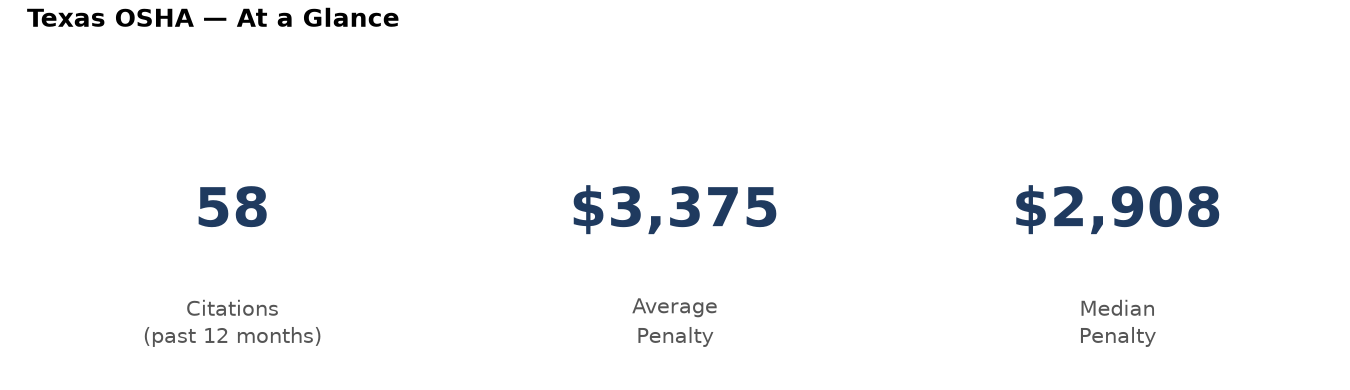
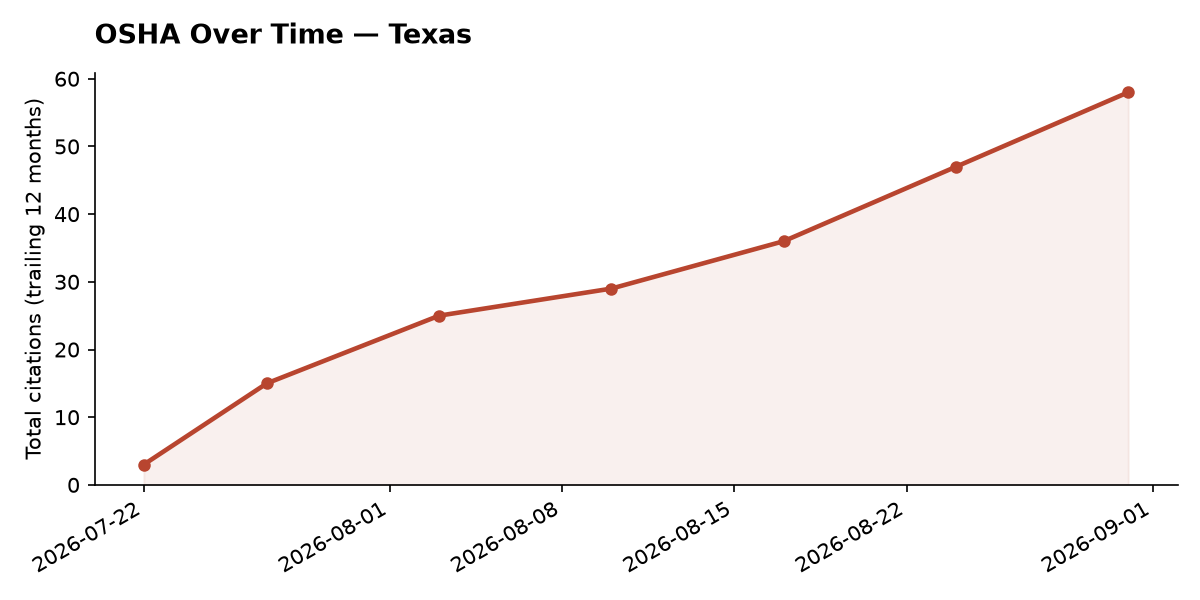
Fifty-eight scaffolding citations landed on Texas employers in the past 12 months, with the average penalty sitting at $3,375 and the median at $2,908. Conroe saw more of these citations than any other city in the state, but the pattern stretches far beyond one town — from Galveston shipyards to San Antonio energy sites to small residential jobs in Wylie and Princeton.
If you’re holding a citation right now, the clock is already running. Before you decide how to respond, talk to a Texas OSHA defense attorney about your specific case and deadline.
What 1926.451 Actually Demands on a Texas Job Site
Nearly every one of these 58 citations traces back to a single rule: 1926.451, OSHA’s general scaffolding standard. It’s not a narrow technical rule — it covers how a scaffold is built, how much weight it can hold, how workers get on and off it, whether fall protection is in place, and whether guardrails and planking meet basic safety thresholds.
In practice, inspectors are checking for the same handful of failures over and over: missing or improperly rated guardrails, scaffold platforms that aren’t fully planked, unsafe access points like ladders or climbing on cross-braces, and scaffolds erected without a competent person confirming stability and capacity. Any one of these gaps can trigger a citation, and several of the real cases below stack more than one violation under the same inspection.
Why Specialty Trade Contractors Account for Most of the Cases
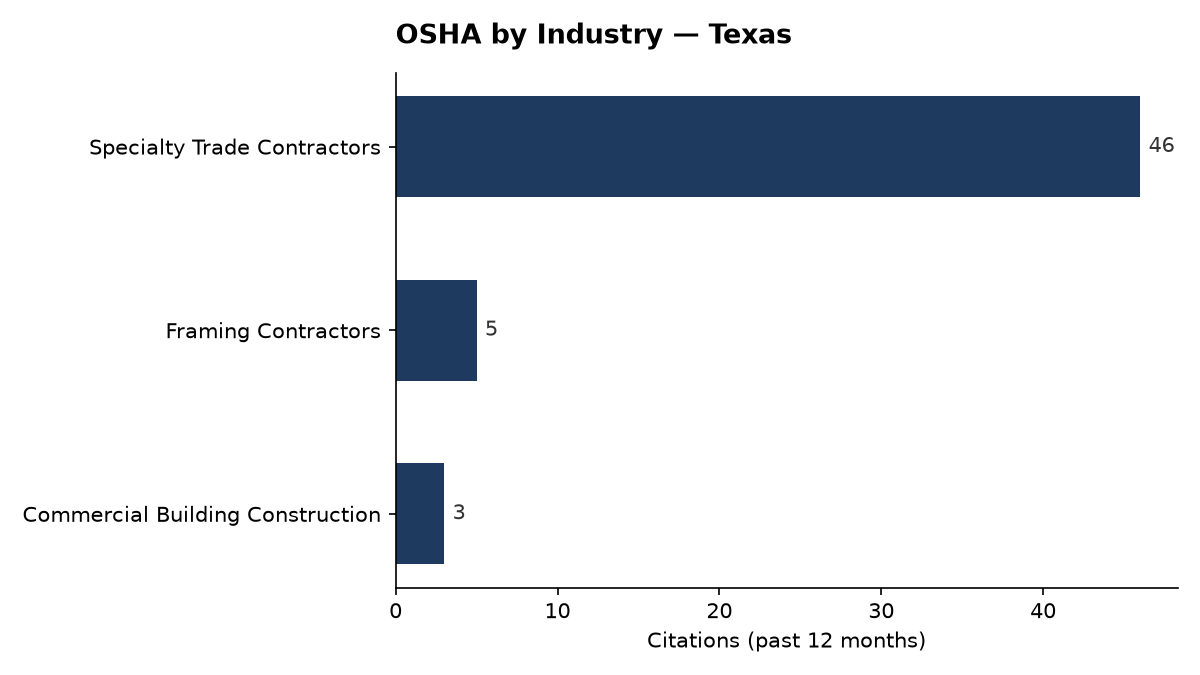
Of the 58 citations, 46 went to specialty trade contractors — masonry, plastering, glazing, and similar subcontractors who spend their days working directly off scaffolds rather than just walking past them. Framing contractors picked up 5 citations, and commercial building construction firms accounted for 3.
That concentration makes sense. Specialty trades are the crews actually standing on the planks, tying rebar, laying brick, or running conduit at height, often on scaffolds erected and moved multiple times during a single project. General contractors oversee the site, but it’s the trade crews whose daily tasks put them directly under 1926.451’s microscope — which is exactly why OSHA inspectors in Texas keep finding violations there.
What a Citation Actually Costs — And Why the Type Matters
Of the 58 violations recorded, 54 were classified as Serious, 3 as Other-than-Serious, and 1 as Repeat. That breakdown matters because Serious violations already carry meaningful penalties on their own, but a Repeat citation — meaning OSHA found the same or a substantially similar hazard at that employer before — multiplies the exposure fast.
The real cases on file show that spread clearly. Winco Masonry Lp in Galveston was cited $11,916 for a Serious violation under 19260451 C01 III, issued September 10, 2025. Isidro Vences in Parker drew the same $11,916 penalty, but as a Repeat violation under 19260451 G01, issued September 25, 2025 — a sharp reminder of how much more expensive a second finding can be. Brand Energy Solutions in San Antonio was cited $11,585 for an Other-than-Serious violation under 19260451 A01. On the smaller end, Cesar Martinez Cortez in Princeton and New Standard Construction Llc in Wylie were each cited $4,965 for Serious violations under 19260451 E01, issued five months apart.
Statewide, the average penalty reduction between the initial citation and the final settled amount runs about 13%. That’s not nothing, but it also tells you most Texas employers aren’t getting citations dismissed outright — they’re negotiating modest reductions, usually with legal help involved. For a fuller breakdown of how these numbers get calculated, see this explanation of OSHA scaffolding violations penalty amounts.
Whether your citation lands closer to $2,908 or $11,916, the amount on paper is rarely the final word. That 13% average reduction didn’t happen by accident — employers who contested or negotiated got it. Talk to a Texas OSHA defense attorney before you decide whether to pay, contest, or negotiate.
The 15-Day Window You Can’t Afford to Miss
Once a citation is issued, you have exactly 15 working days to file a Notice of Contest. Miss that window and the citation becomes a final order — no appeal, no negotiation, no second chance to dispute the classification or the penalty amount. Given that a Serious violation in Texas averages well over $3,000 and a Repeat finding can push past $11,000, that deadline is not something to sit on while you figure out your next move.
If you’re weighing whether to contest, it helps to understand the process before you file anything. This guide on how to contest an OSHA citation walks through what happens after you file and what evidence actually moves the needle in negotiations or before an administrative law judge.
Given how little time the law gives you, the smartest first step is usually a conversation with someone who handles these cases regularly. Get in touch with a Texas OSHA defense attorney now, while you still have options on the table.
Whatever the abatement date or the dollar figure on your citation says, the decisions you make in the next two weeks will shape how this plays out — so don’t wait until the 15 working days are nearly gone to start asking questions.