Data last updated: September 28, 2026
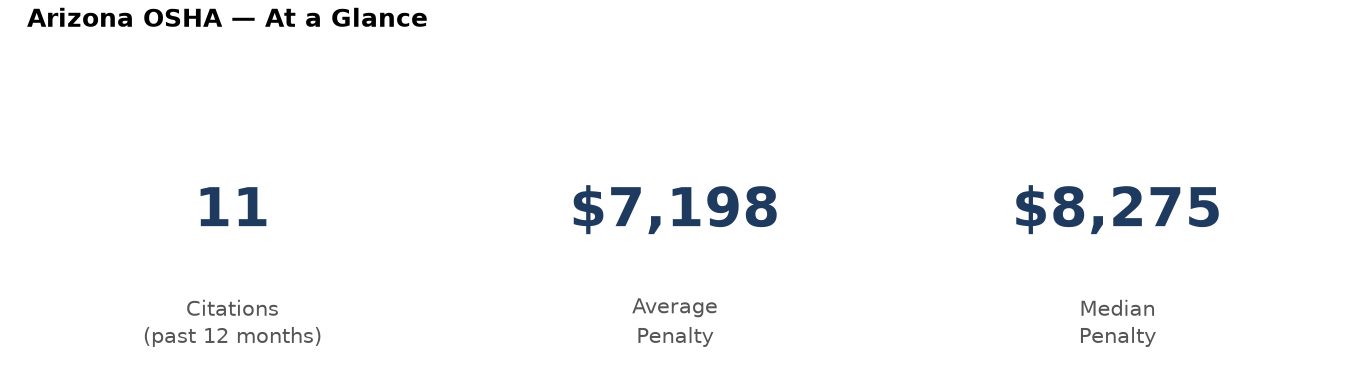
Over the past 12 months, Arizona employers picked up 11 citations under the federal fall protection standard, 1926.501. The average penalty landed at $7,198, with a median of $8,275 — meaning half the citations issued in the state carried a bill higher than that. Mesa saw more of these citations than any other Arizona city. Eight of the 11 were classified Serious, two were Repeat, and one was Other-than-Serious. No willful citations showed up in this window, but Repeat citations still carry a steep premium because OSHA treats a second offense as proof the employer already knew about the hazard.
If you run a construction crew in Arizona, an 11-citation count over a year might sound small. It is not a reason to relax. It means OSHA compliance officers are actively inspecting roofing and specialty trade job sites in this state, and when they find an uncovered edge or an unclipped harness, the fine is rarely small.
If you’ve already received a citation, don’t wait to get informed. Talk to an Arizona OSHA defense attorney before your response window starts running out.
What 1926.501 Actually Demands From an Arizona Job Site
The standard behind every one of these citations, 1926.501, is the backbone of federal fall protection enforcement. Stripped of the legal language, it says this: once a worker is exposed to a fall of six feet or more onto a lower surface on a construction site, the employer has to do something concrete about it. That something is usually one of three things — guardrails around the edge, a safety net system below, or a personal fall arrest system anchored and worn correctly. It is not enough to hand someone a harness and hope they clip in. OSHA expects the system to actually be in use, anchored properly, and appropriate for the task, whether that’s a roof edge, a wall opening, or a leading edge on a framing job.
Where Arizona inspectors keep finding gaps is at the roof edge itself. Several of the citations issued this year cite subsection B10, which deals specifically with roofing work on low-slope and steep roofs where workers were exposed without any arrest system in place, and subsection B13, covering the narrower category of residential construction fall protection.
Why Roofers and Specialty Trades Carry the Weight of Arizona’s Enforcement
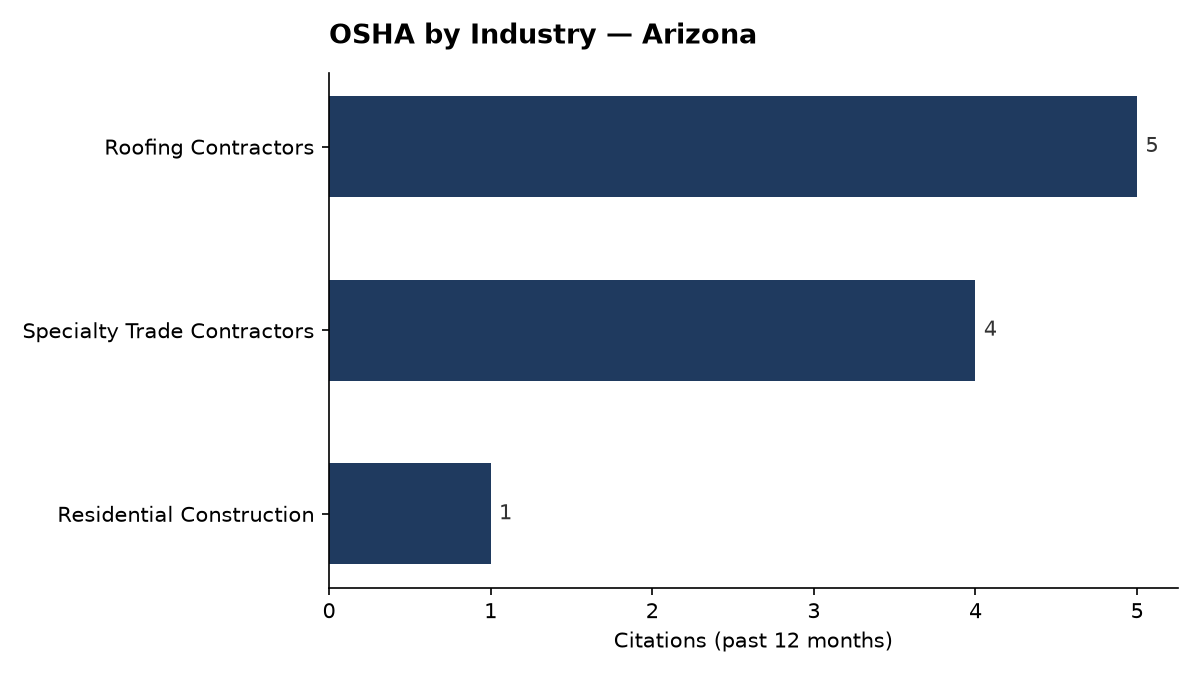
Of the 11 citations, five went to roofing contractors, and four more went to specialty trade contractors — a category that covers everything from siding to exterior finish work. Residential construction accounted for one more. Together, roofing and specialty trades make up roughly 82 percent of all fall protection enforcement in the state this year.
That concentration is not random. Roofing is the one trade where a worker is almost always operating at or above the six-foot threshold, often on a sloped surface, often moving material at the same time. It is also a fast-paced, deadline-driven trade where crews sometimes skip tie-off for a few minutes to move faster — and that is exactly the window an OSHA compliance officer or a competitor complaint tends to catch. Specialty trade contractors get swept into the same enforcement pattern because much of their work also happens on ladders, scaffolds, and roof edges.
The Real Dollar Numbers Behind Arizona’s Recent Citations
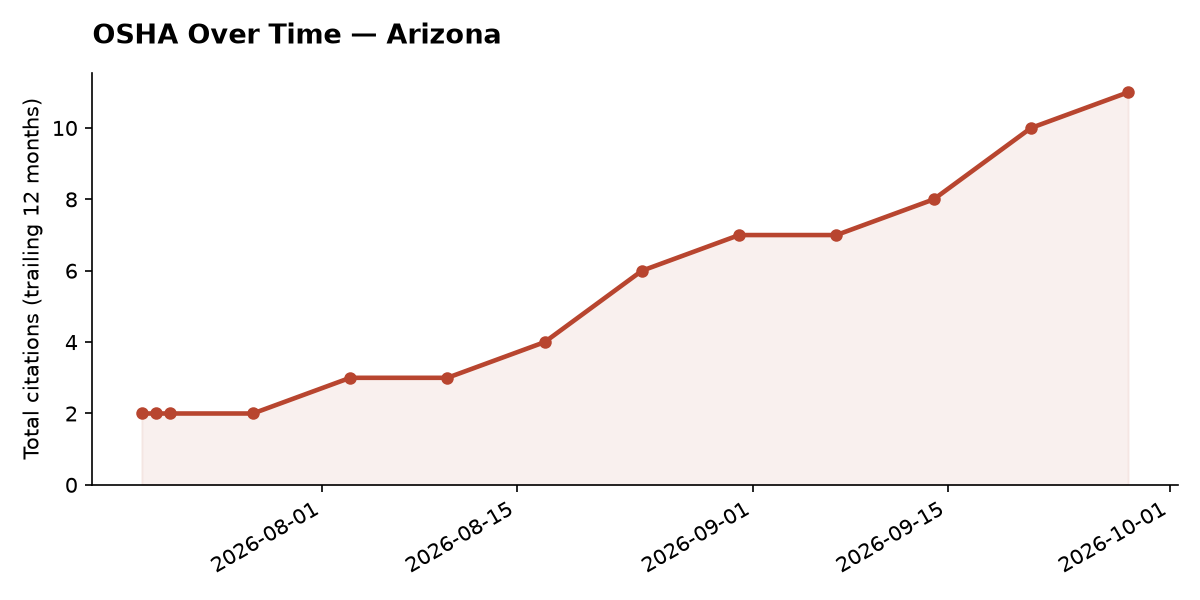
Averages only tell part of the story. Here is what actual Arizona employers were billed:
- Five Guys Roofing, LLC (Peoria) — $16,552, Repeat violation under 19260501 B10, issued February 5, 2026
- Geronimo Wall Systems, LLC (Fountain Hills) — $13,406, Serious violation under 19260501 B13, issued December 18, 2025
- EZ Roofing Company LLC (Mesa) — $11,823, Repeat violation under 19260501 B10, issued August 13, 2026
- OSR Holding Company LLC dba O’Hara’s Son Roofing Company (Casa Grande) — $10,641, Serious violation under 19260501 B01, issued April 9, 2026
- B & F Contracting, Inc. (Phoenix) — $9,458, Serious violation under 19260501 B06, issued March 5, 2026
Notice that the two Repeat citations on this list — Five Guys Roofing and EZ Roofing — carry the two highest penalties. That is not a coincidence. OSHA’s penalty structure is built to punish a second finding of the same hazard far more heavily than the first, on the theory that the employer had already been put on notice. For a full breakdown of how OSHA arrives at these figures, see this explanation of OSHA fall protection violations penalty amounts.
One more number worth sitting with: the average penalty reduction between initial and final citation amount in Arizona over this period was 0 percent. In plain terms, employers who did nothing, or who negotiated without solid legal footing, generally paid exactly what they were initially assessed. That is unusual — in many states, penalties get knocked down through informal conference or settlement. Arizona’s flat 0 percent reduction rate suggests that getting a favorable outcome here takes more than a phone call to the area office. It takes someone who knows how to build a record and negotiate from a position of leverage.
A $16,552 penalty, or even the $7,198 state average, is real money for a small or mid-sized crew. Before you pay it or ignore it, get an Arizona OSHA defense attorney to look at the citation and tell you what your actual options are.
Your Clock Starts the Day the Citation Arrives
If you’ve been cited, the calendar matters more than almost anything else. OSHA gives you 15 working days from the date you receive the citation to file a Notice of Contest. Miss that window, and the citation — penalty, abatement deadline, classification, all of it — becomes final and legally unappealable. There is no extension for being busy, and there is no exception for a first-time offender.
Fifteen working days sounds like plenty of time until you’re also trying to run job sites, manage payroll, and figure out what actually happened on the roof that day. This guide on how to contest an OSHA citation walks through the mechanics, but the short version is this: you need to decide fast whether to contest, negotiate, or accept, and each path has different consequences for your OSHA history going forward — especially since a second finding of the same hazard within a five-year window can turn a Serious citation into a Repeat one, with the penalty jump that comes with it.
Given that Arizona’s data shows essentially no penalty reduction without a real contest, silence or a late response is close to the worst option available.
If a citation is sitting on your desk right now, don’t let the 15-working-day deadline slip past while you weigh your options. Speak with an Arizona OSHA defense attorney and find out what your case is actually worth before you sign anything or pay a dollar.