
Data last updated: September 28, 2026
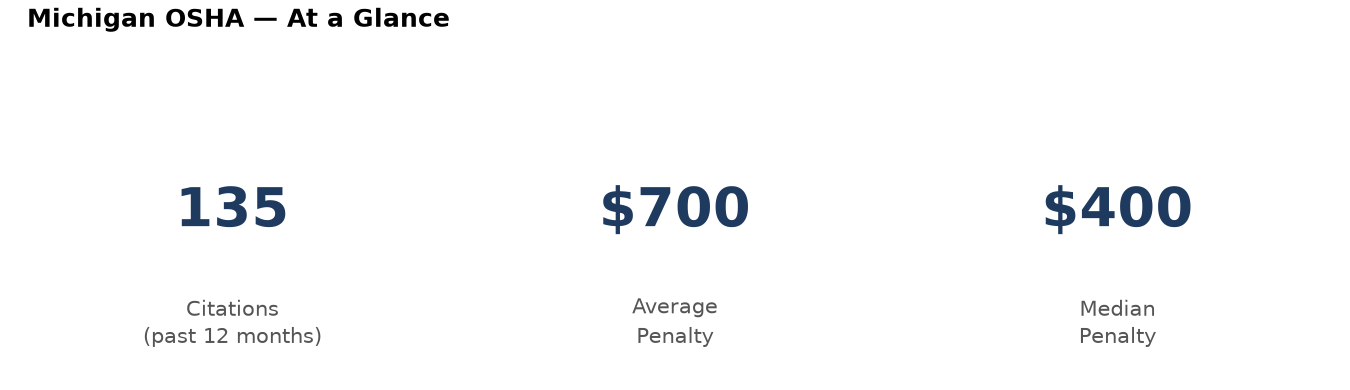
Michigan employers picked up 135 fall protection citations under 29 CFR 1926.501 over the past 12 months. The average penalty landed at $700, with a median of just $400 — but that average hides a wide range, and the numbers get much bigger fast once a citation is marked Repeat instead of Serious. Petoskey, of all places, recorded more fall protection citations than any other city in the state, a reminder that this enforcement priority is not confined to Detroit or Grand Rapids job sites.
If you’ve already received a citation, the clock is running. You have a Michigan OSHA defense attorney available to review your case, and waiting too long to act can cost you options. Talk to a Michigan OSHA defense attorney before you decide how to respond.
What 1926.501 Actually Requires On Site
The rule behind every one of these 135 citations is 1926.501, OSHA’s baseline fall protection standard for construction. In plain terms: once a worker is exposed to a fall of 6 feet or more to a lower level, the employer has to have something in place to stop that fall — guardrails, safety nets, or a personal fall arrest system tied off correctly. It’s not enough to hand someone a harness and hope it gets used. Inspectors are checking whether the system was actually rigged, whether anchor points could hold the load, and whether workers near roof edges, floor openings, or leading edges were protected the entire time they were exposed. For the full breakdown of what compliance looks like under this standard, see the 1926.501 fall protection hub.
Roofing Crews Account For Nearly A Third Of Every Citation
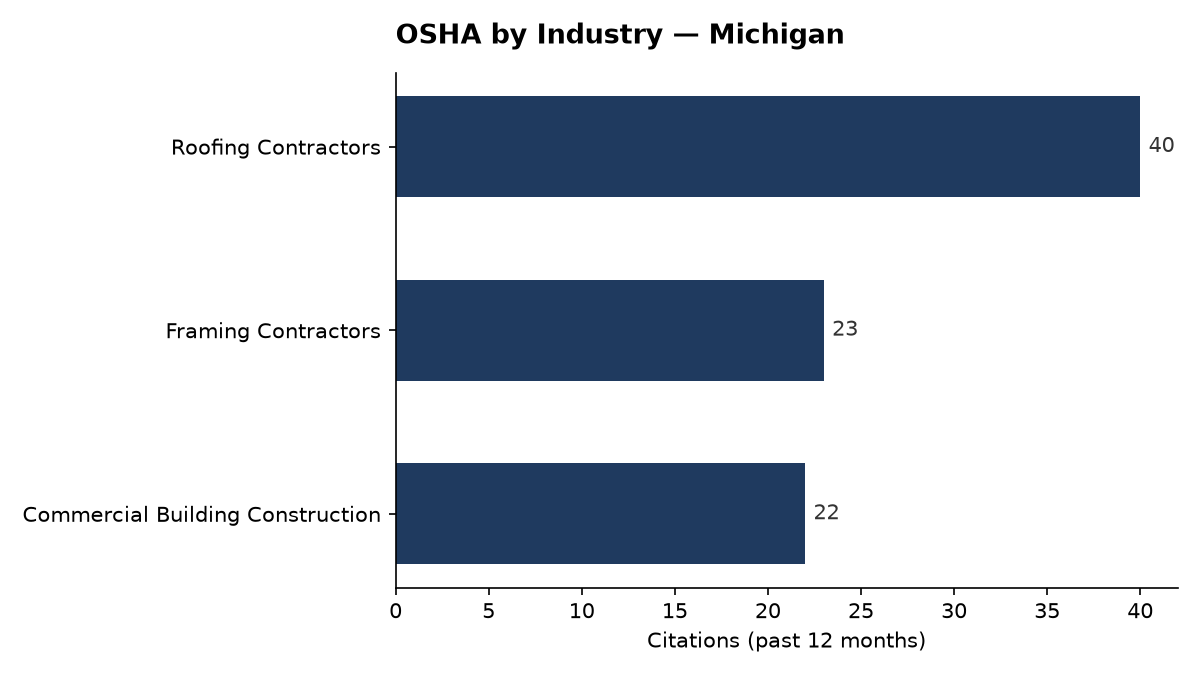
Of the 135 citations issued statewide, 40 went to roofing contractors — close to a third of the total on their own. Framing contractors came in second with 23, and commercial building construction added another 22. That pattern isn’t random. Roofing and framing work put people at unprotected edges and openings all day, often on steep or sloped surfaces where a slip turns into a fall in an instant, and both trades move fast between jobs, which makes it easy for tie-off procedures to slip when deadlines press. If you run crews in this trade, it’s worth reviewing how inspectors approach these jobs specifically — see our page on fall protection enforcement for roofing contractors. Commercial building sites get flagged too, usually around leading-edge work during structural steel or floor deck phases, where protection has to be planned before the work starts, not improvised afterward.
What These Citations Actually Cost In Michigan
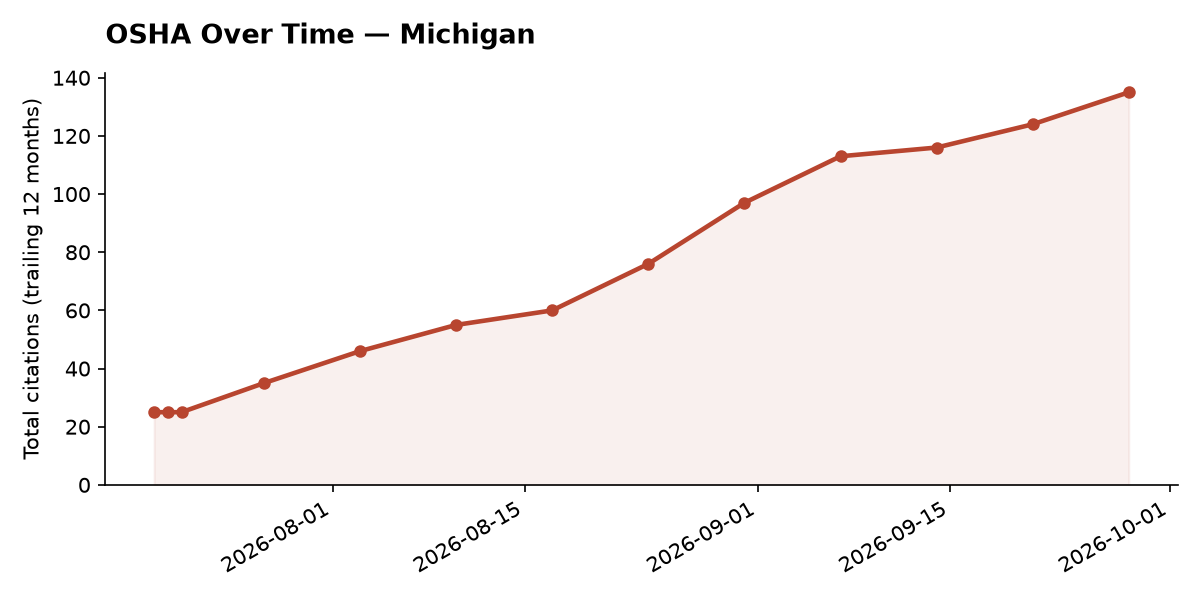
Most of Michigan’s fall protection citations — 106 of the 135 — were classified Serious, meaning OSHA determined the hazard could realistically cause death or serious physical harm. Another 19 were Other-than-Serious. The number that should get real attention is the 10 citations marked Repeat. A repeat violation means OSHA found the same or a substantially similar hazard at that employer before, and repeat penalties are calculated at a much steeper multiple than a first-time serious citation.
You can see that difference in the real citation record. Straight Line Sheet Metal, LLC in Bridgman was cited $7,000 for a Serious violation under 1926.501(b)(13), issued December 15, 2025. Compare that to K & B Jones, Inc. in Mount Pleasant, cited $5,600 for a Repeat violation under the same subsection, or Speck Carpentry, Inc. in Lake Orion, hit with a $4,000 Repeat citation. Tremco Incorporated in Leroy was cited $3,500 for a Serious violation under 1926.501(b)(10), and Northern Awning and Window Company, Inc. in Marquette received a $2,800 Repeat citation. Notice that three of these five real examples are Repeat classifications — that’s not a coincidence, it reflects how often OSHA in Michigan is finding the same fall hazard on a return visit.
Here’s the part that matters most if you’re deciding how to respond: the average penalty reduction between the initial citation and the final settled amount in Michigan is 21%. That gap exists because employers who push back — with documentation, corrected conditions, or legal representation — routinely get penalties reduced. It rarely happens automatically. For a fuller explanation of how these numbers are calculated and where the room to negotiate actually is, see how OSHA fall protection penalties are calculated.
A 21% average reduction on a Repeat citation in the $5,000-$7,000 range is real money, but it doesn’t happen by accident. Before you pay a citation as-issued, get a second opinion from a Michigan OSHA defense attorney who handles these cases regularly.
Your Window To Respond Is Short — Don’t Let It Close
Once you receive a citation, OSHA gives you exactly 15 working days to file a Notice of Contest. That’s calendar business days, not a rough guideline, and it starts the moment the citation arrives — not when you get around to reading it carefully. Miss that window and the citation becomes a final order, which locks in the penalty and the violation classification, including any Repeat designation that will follow you into future inspections and drive up penalties on anything found later. Before that deadline passes, read through how to contest an OSHA citation so you understand what’s actually involved in challenging the classification, the penalty amount, or both.
If you’re inside that 15-day window right now, don’t spend it deciding on your own whether the citation is fair. Get a Michigan OSHA defense attorney looking at the specific subsection you were cited under and the facts on your job site before that deadline closes.
Whether your citation was issued last week or you’re bracing for an inspection after a near-miss on site, the facts in Michigan’s record are clear: fall protection is the standard most likely to bring an inspector to your door, roofing and framing crews carry the heaviest share of the risk, and the difference between the initial penalty and what you actually end up paying often comes down to how quickly and how well you respond.