

Data last updated: September 14, 2026
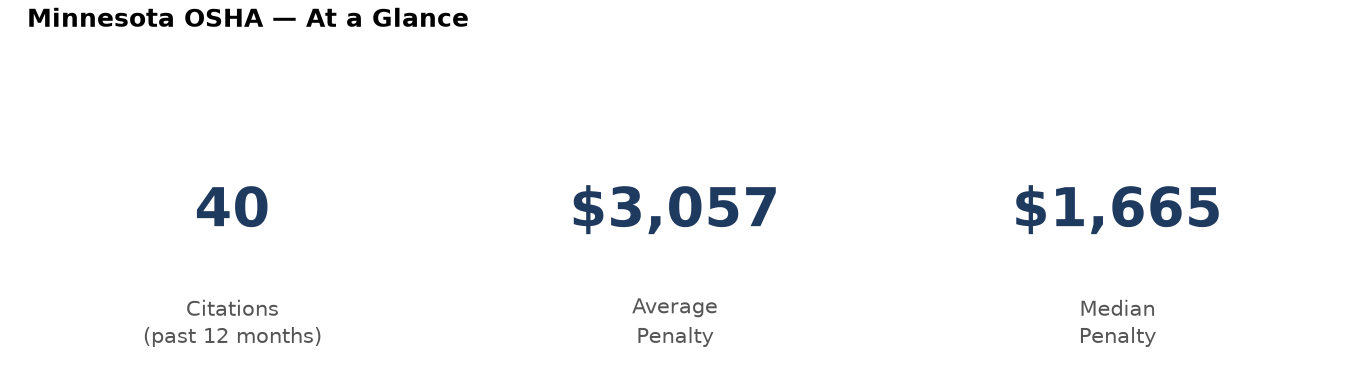
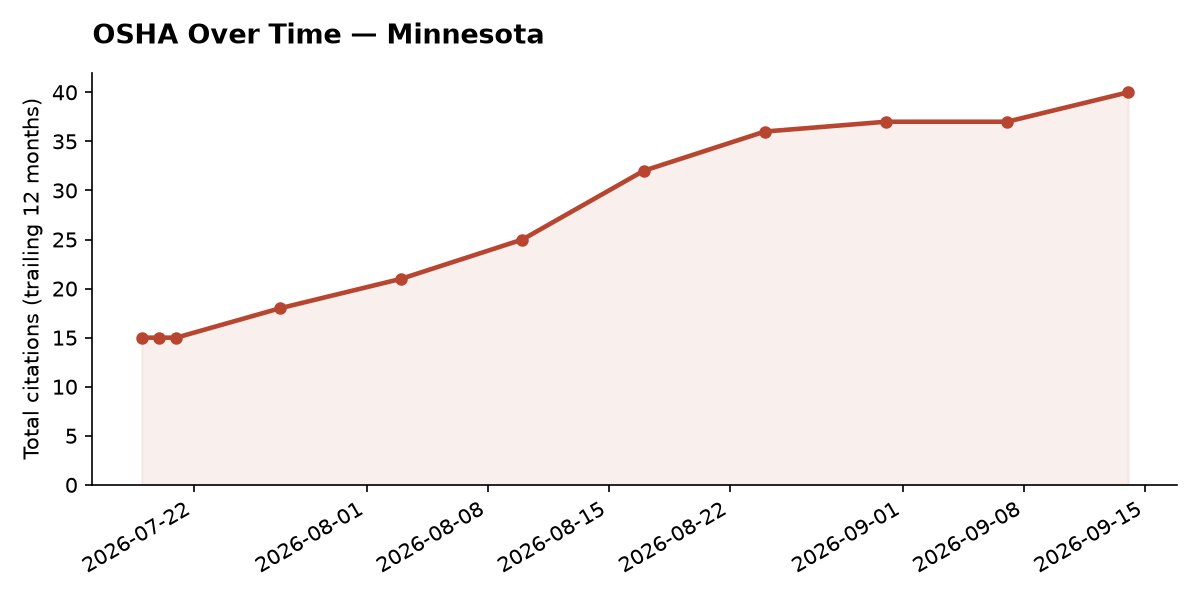
Over the past 12 months, Minnesota employers picked up 40 citations under OSHA’s fall protection rule, 1926.501. The average penalty landed at $3,057, though the median was lower at $1,665 — meaning a handful of larger, repeat-violation cases pulled the average up. Duluth had more of these citations than any other Minnesota city. Two of the 40 citations were classified as Repeat, which is the category that tends to carry the steepest fines.
If your company just received one of these citations, or you’re worried one is coming, the clock is already running. You have a Minnesota OSHA defense attorney available to review the citation and your options before that clock runs out.
What 1926.501 Actually Requires on a Minnesota Job Site
The standard behind every one of these citations, 1926.501, is OSHA’s general fall protection rule for construction. In plain terms: once a worker is exposed to a fall of 6 feet or more to a lower level, the employer has to do something about it — guardrails, safety nets, or a personal fall arrest system (harness, lanyard, anchor point). It’s not a suggestion or a best practice. It’s a baseline requirement that applies the moment someone steps onto a roof edge, a floor opening, or scaffolding without adequate protection.
What trips up a lot of Minnesota contractors isn’t ignorance of the rule — it’s the assumption that a quick task (‘just five minutes on the roof’) doesn’t trigger it, or that a worker’s own experience substitutes for engineered protection. OSHA doesn’t see it that way, and neither do the penalty tables. You can read the full breakdown of this standard on our 1926.501 fall protection hub.
Roofers and Framers Account for Most of Minnesota’s Citations
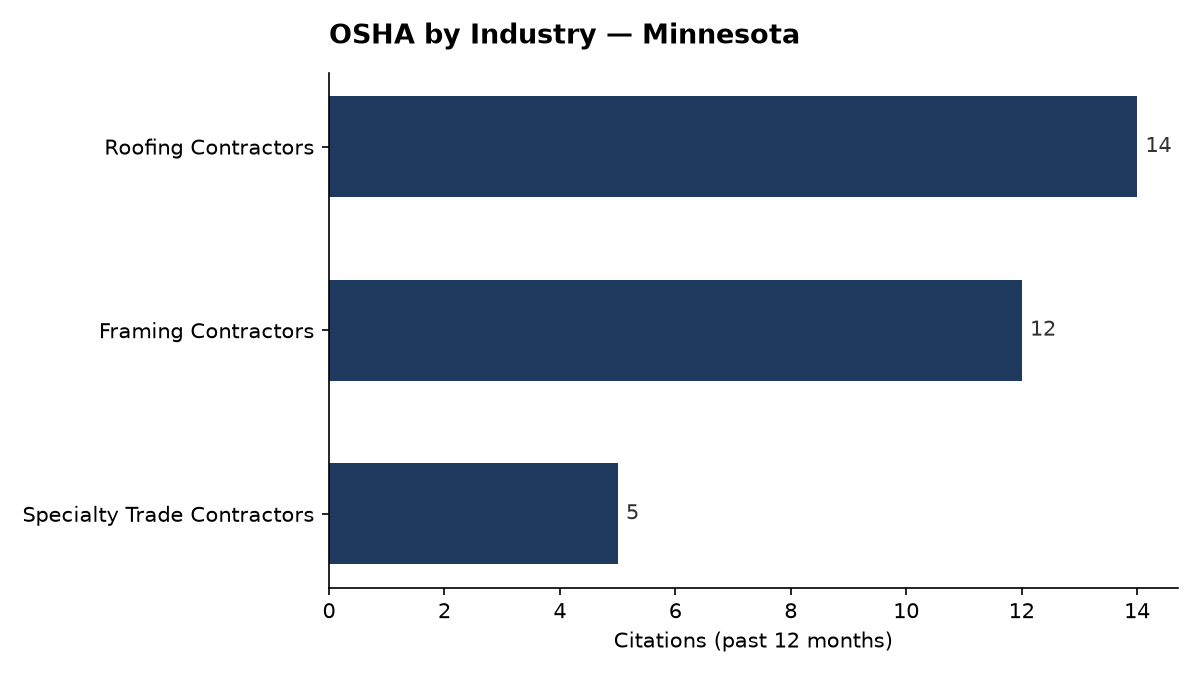
Of the 40 citations, 14 went to roofing contractors and 12 to framing contractors — together that’s about two-thirds of all fall protection enforcement in the state over the period. Specialty trade contractors picked up another 5. This lines up with the physical reality of the work: roofers and framers spend entire shifts at height, often on pitched or unfinished surfaces where a lapse in tie-off procedure or guardrail setup is immediately visible to an inspector, and immediately dangerous to the worker.
If you run a roofing contractor operation in Minnesota, you’re working in the segment OSHA is watching most closely right now. That doesn’t mean framing crews or specialty trades are off the hook — it means the enforcement pattern tracks directly with where the fall exposure actually is.
What These Citations Cost, in Real Minnesota Cases
The dollar figures vary widely depending on the classification. Of the 40 citations, 38 were Serious and 2 were Repeat — and the Repeat designation is where the real money shows up. A Repeat citation means OSHA found the same or a substantially similar violation at that employer before, and the agency responds by multiplying the penalty accordingly.
That pattern is visible in the actual record. Quality Trusted Commercial Construction – Roofing, in Minneapolis, was cited $40,000 for a Repeat violation under 1926.501(b)(10), issued September 19, 2025. Rtl Construction Inc, in Saint Paul, was cited $15,000 for a Repeat violation under 1926.501(b)(1), issued November 26, 2025. By contrast, the Serious citations in the dataset ran much lower: Q-P Exteriors LLC in Mankato was cited $4,900 under 1926.501(b)(11), issued July 17, 2026; Edge Enterprise LLC in Rogers was cited $4,900 under 1926.501(b)(15), issued August 5, 2026; and R-R Capital Investments LLC in Saint Paul was cited $3,850 under 1926.501(b)(10), issued July 8, 2026.
That spread — from under $4,000 to $40,000 for citations under the same standard — shows how much classification matters, and how much room there is to negotiate. Statewide, the average penalty reduction between the initial and final amount was 18%, which tells you employers who push back through the formal process, rather than simply paying the initial number, often end up owing meaningfully less. You can see how these numbers are calculated on our page on OSHA fall protection penalty amounts.
An 18% average reduction is not something that happens automatically. It happens when someone with knowledge of the process challenges the classification, the exposure calculation, or the underlying facts. Before you decide to just pay a citation, it’s worth talking to a Minnesota OSHA defense attorney about whether your case has room to move.
You Have 15 Working Days — Don’t Let It Pass
If you’ve received a citation, the single most important fact to know is this: you have 15 working days from the date you receive it to file a Notice of Contest. Miss that window, and the citation — along with the proposed penalty — becomes final, with almost no way back. There’s no grace period and no automatic extension.
Filing a Notice of Contest doesn’t mean you’re picking a fight with OSHA for the sake of it. It preserves your right to negotiate, to challenge the classification (Serious vs. Repeat vs. Willful matters enormously to the final number), or to dispute the facts the inspector recorded. Our guide on how to contest an OSHA citation walks through the mechanics, but the timeline itself is the part that can’t wait.
Given that two of Minnesota’s 40 citations this period were Repeat violations carrying penalties in the tens of thousands, and given that the average reduction achieved through the process was 18%, the math on getting legal advice quickly is straightforward. Reach out to a Minnesota OSHA defense attorney now, while your 15-day window is still open, rather than after it closes.
Whether you’re staring at your first Serious citation or a Repeat classification that’s pushing your penalty into five figures, the decisions you make in the next few days matter more than anything that happens afterward. Get the citation in front of someone who reviews these for a living before you respond to OSHA on your own.