
Data last updated: September 21, 2026
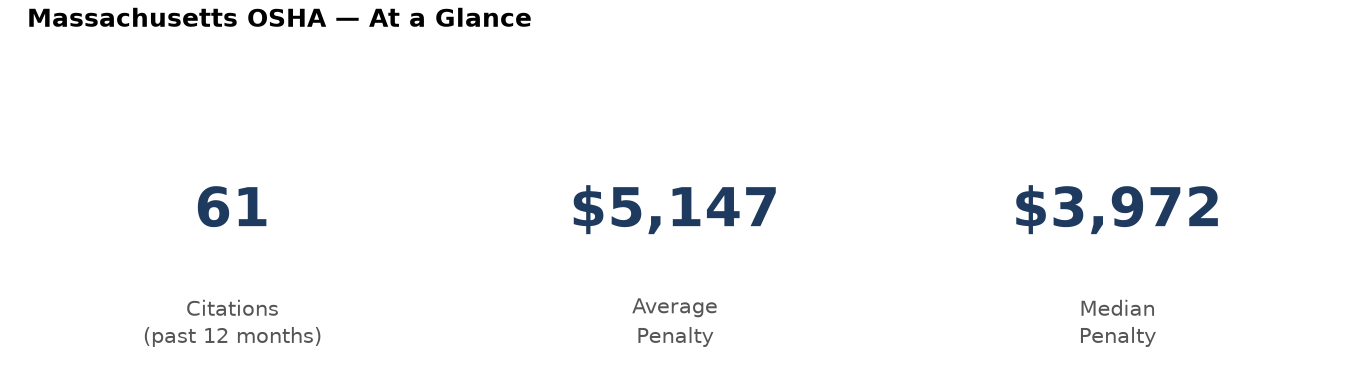
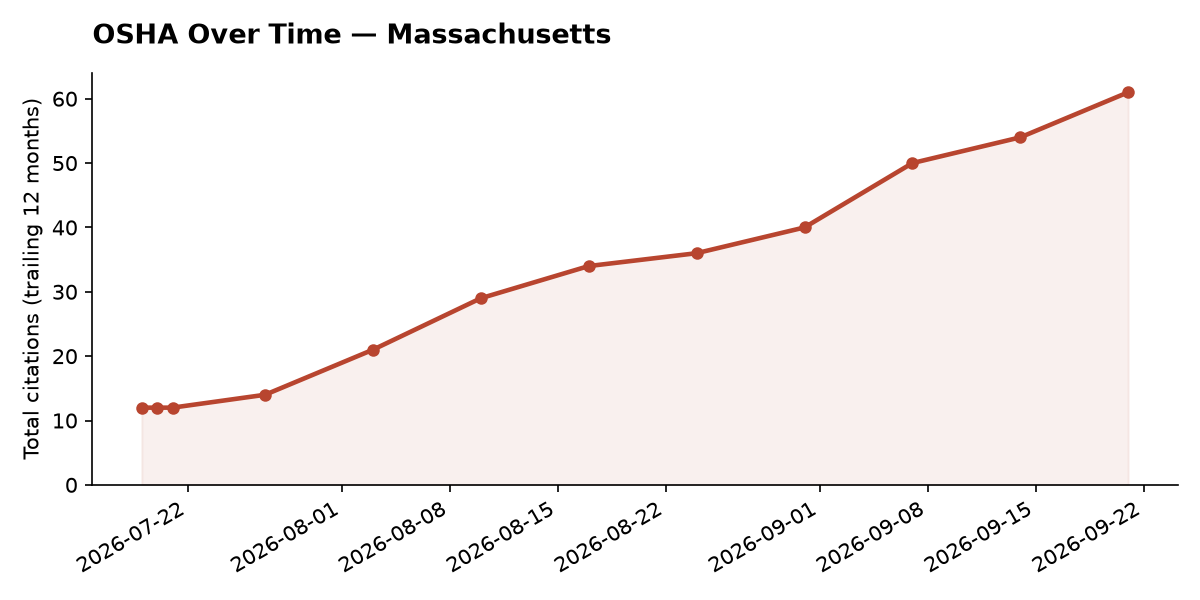
Over the past 12 months, OSHA issued 61 fall protection citations to employers working in Massachusetts, with an average penalty of $5,147 and a median penalty of $3,972. Tewksbury saw more of these citations than any other city in the state. If you run a roofing, framing, or residential construction business anywhere in Massachusetts, this is the enforcement pattern you’re operating inside right now.
If you’ve already received a citation like this, the clock is running. Talk to a Massachusetts OSHA defense attorney before you decide how to respond — the filing window is shorter than most business owners expect.
What OSHA Actually Requires Once Workers Leave the Ground
Nearly every one of these 61 citations traces back to one standard: 1926.501. The rule itself is not complicated. Once a construction worker is exposed to a fall of six feet or more onto a lower level, the employer has to put something between that worker and the ground — guardrails, a properly installed safety net, or a personal fall arrest system worn and anchored correctly. There’s no gray area for whether protection is needed once that six-foot threshold is crossed; the only real question OSHA asks during an inspection is whether it was actually in place and used correctly, not just available in a truck or a job trailer somewhere.
That’s why so many citations in Massachusetts come down to timing. An inspector shows up, sees a worker on a roof edge or an open floor without a harness clipped in, and the citation follows almost automatically. Intent rarely matters to OSHA at the citation stage — exposure does.
Roofing and Framing Crews Are Carrying Most of the Risk
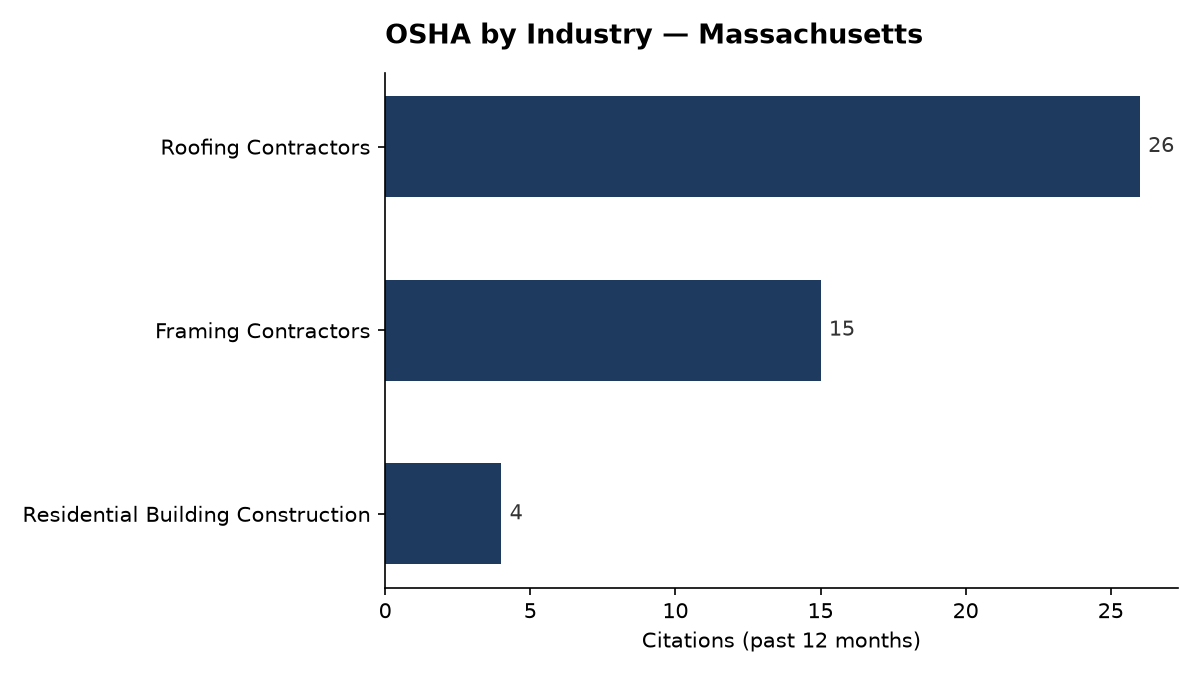
Of the 61 fall protection citations issued statewide, 26 went to roofing contractors alone — well over a third of all cases. Framing contractors picked up 15 more, and residential building construction accounted for another 4. Together, these three trades make up roughly three out of every four fall protection citations written in Massachusetts this year.
The pattern makes sense once you think about the work itself. Roofers and framers spend entire shifts at height, often on pitched or unfinished surfaces, frequently moving between anchor points as a job progresses. Every transition — off a ladder, across a ridge, onto a new section of decking — is a moment where fall protection can lapse for just long enough to draw a citation if an inspector or a competitor complaint brings OSHA to the site.
What These Citations Actually Cost in Massachusetts
The numbers break down unevenly, and that matters. Of the 61 citations, 45 were classified as Serious, 13 as Repeat, 2 as Other-than-Serious, and 1 as Willful. Serious citations carry meaningful penalties on their own, but Repeat and Willful citations are in a different category entirely — OSHA treats them as evidence that a hazard was known and left uncorrected, and the penalties reflect that. Willful violations in particular can multiply the base fine several times over.
You can see that spread in the real citations issued this year. Wr General Construction, Inc. in Belchertown was cited $29,790 for a Repeat violation under 19260501 B13, issued September 26, 2025. Lifetime Contractors, Inc. in Melrose drew a $20,500 penalty for a Willful violation under 19260501 B10, issued June 3, 2026 — the only Willful citation in this dataset and, unsurprisingly, one of the largest fines. Active Pro Construction Inc. in Weymouth was fined $12,413 for a Repeat violation under 19260501 B13, issued September 29, 2025, and Affordable Carpentry, Inc. in Taunton was cited the identical $12,413 amount but as a Serious violation under the same subsection, issued February 20, 2026. Hwa Services LLC in Melrose rounds out the list at $11,916 for a Repeat violation under 19260501 B10, issued June 1, 2026.
One more figure is worth sitting with: penalties in this category get reduced by an average of 29% between the initial citation and the final settled amount, according to how OSHA fall protection violation penalties get calculated and reduced. That gap doesn’t close on its own. It closes because employers push back with evidence, negotiate the classification, or contest the citation outright — not because OSHA lowers numbers as a courtesy.
A near-30% average reduction means the first number on your citation letter is rarely the final number. A Massachusetts OSHA defense attorney can tell you within a short conversation whether your citation has room to move — but that conversation needs to happen fast.
The 15-Working-Day Window You Can’t Afford to Miss
Here’s the part that catches employers off guard: once you receive an OSHA citation, you have exactly 15 working days to file a Notice of Contest. Miss that window and the citation becomes a final order automatically — no hearing, no negotiation, no second look at the classification or the amount. It doesn’t matter if you were mid-project, waiting on an attorney callback, or simply didn’t realize the clock had already started the day the citation arrived.
Given that a Repeat or Willful classification can turn a routine fall protection issue into a five-figure penalty, and given that nearly 1 in 4 citations in this dataset carried one of those two labels, the classification itself is often worth contesting even when the underlying facts aren’t in dispute. Understanding how the Notice of Contest process actually works is the first step, but the deadline doesn’t wait for research.
If a citation with your company’s name on it just arrived, don’t sit with it. Get a Massachusetts OSHA defense attorney looking at the specific subsection you were cited under, the classification OSHA assigned, and whether that 15-working-day window is still open for you — because once it closes, your options close with it.
Whether you’re looking at a five-figure Repeat citation or a first-time Serious violation on a routine job, the smartest move is the same one Massachusetts contractors keep making after they see their citation letter: get someone who handles these cases every day to review it before the deadline passes, not after.