
Data last updated: September 21, 2026
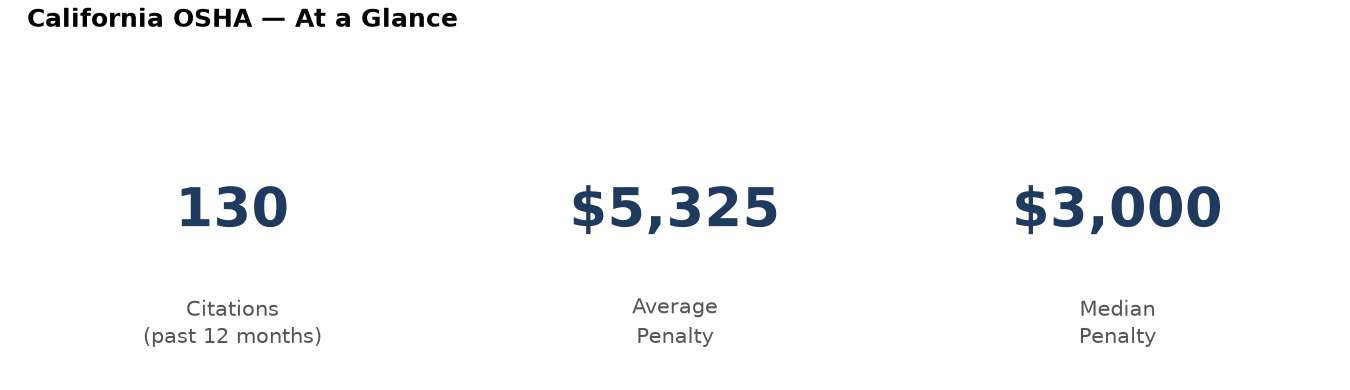
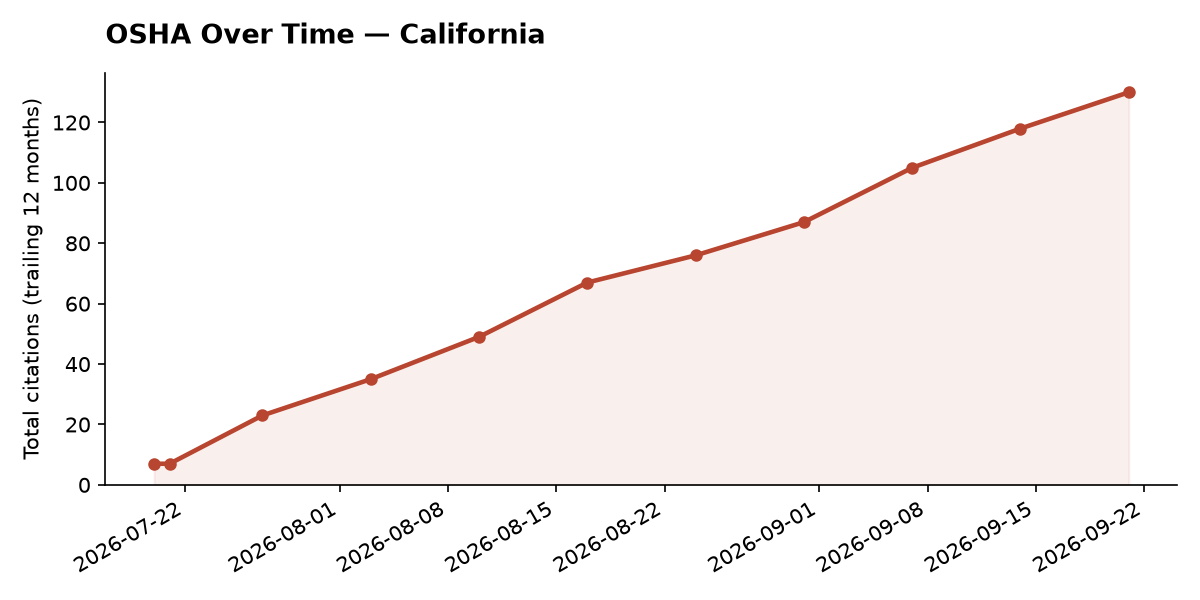
Over the past 12 months, California employers picked up 130 fall protection citations, with penalties averaging $5,325 and a median of $3,000. Redding logged more of these citations than any other city in the state, and roofing contractors accounted for over half of all cases. If you’ve just opened a citation letter with one of these numbers on it, the clock is already running.
Before anything else, get someone in your corner who reads Cal/OSHA citations for a living. Talk to a California OSHA defense attorney about what’s actually on your citation and whether it holds up.
Why California’s Rules Aren’t the Same as Federal OSHA’s
California is one of a handful of states that runs its own workplace safety program instead of deferring to federal OSHA. That means the fall protection rule enforced here isn’t 1926.501 — it’s California’s Cal/OSHA equivalent (Title 8) to the federal 1926.501 standard, and it has its own trigger heights, documentation expectations, and penalty math. Don’t assume advice written for a federal-OSHA state applies cleanly here, and don’t assume California’s numbers stack up directly against another state’s — the agencies, the thresholds, and the enforcement culture are different.
At its core, the standard requires that once a worker is exposed to a fall of roughly 6 feet or more above a lower level on a construction site, the employer has to do something about it — guardrails, safety nets, or a personal fall arrest system. Cal/OSHA doesn’t accept a promise to be careful as a substitute. Inspectors look for the physical protection to already be in place, not planned for later, and they look for it to be used correctly, not just present on site.
Roofing Is Where Most of These Citations Are Coming From
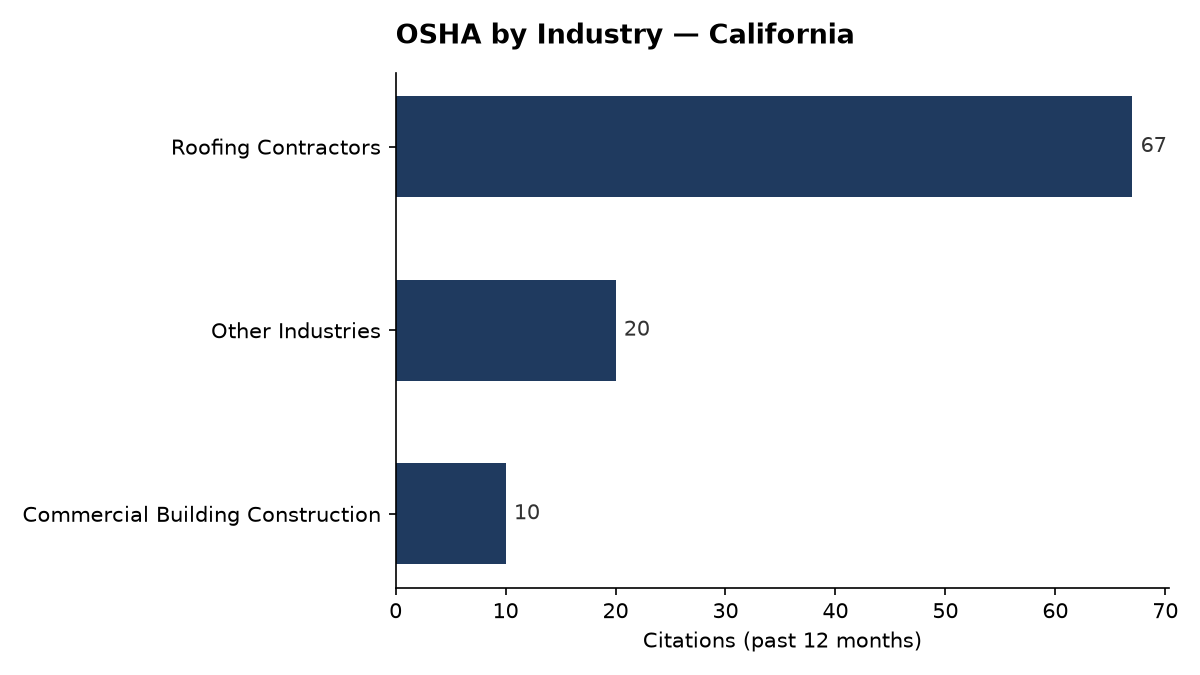
Of the 130 fall protection citations issued statewide, 67 went to roofing contractors — more than half. That’s not surprising given the nature of the work: steep-slope roofs, skylights, and open edges are exactly the conditions this standard was written for, and roofing crews are exposed to them all day, every day. Twenty citations went to a mix of other industries, and commercial building construction picked up 10 more, often tied to work near unprotected edges or floor openings during framing and finishing.
If you run a roofing company, or subcontract roofing work, you should assume Cal/OSHA inspectors already know your trade is a priority target. Toolbox talks and a fall protection plan on paper aren’t enough if the equipment isn’t actually being worn and anchored correctly when an inspector shows up.
What These Citations Actually Cost, and Why Some Are Far More Expensive
Not all 130 citations carry the same weight. Seventy-three were classified as Serious, meaning Cal/OSHA determined there was a realistic chance of death or serious physical harm. Fifty-three were Other-than-Serious. Only four were Repeat citations — but those four matter disproportionately, because repeat violations get penalized far more heavily than a first-time Serious finding, on the theory that the employer already knew about the hazard and didn’t fix it.
You can see that gap play out in real cases. Diablo Roofing, Inc. in Fremont was cited $36,000 for a Repeat violation under section 1670(A), issued January 30, 2026 — more than double the state average, precisely because it wasn’t a first offense. Compare that to two Serious citations issued the same day, October 2, 2025, in Cathedral City: Bernards Bros, Inc. at $20,250 and Challenger Sheet Metal, Inc. at $18,900, both cited under 1730(E). Gardner Roofing Company in San Jacinto was cited $18,900 under 1731(C)(1) in March 2026, and Quality Environmental Inc in Vernon was cited $18,000 under 1670(B)(11)(B) in October 2025. These are all real, named cases from the public record, and the spread between $18,000 and $36,000 shows exactly how much classification and history matter to the final number.
Here’s a detail worth paying attention to: the average penalty reduction between the initial citation and the final settled amount was only 6% statewide. That’s a modest discount, which tells you Cal/OSHA isn’t in the habit of walking back penalties without a real fight or a genuinely strong argument. Employers who go in without preparation, or without understanding how fall protection violation penalty amounts are actually calculated, tend to pay close to the sticker price.
A 6% average reduction isn’t nothing when you’re looking at a $36,000 citation, but it’s not something you get by asking nicely either. A California OSHA defense attorney can tell you early whether your case has grounds for a bigger reduction or dismissal, before you commit to a strategy.
The 15-Day Window That Decides Your Options
Once a citation is issued, you have 15 working days to file a Notice of Contest. Miss that window and the citation typically becomes a final order — no matter how strong your defense might have been. That’s not a lot of time to gather documentation, talk to witnesses, and figure out whether the classification (Serious, Repeat, or otherwise) was even accurate in the first place.
Before that deadline passes, it’s worth understanding how to contest an OSHA citation and what evidence actually moves the needle — things like whether the fall protection equipment was available but not used, whether the hazard was truly foreseeable, or whether the classification itself was inflated. These are exactly the kinds of questions a defense attorney sorts through daily, and they’re hard to answer correctly on your own while also running a job site.
If the clock is already ticking on your citation, don’t wait to see how many working days are left. Get in touch with a California OSHA defense attorney now, while you still have time to actually contest it rather than just accept it.
Whatever the number on your citation says, treat the 15-working-day deadline as the real starting point of your response — not the day you decide you’re ready to deal with it.