
Data last updated: September 28, 2026
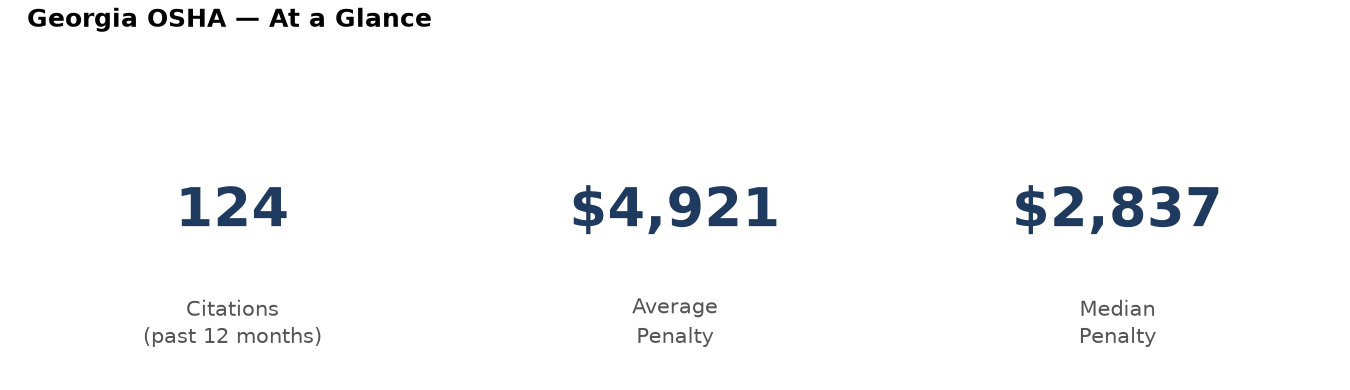
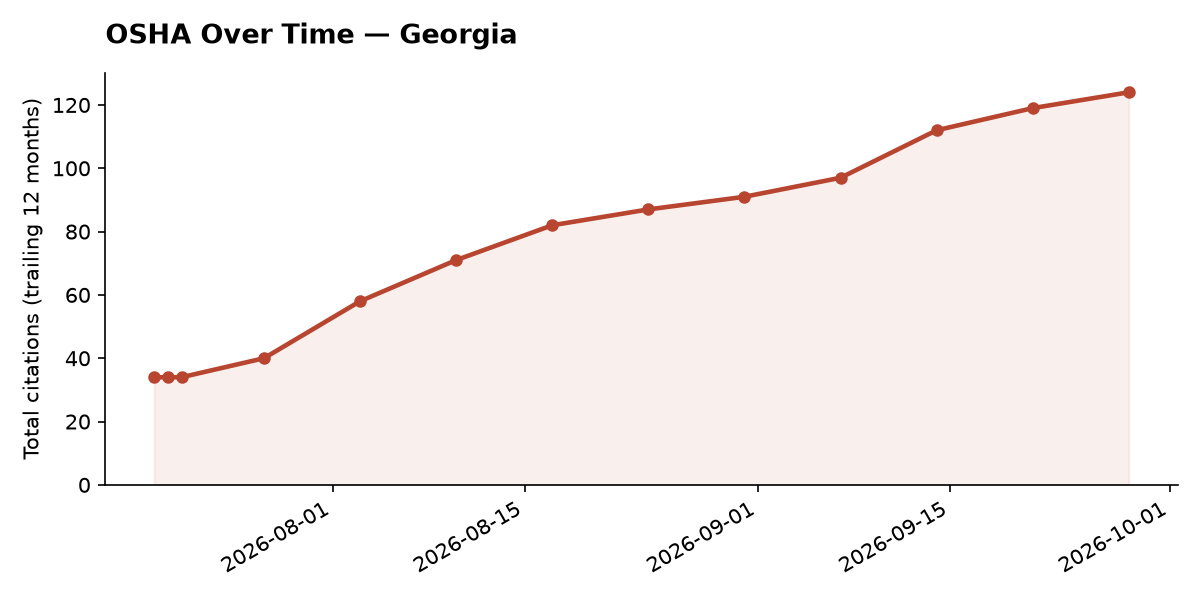
Georgia employers racked up 124 fall protection citations over the past 12 months, with the average penalty landing at $4,921 and the median at $2,837. Nearly all of them, 99 out of 124, were classified as Serious. Another 24 were Repeat violations, which carry steeper fines because OSHA has already flagged the same problem at that employer before. Cumming logged more of these citations than any other city in the state.
If you run a construction crew in Georgia, or you have already opened an envelope with an OSHA logo on it, the clock is already moving. Talk to a Georgia OSHA defense attorney before you decide how to respond.
The Rule Behind Nearly Every One of These Citations
Almost every citation on this list traces back to one standard: 1926.501, OSHA’s core fall protection requirement for construction. In plain terms, it says that once a worker is exposed to a fall of six feet or more to a lower level, the employer has to do something concrete about it, not just tell workers to be careful. That means guardrails, a properly rigged personal fall arrest system, or safety nets, depending on the task and the setup. There is no gray area for waiting until the job gets to a safer point or assuming a crew member will just be cautious on a steep roof pitch. You can read the full breakdown of the 1926.501 standard to understand exactly where the line falls for different work situations.
Several of Georgia’s most expensive citations this year were written under 1926.501(b)(13), the subsection that covers residential construction fall protection specifically. That is a strong signal about where the state’s enforcement attention is concentrated.
Framing Crews Account for Two-Thirds of Georgia’s Cases
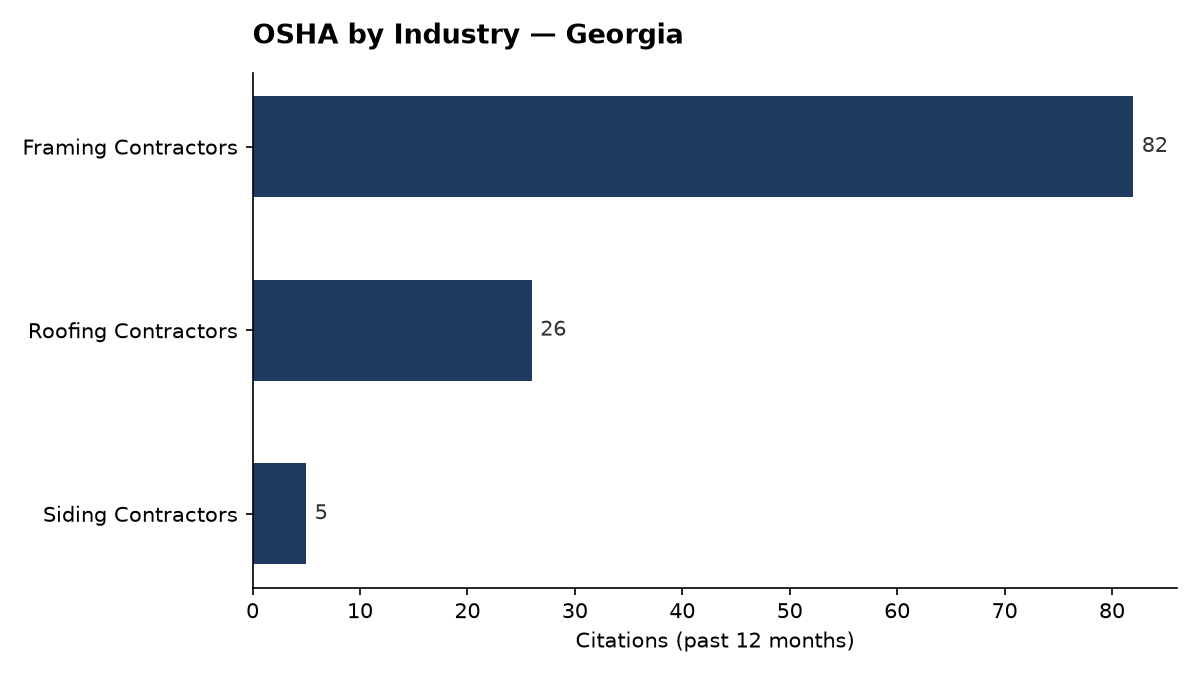
The industry breakdown here is lopsided. Framing contractors alone were cited 82 times, which is roughly two-thirds of every fall protection case issued in Georgia this period. Roofing contractors came in second with 26 citations, and siding contractors trailed with 5.
That pattern makes sense once you think about the work itself. Framing crews spend entire days on open floor systems, exterior walls, and roof decks before any permanent guardrail or wall exists. It is exactly the kind of environment 1926.501 was written for, and it is also where crews under production pressure are most likely to skip tie-off points to keep moving. If you supervise or own a framing operation, it is worth reading up on how framing contractors specifically end up on OSHA’s radar, because the exposures are different from a roofing job even though both involve height.
What These Citations Actually Cost in Georgia
The average penalty of $4,921 doesn’t tell the whole story, because it blends routine Serious citations with much heavier Repeat penalties. Five real Georgia cases from the past year show the spread clearly:
- Jose Briceno, Savannah: $59,580, Repeat, cited under 1926.501(b)(13), issued December 11, 2025
- Tdeh Framing, Inc., Dawsonville: $51,073, Repeat, cited under 1926.501(b)(13), issued January 30, 2026
- Jose Angel Nolasco Dominguez, Dacula: $29,790, Repeat, cited under 1926.501(b)(13), issued March 18, 2026
- Jose Carrera Aranda, Gillsville: $21,281, Repeat, cited under 1926.501(b)(13), issued March 31, 2026
- Jorge Garcia, Lawrenceville: $21,281, Repeat, cited under 1926.501(b)(13), issued May 18, 2026
Notice that every one of these is a Repeat classification, not a first-time Serious violation. That distinction matters enormously for the final bill. A first Serious citation for a fall hazard might land closer to the state median of $2,837. Once OSHA determines the same employer has been cited for a similar hazard before, the penalty multiplies fast, which is exactly what pushed these five cases into five-figure territory.
There is some room to move on these numbers. Georgia’s average penalty reduction between the initial citation and the final settled amount sits at 12%, which reflects cases where employers negotiated, corrected hazards quickly, or successfully contested part of the citation. Twelve percent is not a small number when the starting point is already tens of thousands of dollars. For a fuller picture of how these figures get calculated and where negotiation actually helps, see this breakdown of OSHA fall protection violations penalty amounts.
Before you decide whether to pay, contest, or negotiate, it is worth having someone who does this for a living look at your specific citation. A Georgia OSHA defense attorney can tell you within a short conversation whether the classification, the penalty math, or the underlying facts are worth challenging.
Fifteen Working Days Is Not a Lot of Time
Once a citation arrives, the countdown starts immediately. OSHA gives employers 15 working days to file a Notice of Contest. Miss that window and the citation, including a Repeat classification and its full penalty, becomes final whether or not you agree with it. There is no informal grace period built in.
That short deadline is precisely why waiting to see how things play out is the riskiest option on the table. Read through what actually happens procedurally once you file, including how informal conferences with OSHA work and what evidence tends to move the needle, in this guide on how to contest an OSHA citation. But do not treat that guide as a substitute for legal advice on your particular case, especially if a Repeat or Willful classification is involved, since those carry consequences well beyond the dollar figure on the page.
With 15 working days on the clock and Repeat penalties in Georgia running into the tens of thousands, the smart move is to get a Georgia OSHA defense attorney reviewing your citation today rather than after the contest window has closed.
If you have a citation in hand, pull the actual document, check the issuance date, and count forward 15 working days right now. That number, not the penalty amount, is the deadline that matters most this week.