Data last updated: September 28, 2026
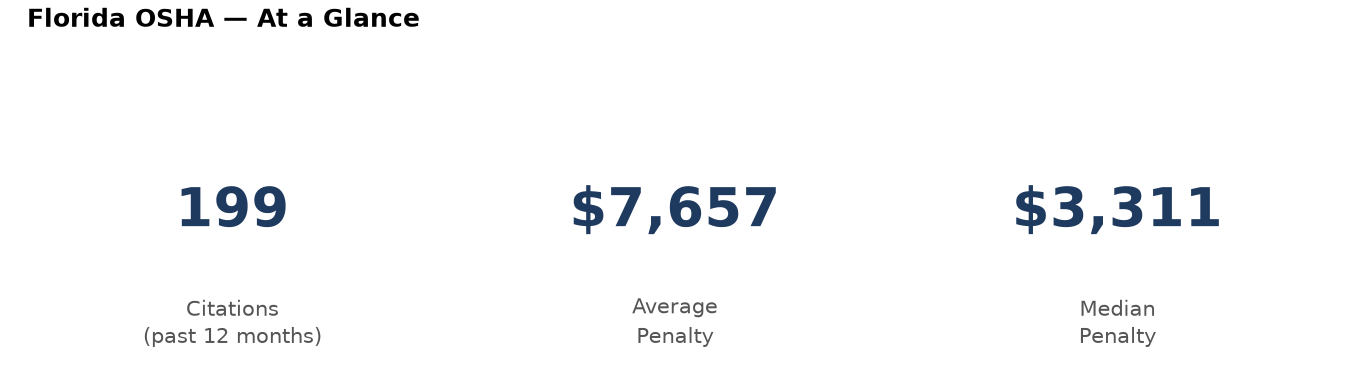
Florida racked up 199 fall protection citations under standard 1926.501 in the past 12 months, with an average penalty of $7,657 and a median of $3,311. The gap between those two numbers tells you something: a lot of citations land in the low-to-mid thousands, but a handful of Willful and Repeat cases pull the average up sharply, some into six figures. If you’ve just opened a citation letter, the number on it matters less than what OSHA labeled it — and what you do in the next 15 working days.
Before you decide anything, it makes sense to have someone who handles these cases for a living look at the paperwork. Talk to a Florida OSHA defense attorney before you sign, pay, or ignore anything.
What 1926.501 Actually Asks of a Florida Crew
The rule at the center of nearly all these citations is straightforward in concept, harder in practice. Once a worker is exposed to a fall of six feet or more to a lower level on a construction site, the employer has to have a real fall protection system in place — guardrails, safety nets, or a personal fall arrest system. It’s not enough to hand someone a harness and hope; the system has to be set up, anchored, and actually used correctly for the specific task. OSHA inspectors in Florida are looking for gaps between what’s written in a company’s safety plan and what’s happening on the roof or the frame when they show up. You can read the full breakdown of the 1926.501 standard on our hub page if you want the underlying mechanics before you talk to counsel.
Roofers and Framers Carry the Weight of Florida’s Enforcement
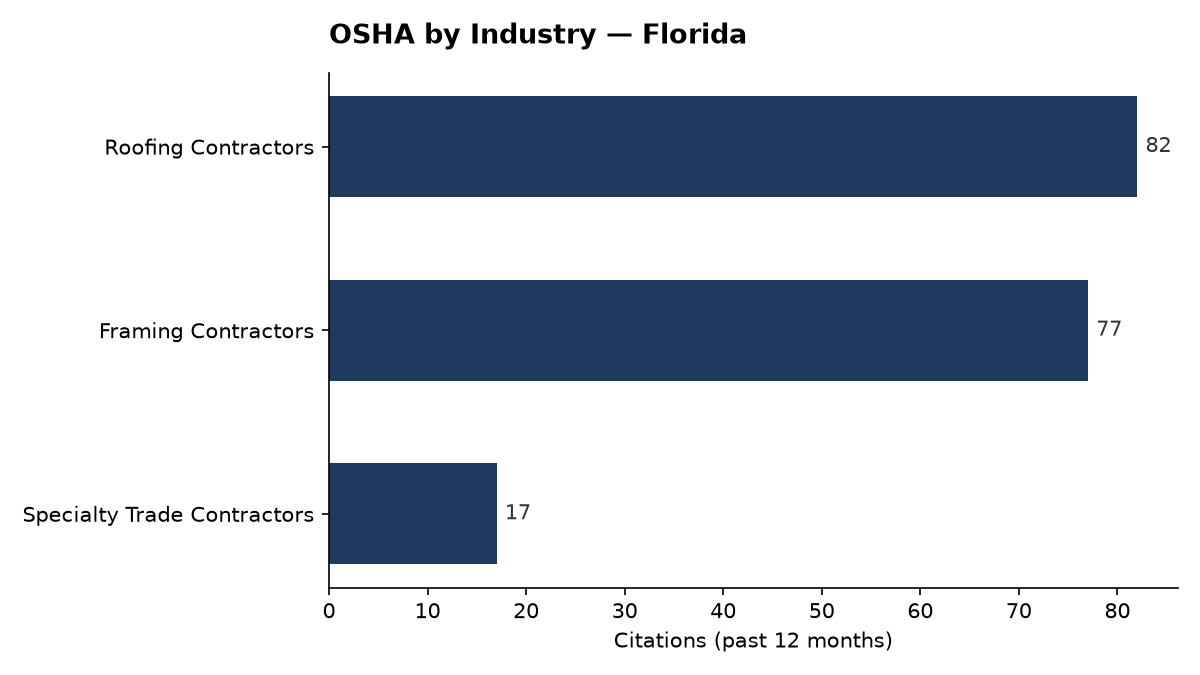
Two industries account for the overwhelming majority of the state’s citations. Roofing contractors were cited 82 times, and framing contractors weren’t far behind at 77. Specialty trade contractors picked up another 17. Together, roofing and framing make up roughly 80% of all fall protection citations issued in Florida over the period — which lines up with how those trades work. Steep-slope roofs, open floor edges, and constant movement at height are exactly the conditions 1926.501 was written for, and Florida’s year-round construction pace means crews are exposed to these hazards more often than in colder states. Cantonment turned up as the city with the most citations, but the pattern isn’t limited to one metro area — it’s an industry-wide exposure. If you run a roofing operation, it’s worth reading our breakdown of roofing contractor citations to see how inspectors are approaching this trade specifically.
What These Citations Actually Cost in Florida
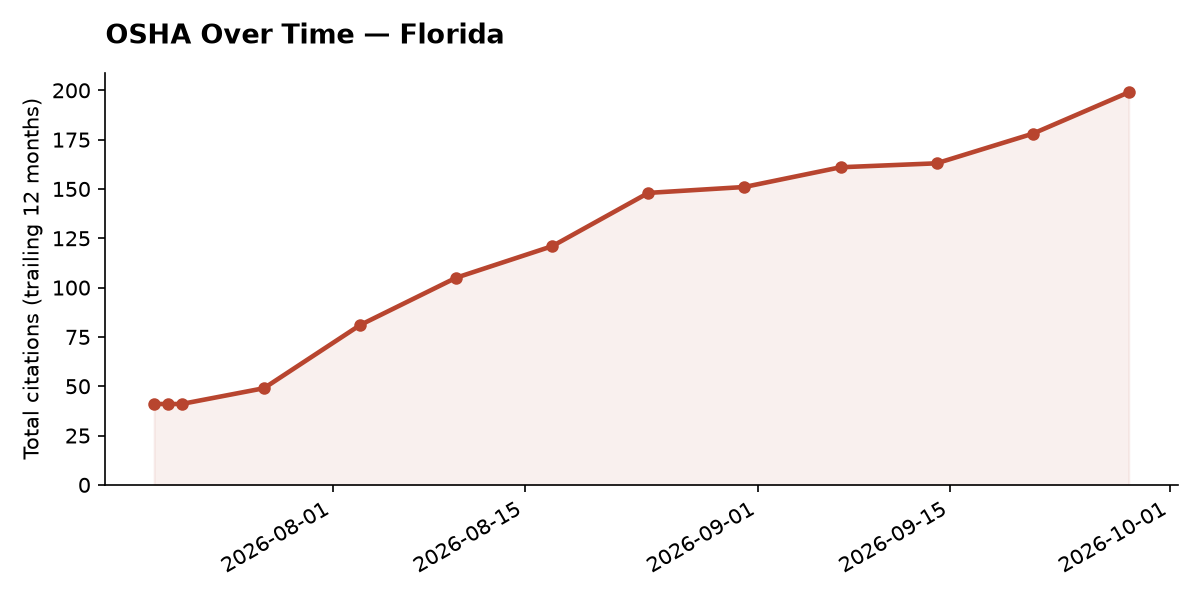
Of the 199 citations, 159 were classified Serious, 34 were Repeat, 4 were Other-than-Serious, and 2 were Willful. That classification drives the penalty far more than the underlying hazard does. A Serious citation reflects a violation that could cause death or serious injury and carries a moderate fine. Repeat citations — meaning OSHA found the same or a substantially similar violation at that employer before — carry a steep multiplier. Willful citations, reserved for cases where OSHA believes the employer knew about the requirement and disregarded it, or acted with plain indifference, are in a different league entirely.
The real examples from the past year make the spread obvious. Colossus Contracting Group LLC, cited in Parrish, faced a Willful citation under subsection B13 with a penalty of $165,514, issued in late November 2025. Max Home Services LLC in Weston received an identical Willful classification and the same $165,514 penalty a few months later. On the Serious side, D. R. Horton Inc., also cited in Parrish, was assessed $79,440. Garabar, Inc. in Ocean Ridge picked up a Repeat citation at $69,510, and All Phase Roofing, Inc. in Stuart was hit with a Repeat citation at $33,195. Every one of these was cited under the same B13 provision of 1926.501, which underscores how narrowly focused OSHA’s fall protection enforcement really is in this state — it’s almost always the same failure to provide or properly use a fall arrest system.
Here’s the part that matters for your next move: the average penalty reduction between initial and final assessment across these Florida cases was 13%. That’s not automatic — it happens because employers negotiate, provide evidence, or formally contest the citation. Nobody gets that reduction by paying the fine on day one without a second look. For more on how these numbers are built and adjusted, see our page on how OSHA fall protection penalty amounts are calculated.
A 13% average reduction on a $69,510 or $165,514 citation is real money — but it doesn’t happen by accident. Get a Florida OSHA defense attorney involved while there’s still time to negotiate or contest.
The Clock That Actually Controls Your Options
Whatever the citation says, whatever classification OSHA assigned, you have exactly 15 working days from the date you receive it to file a Notice of Contest. Miss that window and the citation becomes a final order — no appeal, no negotiation, no reduction, regardless of whether the classification was fair or the penalty was calculated correctly. This is true whether you were cited $3,311 or $165,514. Given that Florida’s Willful and Repeat citations in this dataset ran from $33,195 up past $165,000, that deadline is not a formality to skip past.
If you’re weighing whether to contest, negotiate an informal settlement, or simply pay, you need to understand the mechanics before the clock runs out. Our guide on how to contest an OSHA citation walks through the process, but the short version is this: contesting preserves your options, and doing nothing forfeits them permanently.
With 15 working days on the clock and classifications ranging from Serious to Willful on the line, this isn’t a decision to make alone or at the last minute. Speak with a Florida OSHA defense attorney now, while your Notice of Contest window is still open.
Pull your citation paperwork, check the issuance date, and count your 15 working days starting today — then get a qualified attorney reviewing the classification, the cited subsection, and the penalty math before that window closes.