

Data last updated: September 21, 2026
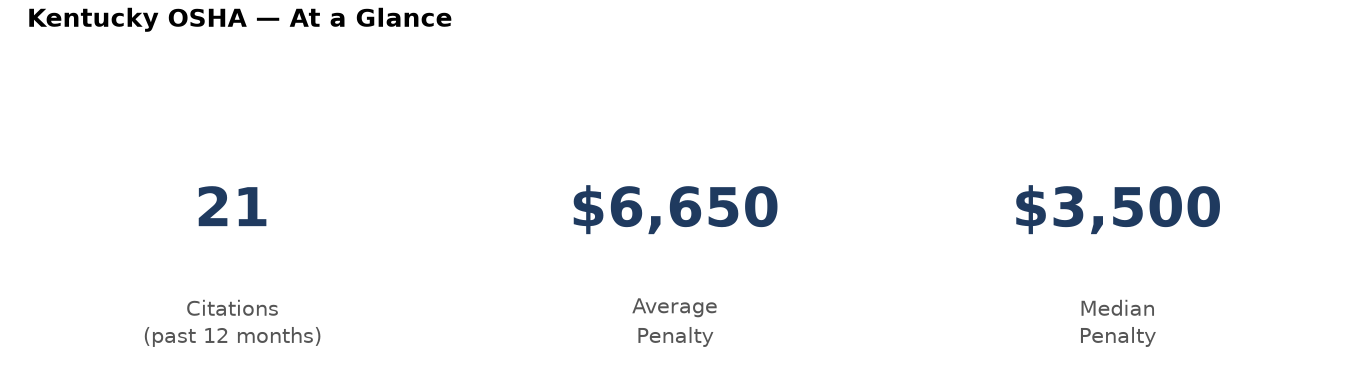
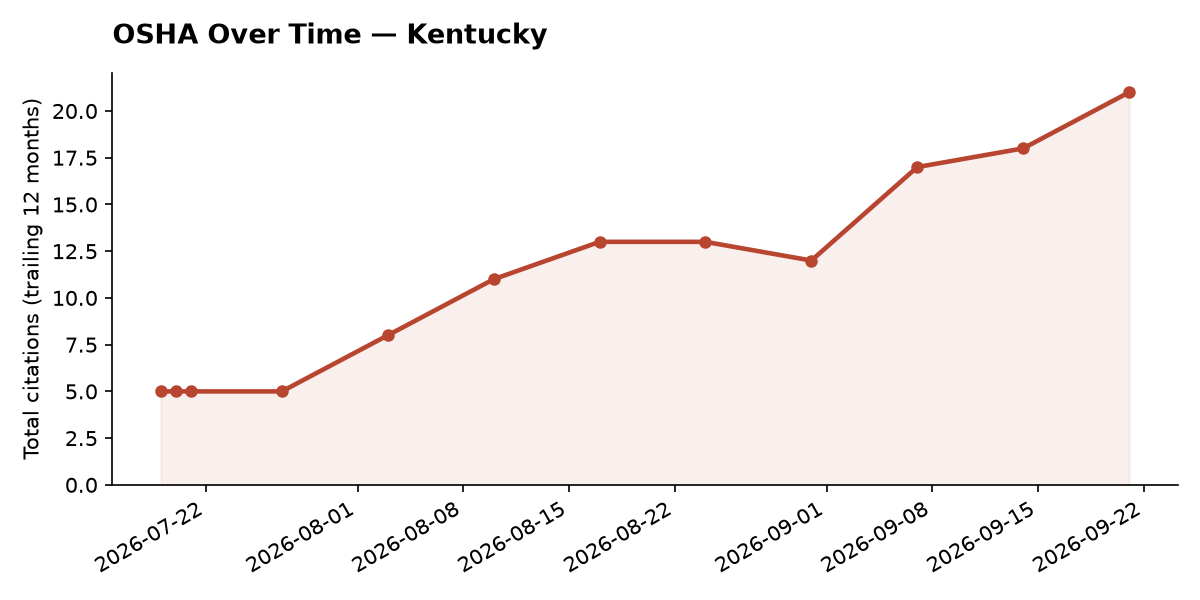
Over the past 12 months, Kentucky employers picked up 21 fall protection citations under 1926.501, the standard covering work at height. The average penalty landed at $6,650, though the median — a better read on what a typical violator actually pays — was $3,500. Twenty of the 21 citations were classified Serious. One was a Repeat violation, and that single citation alone carried a $70,000 penalty. Lexington had more of these citations than any other city in the state.
If you’ve just opened a citation letter with your company’s name on it, the clock is already running. Talk to a Kentucky OSHA defense attorney before you decide how to respond — the deadline to contest is shorter than most people expect.
What 1926.501 Actually Requires On Site
The rule at the center of nearly every one of these citations, 1926.501, is not complicated in concept: once a worker is exposed to a fall of six feet or more to a lower level on a construction site, the employer has to do something about it. That means guardrails, a properly installed safety net, or a personal fall arrest system — not a promise that the crew will be careful, and not a plan to add protection later once the schedule allows for it. Inspectors don’t need to see someone fall to write a citation. They only need to see a worker exposed at height with no system in place, which is exactly what shows up again and again in Kentucky’s citation record.
Roofing Crews Account For Most Of Kentucky’s Citations
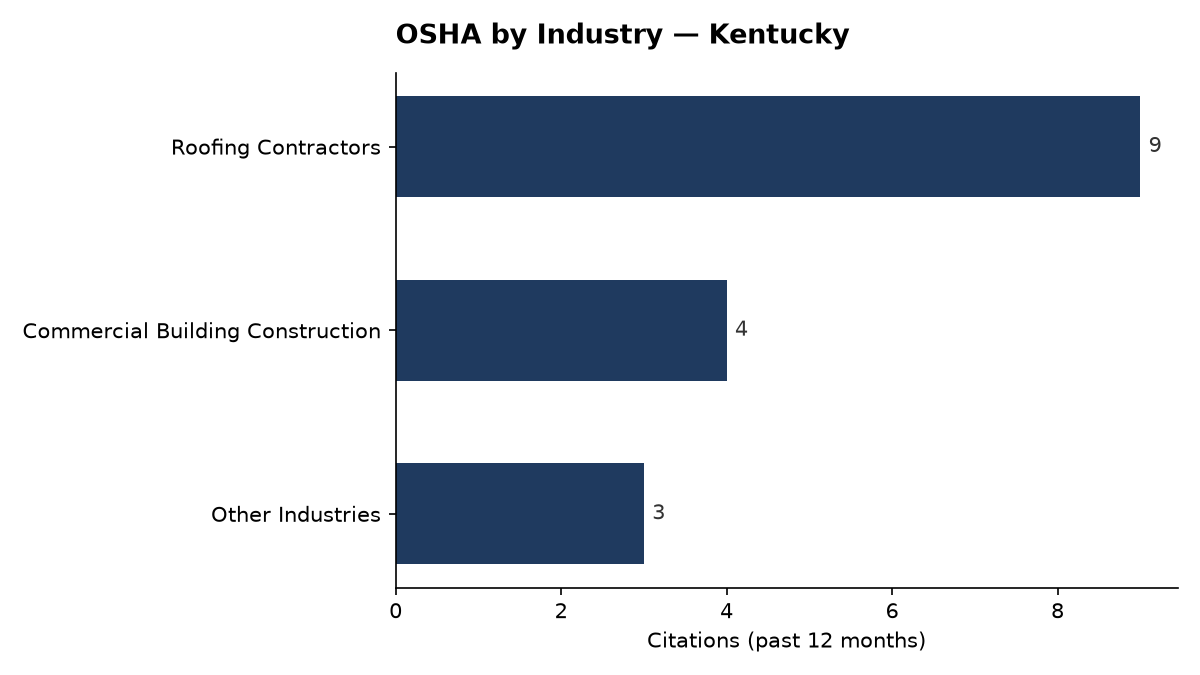
Of the 21 fall protection citations issued statewide, 9 went to roofing contractors — nearly half the total. That’s not a coincidence. Roofing work puts crews at the roof edge or near openings for hours at a stretch, often on steep or unstable surfaces, and it’s one of the easiest jobs for an inspector to observe from the ground. Commercial building construction added another 4 citations, with the remaining 3 spread across other trades.
Two roofing companies show up in the recent record with specific, named citations: Swift Roofing Inc in Mayfield was cited $4,900 for a Serious violation under 1926.501(b)(13), issued December 12, 2025, and American Roofing Company LLC in Lexington was cited $4,200 for a Serious violation under 1926.501(b)(11), issued December 24, 2025. Both are typical of what inspectors find on residential and low-slope commercial roofs — workers near an edge or opening without a guardrail, net, or harness system tied off correctly.
Why the $70,000 Bone Dry Roofing Citation Stands Out
Most fall protection penalties in Kentucky are modest compared to the headline-grabbing fines you hear about nationally — the median of $3,500 reflects that. But averages get pulled hard by outliers, and Kentucky has one: Bone Dry Roofing Inc in Lexington was cited $70,000 under 1926.501(b)(13) as a Repeat violation, issued January 12, 2026. A Repeat classification means OSHA found the same or a substantially similar hazard at that employer before, and the penalty math reflects that history — it multiplies fast.
Other recent examples show where the more typical Serious penalties land: Perdue Agribusiness Grain LLC in Livermore was cited $7,000 under 1926.501(b)(4)(i), issued February 3, 2026, and A-K Construction Inc in Mayfield was cited $5,600 under 1926.501(b)(1), issued April 10, 2026. Check current figures against OSHA fall protection violations penalty amounts to see how your citation compares to what’s typical for the classification you received.
Worth knowing: Kentucky’s average penalty reduction between the initial citation and the final settled amount runs about 16%. That gap doesn’t close itself — it comes from employers or their counsel pushing back on the classification, the abatement date, or the calculation itself before the case is finalized.
A 16% swing on a citation in the thousands of dollars is real money, and it usually requires someone who knows how OSHA’s penalty calculations work to go get it. Talk to a Kentucky OSHA defense attorney before you sign off on anything or pay the citation as written.
The 15-Day Window You Can’t Afford To Miss
Once your citation is issued, you have 15 working days to file a Notice of Contest. Not 15 calendar days — 15 working days, and OSHA counts them strictly. Miss that window and the citation becomes a final order automatically, with no further right to argue the classification, the penalty amount, or even factual errors in the inspector’s report. There’s no informal extension process once that deadline passes.
Before that clock runs out, it’s worth understanding your options — including informal conferences with the OSHA area office, negotiated settlements, and formal contests through the Review Commission. The process is laid out in more detail on our page about how to contest an OSHA citation, but the short version is that the earlier you get advice, the more options stay open.
Given that one Repeat citation in this state’s own record hit $70,000, and that a Serious classification can still run into the thousands even on a first offense, this isn’t the moment to guess at strategy. If you’ve received a fall protection citation in Kentucky — or you suspect one is coming after an inspection — get in touch with a Kentucky OSHA defense attorney while your 15 working days are still on the table.
Whatever the citation says right now, the amount and the classification aren’t necessarily final — but only if you act inside the window OSHA gives you. Pull your citation paperwork, note the issuance date, and get a professional read on it before that deadline passes.