
Data last updated: September 21, 2026
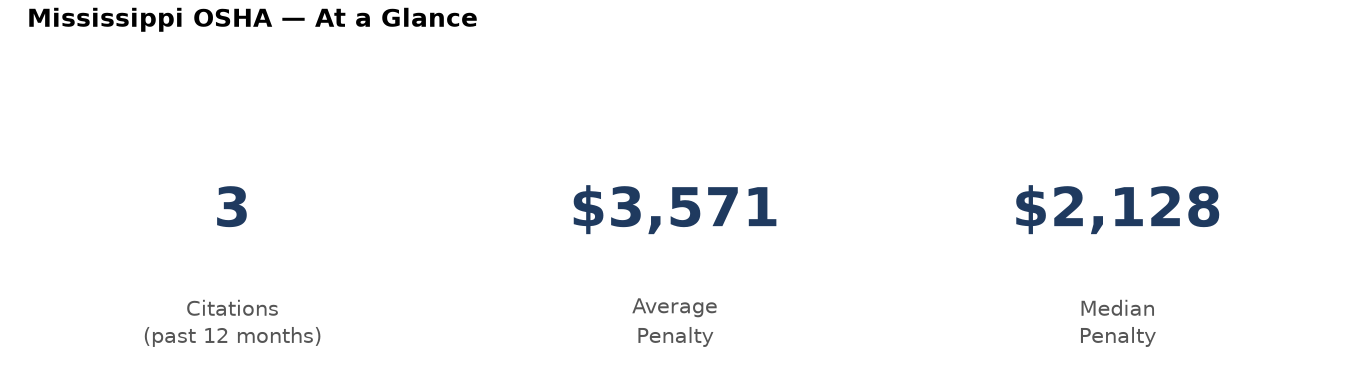
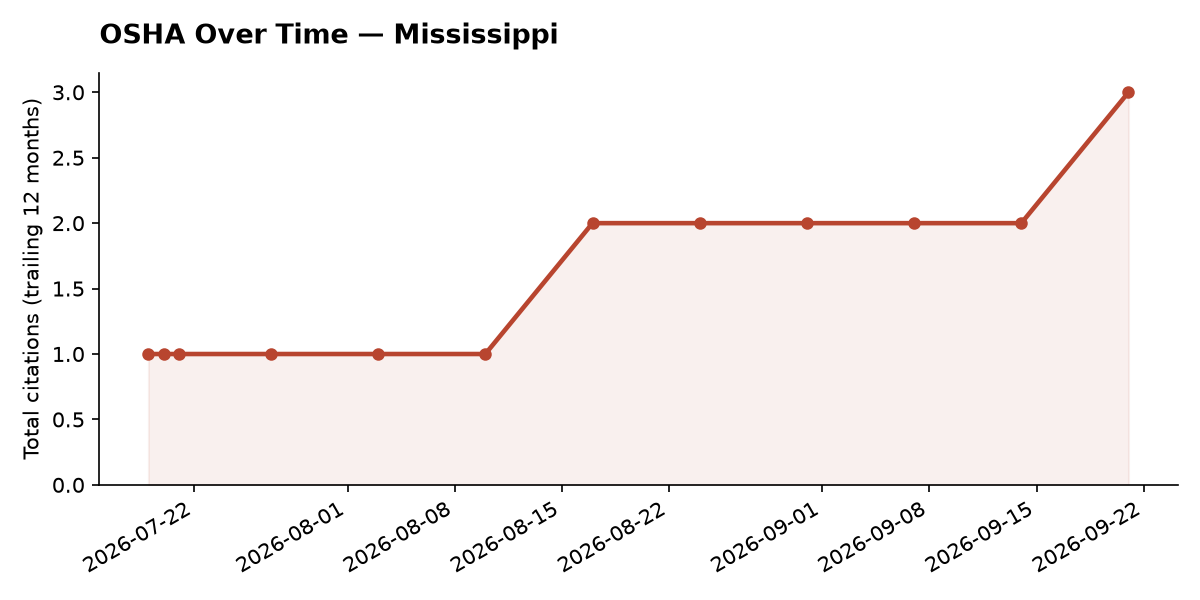
Mississippi is not a state where OSHA hands out fall protection citations by the dozen. Over the past 12 months, only three citations were issued statewide under the fall protection standard, 1926.501, with an average penalty of $3,571 and a median of $2,128. That low number can lull contractors into thinking the risk is small. It is not. When Mississippi employers do get cited, the case tends to move fast, and the dollar amounts can still hit hard, as one recent $7,500 citation in Pascagoula shows.
If you or your company just received a citation like this, the clock is already running. You do not have to figure out your options alone — talk to a Mississippi OSHA defense attorney before you decide how to respond.
What OSHA Actually Requires Once Someone Works at Height
The standard behind every one of these three citations, 1926.501, sets the baseline rule for construction work: once a worker is exposed to a fall of six feet or more onto a lower level, the employer has to do something about it. That something is not optional or left to judgment calls on site. The employer has to choose and properly use one of the recognized methods — guardrail systems, safety nets, or a personal fall arrest system with harness, lanyard, and anchor point rated to hold a fall.
What trips up a lot of small and mid-size contractors is not ignorance of the rule itself, but inconsistent application of it. A crew might tie off on the roof but skip protection at a floor opening, or a subcontractor shows up without the right gear and nobody stops the work. OSHA inspectors are trained to look for exactly these gaps, and a single unprotected worker at height is enough to trigger a citation.
Why Residential and Framing Crews Show Up Most in Mississippi’s Numbers
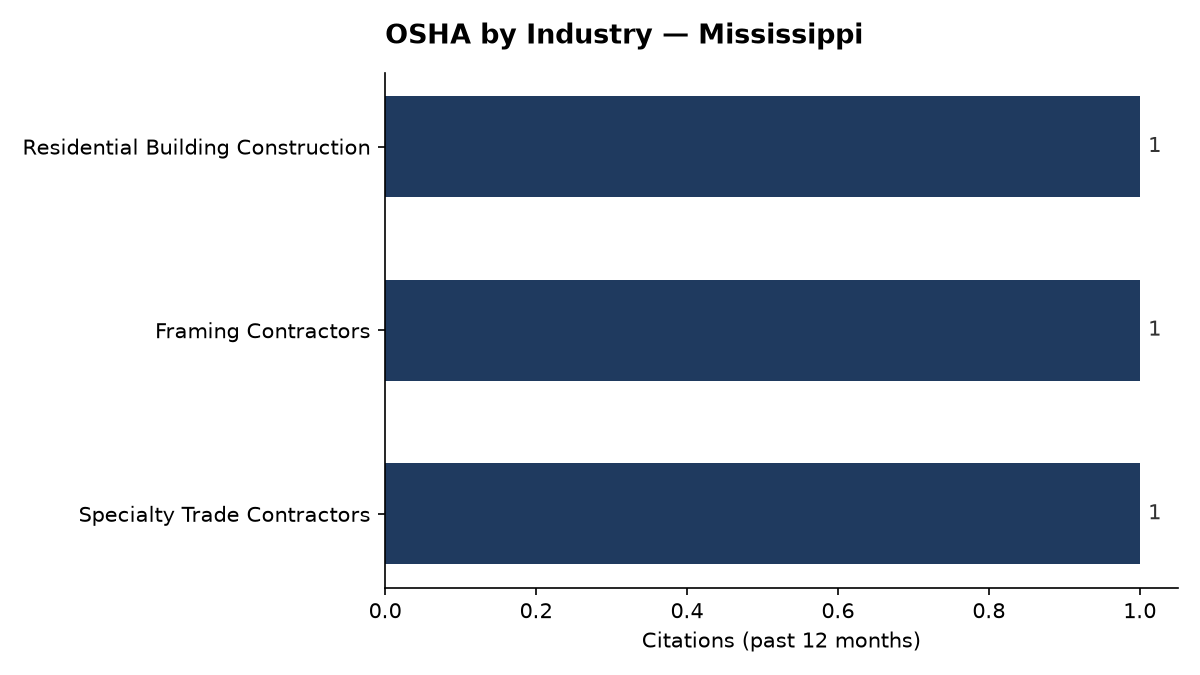
Small as the dataset is, the pattern lines up with what shows up nationally: residential building construction, framing contractors, and specialty trade contractors each accounted for one citation apiece in the past year. These trades share a common risk profile — workers moving across open roof decks, unfinished floor systems, and temporary structures where guardrails have not gone up yet or fall arrest anchors have not been set. Framing in particular puts crews at height early in a project, often before a job has settled into a routine safety rhythm, which is exactly when gaps in fall protection tend to appear.
Diamondhead was the city with the most activity, accounting for two of the state’s three citations. That is a small number in absolute terms, but it tells you enforcement in Mississippi is not concentrated only in the biggest metro areas — inspectors follow construction activity wherever it is happening, including smaller coastal and residential communities.
What These Citations Actually Cost Mississippi Employers
Of the three citations, two were classified Serious and one was Other-than-Serious. That split matters because classification drives penalty size and, more importantly, signals how OSHA viewed the risk. A Serious citation means the agency concluded the hazard could realistically cause death or serious physical harm — even if no one was actually hurt on the day of inspection.
Here is what that looked like in practice. Cheyenne Steel, Inc. in Pascagoula was cited Other-than-Serious under 19260501 B01 and issued a penalty of $7,500 on August 7, 2026 — notably higher than either Serious citation in this dataset, showing that classification alone does not always predict the final number. Roberto Duarte in Diamondhead received a Serious citation under the same subsection, issued April 29, 2026, with a penalty of $2,128. Mauna Kea Townhomes LLC, also in Diamondhead and cited the same day under the same subsection, faced a penalty of $1,085.
Notice the spread: penalties on paper for the same violation type and even the same code section ranged from just over $1,000 to $7,500. Part of that spread comes from negotiation. Statewide, the average penalty reduction between the initial and final amount was 25 percent, which means a meaningful share of employers who pushed back, corrected hazards, or negotiated ended up paying substantially less than the number on the original citation. For a full breakdown of how these figures get calculated and where the room to negotiate actually exists, see this explanation of OSHA fall protection penalty amounts.
A 25 percent reduction on a $7,500 citation is real money. Before you pay a citation at face value, it is worth finding out whether your case has the same room to move — a Mississippi OSHA defense attorney can tell you fairly quickly whether contesting or negotiating makes sense for your situation.
The 15-Day Window You Cannot Afford to Miss
Whatever the final number on your citation turns out to be, there is a hard deadline sitting in front of it. Once you receive an OSHA citation, you have exactly 15 working days to file a Notice of Contest. Miss that window and the citation becomes a final order, penalty and all, with essentially no room left to argue the facts, the classification, or the amount.
Fifteen working days sounds like more time than it is. It excludes weekends and holidays, but it goes fast once you account for gathering documentation, talking to your insurance carrier, and figuring out whether the cited condition was accurately described. Employers who wait to see if OSHA forgets about a small citation, or who assume they can negotiate informally after the deadline passes, routinely lose the ability to contest anything. If you want to understand exactly what the contest process involves and what happens at each step, this guide on how to contest an OSHA citation walks through it in plain terms.
Given how little time you actually have, the smartest move is to get legal input before that clock runs out, not after. Speak with a Mississippi OSHA defense attorney now so someone with experience in these cases can review your citation, check the classification and the cited subsection, and tell you honestly whether contesting, negotiating, or paying is the right call.
Mississippi may not generate a high volume of fall protection citations, but the ones that do land carry real financial weight and a strict deadline attached. Pull your citation paperwork, confirm the issue date, and get a professional opinion before those 15 working days run out.