
Data last updated: September 14, 2026
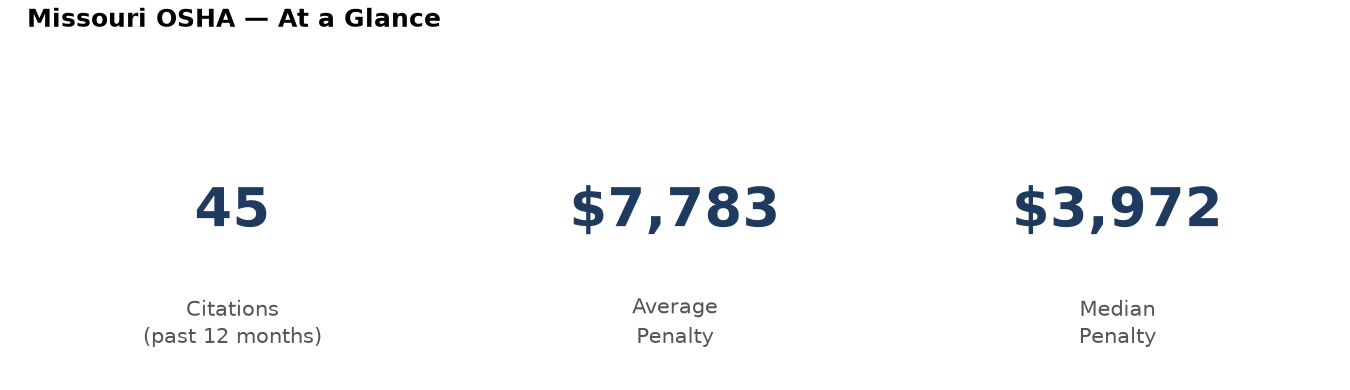
Missouri employers racked up 45 fall protection citations under 1926.501 over the past 12 months, with penalties averaging $7,783 and a median of $3,972. Eleven of those 45 were Repeat violations, which is a category that pushes fines far higher than a first-time Serious citation. Kansas City logged more of these cases than any other city in the state.
If you just opened a citation letter with a number on it that made your stomach drop, you are not alone, and you are not out of options yet. Talk to a Missouri OSHA defense attorney before you decide what to do next.
What 1926.501 Actually Requires On A Missouri Job Site
The standard behind every one of these 45 citations is 1926.501, the general fall protection rule. In plain terms, it says that once a worker is exposed to a fall of six feet or more to a lower level on a construction site, the employer has to have already put something between that worker and the ground: a guardrail system, a safety net, or a personal fall arrest system with proper anchorage. There is no grace period for getting set up once someone is already at height, and there is no exception for a quick task or a small crew. OSHA compliance officers who show up on a Missouri roof or steel frame are looking for exactly one thing first: is anyone exposed right now without protection. If the answer is yes, a citation follows.
Roofing Crews Account For More Than Half Of Missouri’s Cases
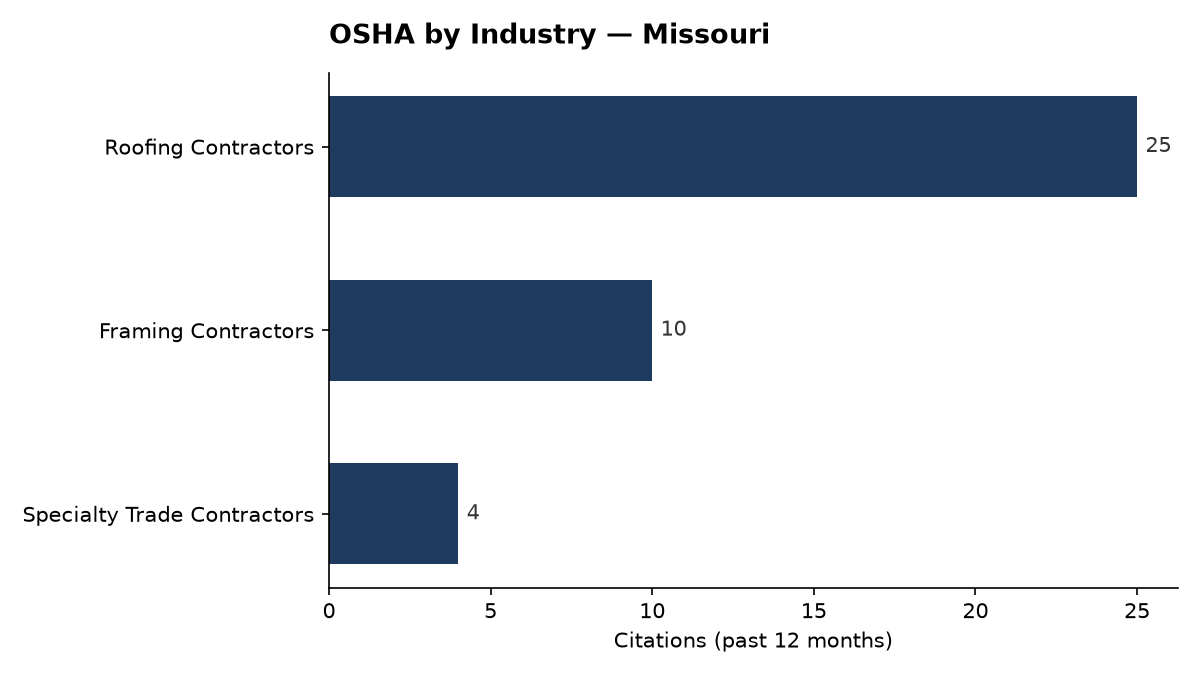
Of the 45 citations issued statewide, 25 went to roofing contractors. That is more than every other industry combined. Framing contractors picked up 10 citations, and specialty trade contractors accounted for 4 more. This pattern is not surprising once you look at the work itself. Roofing puts crews at height on sloped, often unguarded surfaces for hours at a time, and it is one of the easiest violations for an inspector to spot from the ground or a neighboring property. Framing crews face a similar problem during floor and wall assembly, before permanent guardrails or floor systems are in place. If your business falls into either category, the odds that a Missouri OSHA inspector shows up unannounced are meaningfully higher than for most other trades.
What A Citation Actually Costs In Missouri
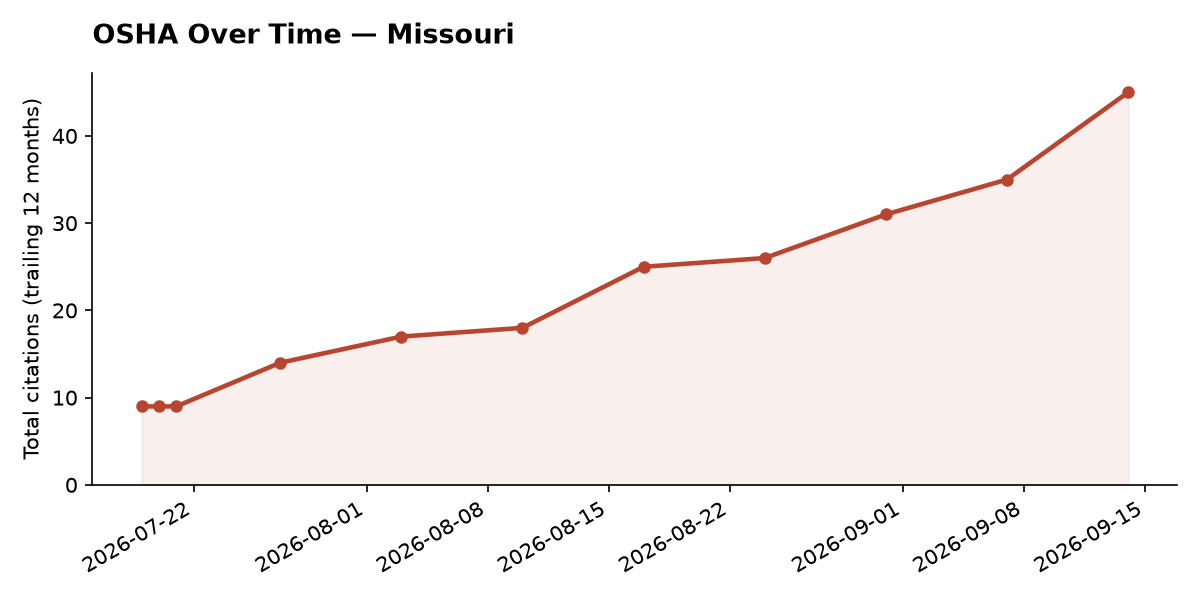
The dollar figures tell their own story. Thirty-two of the 45 citations were classified Serious, which is the baseline category for a hazard that could cause death or serious injury. Eleven were Repeat, meaning the employer had a substantially similar violation on record before, and Repeat penalties are calculated on a much steeper scale. Two were Other-than-Serious.
Real cases from the state show how wide that range gets. J Felix Jaraleno Barrientes Roofing in Liberty was cited $59,580 for a Repeat violation under 19260501 B13, issued May 8, 2026. Barrientos Roofing LLC in Pleasant Hill faced a $29,790 Repeat citation under the same subsection, issued September 26, 2025. VK Cifuentes Contractors LLC in Weldon Spring drew a $24,825 Repeat penalty under 19260501 B11 on September 24, 2025, and Gonzales Construction LLC in Kansas City was cited $24,825 under 19260501 B01, issued April 6, 2026. On the Serious side, Lithko Contracting LLC in Sedalia was cited $16,550 under 19260501 B04, issued April 2, 2026.
Notice how much higher the Repeat penalties run compared to the single Serious example above. That gap is exactly why the classification on your citation letter matters as much as the dollar figure itself. It is also worth knowing that the average penalty reduction between initial and final amounts in these Missouri cases runs about 15 percent, which means negotiation and formal contest both have a track record of moving the number. For more detail on how these figures get calculated, see this breakdown of OSHA fall protection violations penalty amounts.
A $7,783 average penalty is bad enough on its own, but a Repeat classification can multiply that several times over, and it stays on your record for future inspections. A Missouri OSHA defense attorney can tell you within a short conversation whether your citation is likely to hold up as written or whether the classification itself is worth challenging.
The Clock Starts The Day You Receive The Citation
Missouri employers get exactly 15 working days from the date they receive an OSHA citation to file a Notice of Contest. Miss that window and the citation becomes a final order, penalty and all, with essentially no path back. That is a short runway, especially if you are also trying to run a job site, and it does not pause for weekends beyond the standard count or for you to gather more information.
Before that deadline hits, it is worth understanding how to contest an OSHA citation and what a formal contest actually involves versus an informal conference with the area office. Both routes exist, but they are not the same process and they do not carry the same deadlines or outcomes.
If you are inside that 15-working-day window right now, do not spend it guessing. Get a Missouri OSHA defense attorney to review the citation, the cited subsection, and the classification before you file anything or let the deadline pass.
Whatever category your citation falls into, the numbers above show that Missouri fall protection cases rarely resolve for the amount on the first letter, and the difference usually comes down to whether someone challenged it in time.