
Data last updated: September 28, 2026
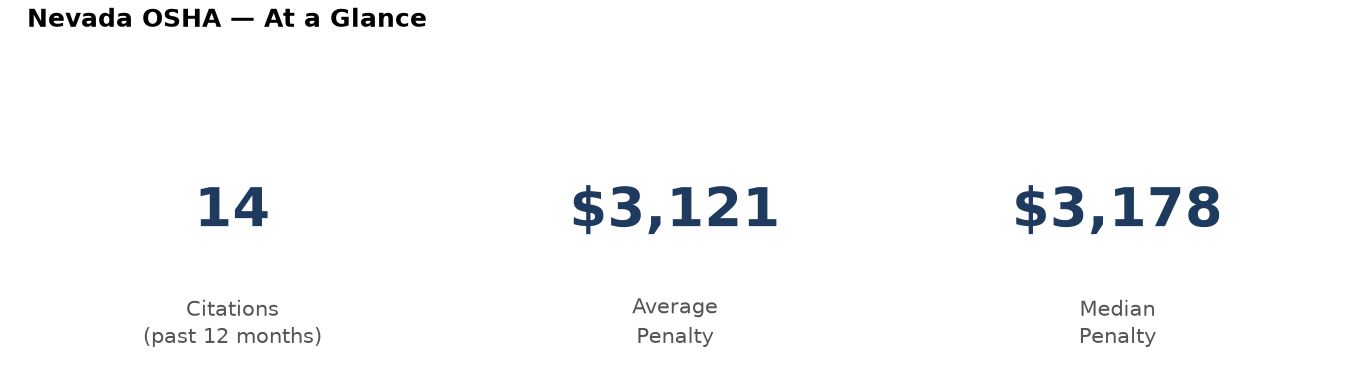
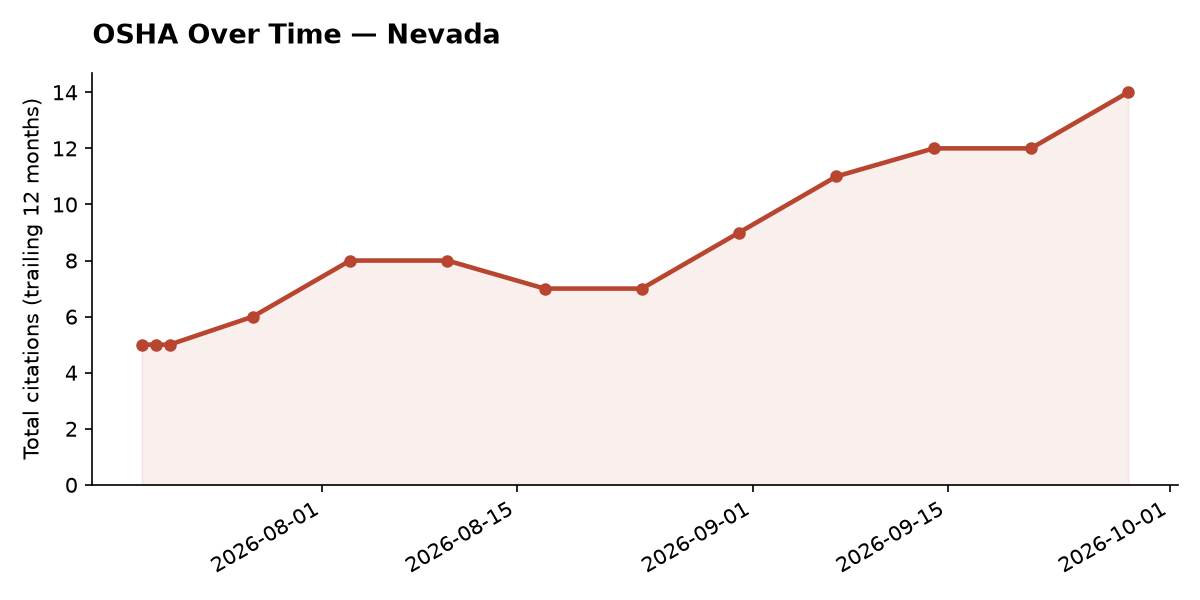
Fourteen fall protection citations doesn’t sound like a lot, and compared to bigger states, it isn’t. But if your company is one of the fourteen, the average penalty of $3,121 (with a median of $3,178) is real money, and the pattern behind those numbers tells you exactly where Nevada inspectors are looking. Sparks, not Las Vegas or Reno, was the city with the most citations over the past 12 months, and roofing and specialty trade contractors accounted for eight of the fourteen cases between them.
If you’ve already received a citation, the clock is running. You get 15 working days from the date on the citation to file a Notice of Contest, and after that window closes, the penalty and the violation become final. Talking to a Nevada OSHA defense attorney before that deadline is the single most useful thing you can do right now.
What OSHA Actually Requires Once Someone Is Working at Height
Every one of these fourteen citations traces back to one rule: 29 CFR 1926.501, the general fall protection standard for construction. The rule is simpler than the legal language makes it sound. Once a worker is exposed to a fall of six feet or more onto a lower level, the employer has to do something about it: install guardrails, use safety nets, or put the worker in a personal fall arrest system. There’s no gray area for waiting until the job is almost done, or assuming a worker will be careful on a short roof section. The standard applies from the moment the exposure exists, and OSHA inspectors in Nevada are citing employers under specific subsections of 1926.501 – like B01, B04, B10, and B13 – depending on exactly how the fall hazard was left unprotected.
Of the fourteen citations issued statewide, ten were classified as Serious and four as Other-than-Serious. A Serious classification means OSHA determined there was a real possibility of death or significant injury tied to the hazard, which is why these carry the bulk of the financial exposure. None of the recent Nevada cases in this data set were marked Willful or Repeat, which are the categories that bring penalties into much higher territory – but that’s exactly why it’s worth getting a citation reviewed early, before a Serious classification hardens into something more severe on appeal or during a follow-up inspection.
Roofing and Specialty Trades Are Carrying Nevada’s Enforcement Numbers
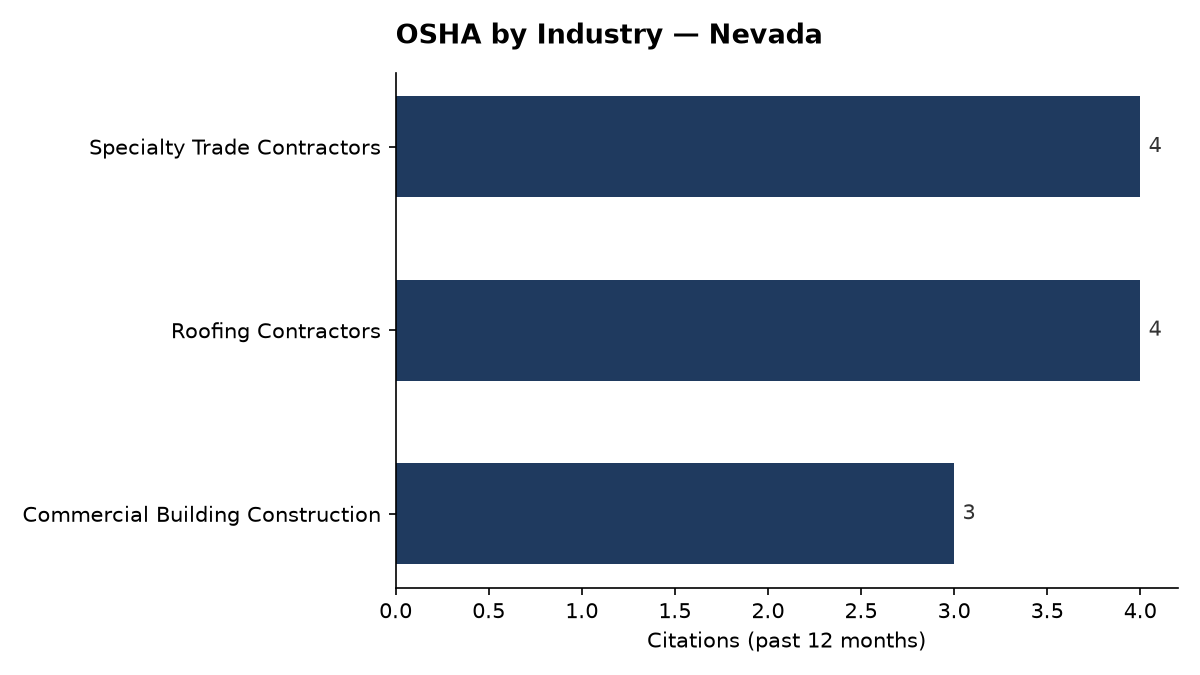
The industry breakdown here is not subtle. Specialty trade contractors and roofing contractors each logged four citations, and commercial building construction added three more. Together, those three categories account for the vast majority of the state’s fall protection enforcement activity.
That’s not a coincidence. Specialty trade contractors – electricians, framers, HVAC crews, and similar subcontractors – routinely work on rooftops, scaffolds, and elevated platforms for short stretches, which makes it tempting to skip full fall protection setup for a quick task. Roofing work is even more exposed by nature: workers are on sloped, often unguarded surfaces for entire shifts, and OSHA has made roofing a recurring enforcement priority nationally, not just in Nevada. Commercial building projects bring their own version of the same problem, with multiple trades moving through partially completed structures where guardrails haven’t been installed yet or have been temporarily removed.
What a Citation Like This Actually Costs
The dollar figures in Nevada’s recent record give a clear picture of what employers are actually paying. Bzi Construction Llc in Sparks was cited $7,235 for a Serious violation under subsection B04 II, issued October 2, 2025. Dri Tech Llc, also in Sparks, was cited $7,035 under B10 in a citation issued January 13, 2026. In Las Vegas, A4 Builders Llc received a $5,296 Serious citation under B13, issued October 21, 2025. Authentic Roofing, Llc. in Sparks was cited $4,020 under B10 on December 23, 2025, and Global Commercial Roofing Inc. in Reno was cited $3,547 under B01 on December 30, 2025.
Notice how much these figures vary even within the same Serious classification – from roughly $3,500 to over $7,200. That spread usually comes down to the specific subsection cited, the size of the employer, and how the case was negotiated. Statewide, the average penalty reduction between the initial citation and the final settled amount was 18 percent, which tells you that a meaningful share of these cases get adjusted downward once the employer pushes back or negotiates, rather than simply paying the number on the page. For a full explanation of how OSHA calculates these figures and where the reduction typically comes from, see this breakdown of OSHA fall protection violations penalty amounts.
An 18 percent reduction on a $7,000 citation is close to $1,300 back in your pocket, and that’s before accounting for what happens if a classification gets downgraded or a citation gets dismissed outright. None of that happens automatically. Getting a Nevada OSHA defense attorney involved before you respond is what turns an 18 percent average into a specific number for your case.
Your Move After the Citation Arrives
The moment a citation lands, a 15-working-day countdown starts toward the deadline for filing a Notice of Contest. Miss it, and the citation – penalty, classification, and all – becomes a final order, with no further avenue to argue the facts or the amount. This is not a soft deadline with room for informal extensions; it’s the mechanism that determines whether you get a hearing at all.
Before that window closes, you have real options: contesting the citation formally, requesting an informal conference with the area OSHA office, or negotiating a reduced classification and penalty. Which path makes sense depends on the specifics of your case – whether the hazard was genuinely present, whether the subsection cited actually fits the situation on the ground, and whether your abatement efforts since the inspection strengthen your position. This overview of how to contest an OSHA citation walks through the mechanics of that process in more detail.
Given how much variation there already is in Nevada’s own penalty numbers – from roughly $3,500 to over $7,200 for comparable Serious violations – the fifteen-day window is not something to spend deciding on your own. Get a Nevada OSHA defense attorney looking at the citation while you still have time to act on it.
Whatever the amount on your citation, treat the fifteen-working-day deadline as the real number that matters this week – it determines whether every other option is still on the table.